


How Long Does a Dog Stay Clean After a Bath? A Realistic Timeline
Most healthy dogs stay genuinely fresh for about one to three days after a bath, and the familiar warm-dog scent returns gradually rather than all at once. How long does a dog stay clean after a bath in practice depends less on the shampoo's fragrance and more on three biological events that happen on a predictable schedule: oil production restarts, trapped moisture lingers in the undercoat, and the skin's microbial population climbs back to its normal density.
That is the part most owners never get told. The bath does not create a sterile, odor-free dog. It resets a living surface, and that surface starts rebuilding itself the moment your dog steps out of the tub. Understanding the rebuild schedule is what lets you stop guessing, stop over-bathing, and start extending the fresh window with technique instead of stronger product.
How Long Does a Dog Stay Clean After a Bath? The Honest Answer
Definition: the "clean window" is the stretch of time between the end of a bath and the point where your dog's natural scent is noticeable again at arm's length. For most dogs it runs roughly 24 to 72 hours, with a long tail of gradual return after that.
Why nobody gives you a single number
A Frenchie living in an air-conditioned apartment and a Golden Retriever who swims twice a week do not share a timeline. Coat density, skin oil output, ambient humidity, drying quality, bedding hygiene, and diet all move the number. Any brand promising a fixed number of "fresh days" is describing a fragrance, not a dog.
What actually smells
Odor is mostly a byproduct of normal skin residents metabolizing skin oils and moisture. Reduce any one of the three inputs (oil, moisture, microbes) and the window stretches. Remove too much of the first one, and you accidentally shrink it, which is the counterintuitive part covered below.
The Odor Return Timeline, Hour by Hour
The table below reflects general canine skin and coat physiology. Individual dogs vary widely, and these are ranges rather than guarantees.
| Time since bath | What is happening on the skin | What you typically notice |
|---|---|---|
| 0 to 12 hours | Surface lipids largely removed, coat drying, skin pH re-equilibrating | Neutral coat, light product scent |
| Around 24 hours | Sebaceous glands have meaningfully restored the oil film | First faint warm scent at the ruff and behind the ears |
| Around 36 hours | Any moisture still held near the skin in a dense undercoat stays warm and humid | Slightly musty or damp note close to the body |
| 48 hours and beyond | Bacterial and yeast populations rebuild toward baseline density | Recognizable, breed-typical dog smell |
| Day 4 onward | Full steady state: normal oil, normal flora | Your dog smells like your dog again |
Roughly 24 hours: the sebum reset
Sebaceous glands sit alongside hair follicles and continuously push out sebum, a fatty secretion that keeps skin pliable and coats the hair shaft. Per the Merck Veterinary Manual, sebum "gives the hair coat sheen and has antibiotic properties". It is not dirt. It is a defense layer.
Washing removes a portion of that layer, and the glands respond by producing more. Within about a day, a functional film is back on most dogs. That film is the substrate the rest of the timeline runs on. No oil, no odor. Some oil, eventually some odor. That is the trade, and it is not one you actually want to win.
Around 36 hours: moisture in the undercoat
Double-coated and thick-coated dogs hold water against the skin far longer than the outer coat suggests. A Samoyed can feel bone dry on top while the base of the coat is still humid hours later. That warm, enclosed, damp pocket is close to ideal for the organisms that produce sour and musty smells.
This is where most self-inflicted odor comes from, and it is entirely fixable with technique. If your dog smells worse a day or two after a bath than before it, incomplete drying is the first suspect, which is why our complete guide to drying your dog after a bath treats drying as a real grooming step rather than an afterthought.
48 hours and beyond: microbes rebuild
Canine skin carries a resident community of bacteria and yeasts, including Malassezia, at all times. A bath temporarily knocks population numbers down. They recover. Veterinary work on medicated shampoos measures exactly this: a 2015 study of a 2% climbazole shampoo tracked Malassezia population sizes falling and then being monitored over the following weeks, which only makes sense as a research design because populations naturally climb back.
On a healthy dog, that rebound is normal and desirable. A balanced surface community is part of skin defense. The published review on canine Malassezia dermatitis is clear that the organism is a normal commensal, and the problem is overgrowth, not presence.
Why a Harsher Cleanser Brings Odor Back Faster
Here is the differentiating point, and it runs against instinct: the stronger the cleanser, the sooner the smell returns.
Stripping triggers rebound oil
The American Kennel Club's guidance on bathing frequency points the same direction, recommending owners bathe as infrequently as the dog's lifestyle allows in order to preserve natural oils. Strip those oils aggressively and the skin does not simply accept the loss. It compensates. Owners of oily-coated dogs often describe a treadmill: wash to fix the grease, get a greasier coat sooner, wash again. We break that loop down in detail in our piece on oily dog coats, causes, and a workable bathing plan.
A weakened barrier loses water and invites overgrowth
The stratum corneum, the outermost layer of skin, is what keeps water in and irritants out. Veterinary dermatology uses transepidermal water loss as a direct measure of how well that barrier is functioning, and research confirms that rising water loss reflects impaired barrier function in dogs. Harsh surfactants and poorly matched pH temporarily raise that loss. A leakier, drier, more reactive surface is a friendlier surface for microbial overgrowth, and it also itches, which produces scratching, which produces more damage.
The compounding loop
- Aggressive wash removes more lipid than necessary.
- Glands overcorrect, and oil returns heavier and faster.
- Barrier stays temporarily compromised, so moisture regulation is worse.
- Microbial populations rebuild on a richer, damper surface.
- Odor arrives earlier than it did after the previous bath.
- Owner washes more often, and the loop tightens.
Gentle cleansing is not a softer version of the same thing. It is a different outcome curve. If you want a longer clean window, the goal is to remove dirt and excess oil while leaving the barrier intact, which is the reasoning behind our guide to the canine skin barrier.
What Changes How Long Your Dog Stays Clean After a Bath
| Factor | Shortens the window | Lengthens the window |
|---|---|---|
| Coat structure | Dense double coat, heavy undercoat | Short, single, low-density coat |
| Skin oil output | Naturally oily skin, seborrheic tendency | Balanced or dry skin type |
| Drying | Towel only, air dry in a humid room | Dried to the skin, coat lifted while drying |
| Cleanser | Harsh surfactants, mismatched pH, heavy fragrance masking | Gentle, pH-appropriate, barrier-respecting formula |
| Environment | Humid climate, unwashed bedding, daily swimming | Dry air, laundered bedding, clean collar and harness |
| Grooming between baths | No brushing, matted coat | Regular brushing, mat-free coat |
Skin type matters more than coat type
Two Cocker Spaniels with identical coats can be on completely different odor schedules because one has oily skin and one does not. Sorting your dog by skin behavior rather than breed appearance is the more useful frame, which we argue in dog skin types, not coat types.
Frequency is a lever, and it cuts both ways
Bathing too rarely lets oil, dander, and debris accumulate. Bathing too often keeps the barrier in a permanent state of repair. Most healthy dogs land somewhere between every two and every six weeks, and the right answer is dog-specific. Our breakdown of how often you should bathe your dog walks through the variables.
Practical Ways to Stretch the Clean Window
- Dry to the skin, not to the touch. Part the coat in several places and check the base. A high-velocity dryer or a forced-air dryer on low heat beats a towel and hope.
- Brush before the bath, not only after. Removing loose undercoat first means less material holding water later.
- Rinse longer than feels necessary. Residue left in the coat attracts dirt and can irritate skin. Undetected residue is one of the most common bathing mistakes.
- Wash the gear. A clean dog sleeping on a three-week-old bed re-scents fast. Bedding, collars, harnesses, and car blankets all carry odor back.
- Target the hotspots between baths. Paws, muzzle folds, ears, and the rear account for a disproportionate share of noticeable smell.
- Resist the extra bath. If odor returns early, treat drying and gear first. Adding a wash usually accelerates the loop rather than breaking it.
When Odor Is a Veterinary Question, Not a Grooming One
Grooming technique cannot fix a medical problem, and trying harder with product is the wrong response to the following signals. Talk to your veterinarian if you see:
- Odor that returns within hours of a bath rather than days
- A distinctly yeasty, sour, sweet, or foul smell instead of a general dog smell
- Persistent itching, licking, chewing, or head shaking
- Redness, greasy or flaky patches, hair loss, crusting, or thickened skin
- Any discharge from ears, skin, or eyes
- Odor concentrated in the ears, between toes, or in skin folds
These patterns can point to skin or ear conditions that need diagnosis and treatment. Cosmetic grooming products, including ours, are not designed to treat, cure, or prevent any condition. If odor is persistent or accompanied by any of the above, that is a clinic conversation. Our overview of why a dog can smell bad right after a bath covers the grooming-side causes worth ruling out first.
The Case for a Gentler Wash
If the mechanism above holds, the cleansing philosophy follows from it. The objective is not maximum stripping power. It is removing what needs removing while leaving the lipid layer and skin barrier in reasonable shape, so the rebuild happens calmly instead of as an overcorrection.
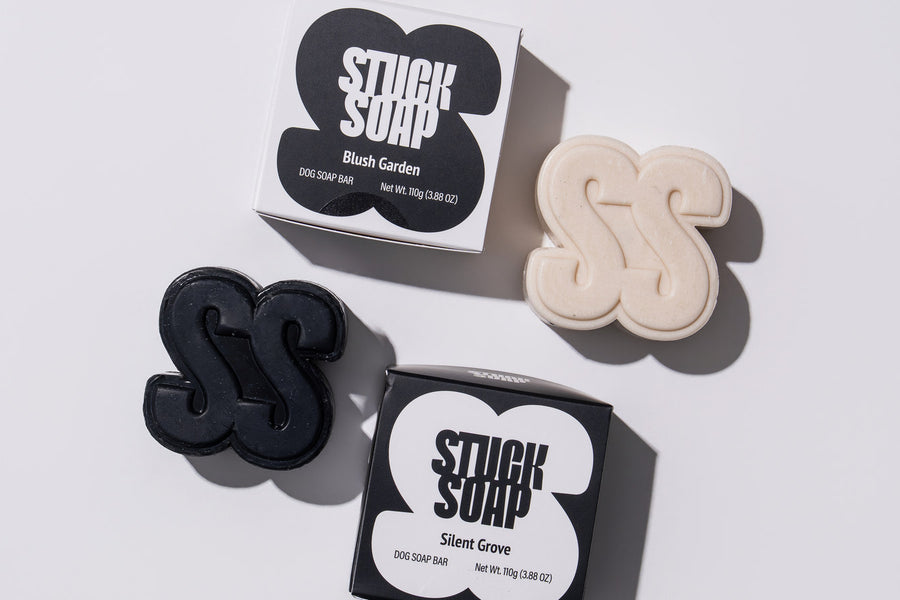
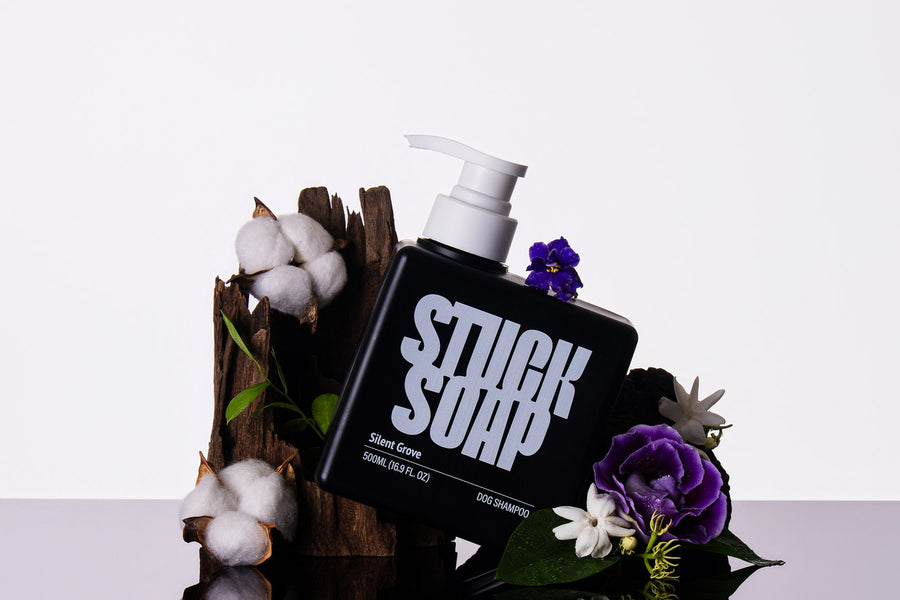
That is the approach behind STUCK SOAP. Our Liquid Shampoo and Shampoo Bar are formulated pH-balanced for dog skin, built around Green Tea, Camellia Oil, and Centella Asiatica, and designed for sebum control and skin-barrier support rather than brute-force degreasing. The fine-bubble lather is high-concentrate, so one pump handles most dogs, and both scents (Silent Grove, earthy, and Blush Garden, floral) are formulated to work with a clean coat rather than mask a dirty one. Both products are vegan, and the bar is zero-waste.
We do not attach a freshness countdown to any of it, because no honest brand can. What a gentle, barrier-respecting wash does is stop working against your dog's own skin chemistry. The timeline above is biology. Your job, and ours, is to avoid making it run faster than it has to.
Frequently Asked Questions
How long does a dog stay clean after a bath?
Most healthy dogs hold a genuinely fresh, neutral scent for roughly one to three days, and a breed-typical baseline smell returns gradually after that. Sebum output resumes within about a day, and skin surface microbes rebuild over the following two. Coat density, drying quality, and daily environment shift that window in either direction.
Why does my dog smell again the day after a bath?
A single day is usually enough for sebaceous glands to restore the oil film that washing removed. That oil is normal and protective, and it carries the warm, familiar scent owners recognize. If the smell is sharp, sour, or yeasty rather than simply doggy, ask your veterinarian to take a look.
Does a stronger shampoo keep a dog clean longer?
Usually the opposite happens. Aggressive surfactants strip more of the protective lipid layer, which can prompt heavier rebound oil production and leave the skin barrier temporarily weaker. Both effects help odor return sooner rather than later. A gentle, pH-appropriate wash tends to produce a steadier, less oily result over time.
Can drying really change how long my dog stays clean?
Yes, and it is one of the biggest levers you control. Moisture trapped against skin in a dense undercoat creates a warm, humid pocket where odor-producing microbes multiply quickly. Drying to the skin, not just the outer coat, routinely buys extra fresh time with no change of product at all.
How often should I bathe my dog to keep odor down?
Most healthy dogs do well somewhere between every two weeks and every six weeks, adjusted for coat, skin type, and lifestyle. Bathing more often to chase odor often backfires by irritating skin and increasing oil output. Your veterinarian can set a specific schedule for skin-sensitive dogs.
Do dog wipes and sprays between baths actually help?
They help with surface dirt and localized spots like paws, muzzle, and the rear, which is where a lot of noticeable odor sits. They do not reset the skin surface the way a bath does, so treat them as maintenance between washes rather than as replacements for one.
When is dog odor a medical issue?
Odor that returns within hours of a bath, smells distinctly sour, sweet, or yeasty, or arrives with itching, redness, greasy patches, discharge, or head shaking deserves veterinary attention. Those patterns point toward skin or ear conditions that grooming products are not designed to address or resolve.
Sources
- Merck Veterinary Manual, Structure of the Skin in Dogs
- American Kennel Club, How Often Should You Bathe Your Dog?
- Cavana P. et al., Efficacy of a 2% climbazole shampoo for reducing Malassezia population sizes on the skin of naturally infected dogs, PubMed
- Bond R. et al., Canine Malassezia dermatitis, PMC
- Hightower K. et al., Transepidermal water loss (TEWL) reflects skin barrier function of dog, PubMed
Wash Gently, Stay Fresh Longer
A longer clean window comes from respecting your dog's skin, not overpowering it. Explore the pH-balanced Liquid Shampoo and zero-waste Shampoo Bar in Silent Grove and Blush Garden at stucksoap.com.