


Does Deshedding Shampoo Actually Reduce Shedding?
Short answer: no. The honest verdict on the question "does deshedding shampoo work" is that no shampoo changes how much hair your dog grows, sheds, or drops on a seasonal cycle. What a well-made deshedding formula genuinely does is loosen and lubricate the dead undercoat hairs that are already detached at the follicle, so they come out in your tub and your brush instead of on your sofa over the next two weeks.
That distinction sounds like a technicality. It isn't. It's the whole reason two people can buy the same bottle and give completely opposite reviews. One follows a full wash-rinse-dry-brush sequence and pulls out a grocery bag of fluff. The other lathers, rinses, towels the dog off, lets him air dry in the yard, and concludes the product is a scam. Same shampoo. Different outcome, because the shampoo was never the part doing the heavy lifting.
We don't sell a deshedding shampoo, which makes this an easy article to write straight. Here's what the category actually does, where it fails, and what the sequence looks like when it works.
What a deshedding shampoo is, mechanically
A deshedding shampoo is a conditioning cleanser formulated to soften the coat and reduce friction between individual hairs, so dead undercoat that has already released from the follicle can be physically pulled free during the bath and brush-out. That's the definition, and it's less exciting than the packaging, but it's the accurate one.
Most formulas in the category lean on some combination of humectants, fatty alcohols or oils, silicones or plant-derived slip agents, and sometimes omega fatty acids. The purpose of all of it is glide. A dry, tangled double coat grips its own dead hair like Velcro. A conditioned, slippery coat lets that hair slide out with far less pulling.
What it does not do
It does not reach the follicle and tell it to stop cycling. Hair growth follows anagen, catagen, telogen, and exogen phases governed by daylight, hormones, breed genetics, and overall health. A cosmetic wash applied to the outside of the coat for five minutes has no mechanism to alter that. Any product suggesting it reduces the biological rate of shedding is describing something a topical rinse-off cannot do.
| The implied promise | What actually happens |
|---|---|
| "Reduces shedding" | Relocates shedding. Hair that would have fallen out over 10 to 14 days comes out during one grooming session instead. |
| "Stops seasonal blow" | No effect on the cycle. Coat blow is driven by photoperiod and hormones, not by what you wash with. |
| "Less hair on furniture" | Genuinely true, but only if you complete the dry and brush steps. This is a downstream result of the sequence, not the bottle. |
| "Loosens dead undercoat" | Accurate. This is the real, provable function of the category. |
| "Fixes excessive shedding" | No. Sudden or patchy hair loss is a veterinary question, not a grooming-aisle one. |
Does deshedding shampoo work without the rest of the sequence?
Barely. This is the part almost nobody puts on the label, so here it is plainly: the shampoo is step one of four, and it is the least important of the four.
Think of it as prep work. The shampoo loosens the bond. Something else has to actually carry the loosened hair out of the coat, and that something is air and a brush, in that order.
The four-step sequence
- Bath. Wet down to the skin, work the product through the undercoat rather than over the topcoat, and give it contact time. On a thick double coat, most of the work here is just getting water and product past the guard hairs.
- Rinse completely. Longer than you think. Residue leaves the coat sticky and dull, which is the exact opposite of the slip you were trying to create.
- Dry fully, to the skin. For a double coat this means a force dryer, moving with the coat and lifting it, until there is no damp layer at the base. The airflow itself blows out an enormous amount of dead hair. This is where the actual deshedding happens.
- Brush and rake while dry. Undercoat rake or slicker, in sections, on a fully dry lifted coat. Wet fur mats and tears; dry fur releases.
What breaks if you skip a step
| Step skipped | What you get |
|---|---|
| Product never reaches the skin | You conditioned the guard hairs. The undercoat, where the dead hair lives, was never touched. |
| Incomplete rinse | Sticky residue, dull coat, sometimes itch. Dead hair grips harder, not less. |
| Air-dried instead of force-dried | The single biggest failure point. Dead hair stays packed in the undercoat and drops on your floor over the next two weeks. This is the review that says "did nothing." |
| No brush-out | Loosened hair sits in the coat waiting to fall out on its own schedule, which defeats the entire point. |
If you have ever wondered why a professional groom leaves your dog shedding noticeably less for a couple of weeks, this is it. It isn't a secret bottle. It's a high-velocity dryer and forty minutes of patient raking. Our piece on why your dog smells so good after the groomer covers the same principle from a different angle: the technique is the product.
Getting product to the skin on a double coat
Nearly every deshedding failure I've watched happens in the first ninety seconds of the bath, when the owner squeezes shampoo onto a coat that is wet on the outside and bone dry two inches down. Guard hairs are water-shedding by design. That's their job.
Take longer than feels reasonable to saturate. Push water backward against the lay of the coat. Work in sections along the spine, the ruff, the britches, and the tail base, which is where undercoat packs densest. If you want the full method, we wrote it up in how to get shampoo through a double coat.
Dose and dwell
Underdosing a big coat is common, and so is dumping in four times what's needed and then failing to rinse it out. A concentrated formula complicates this further, since one pump of a high-concentrate shampoo can outperform three pumps of a watery one. Two references worth having: how much dog shampoo to use by weight and coat and how long to leave shampoo on a dog.
Coat type changes the answer
Deshedding products are marketed as though every dog benefits equally. They don't. The category is built for one specific coat architecture.
| Coat type | Examples | Realistic benefit |
|---|---|---|
| Dense double coat | Husky, Malamute, German Shepherd, Corgi, Golden Retriever | High. This is the intended use case, especially during spring and fall coat blow. |
| Short double coat | Labrador, Beagle, Pug | Moderate. Shedding is steady rather than seasonal; the bath-and-rubber-curry combination helps. |
| Single coat, continuous growth | Poodle, Bichon, Maltese, most doodle crosses | Low. These dogs shed minimally into the environment. They need detangling and mat prevention, not deshedding. |
| Wire coat | Terriers, Schnauzers | Low, and conditioning heavily can soften a wire coat in ways owners of stripped breeds dislike. |
| Hairless or near-hairless | Chinese Crested, Xolo | None. Skin care is the entire job here. |
Coat type isn't the only sorting variable that matters, either. Two Golden Retrievers with identical coats can have completely different skin, and skin is what determines whether a given wash leaves a dog comfortable or itchy. We argued that case in why grooming should stop sorting dogs by coat.
When shedding is a medical question, not a grooming one
This is the part of the article that matters most, so it gets its own section rather than a footnote.
Normal shedding is diffuse, seasonal or steady, and leaves a full coat behind. It does not produce bare patches, broken skin, or a dog who cannot stop scratching. The Merck Veterinary Manual, discussing hair loss in dogs, notes that alopecia is "a symptom of a disorder or disease" rather than a condition on its own.
Call your veterinarian, not the grooming aisle, if you see any of these:
- Sudden change in shedding volume with no seasonal explanation
- Symmetrical thinning on both flanks or along the trunk
- Bald patches, scabs, crusting, or open sores
- Persistent scratching, chewing, or licking one area
- Hot spots, odor, or greasy skin
- Shedding paired with weight gain, lethargy, or heat-seeking behavior
Endocrine disease such as hypothyroidism, external and internal parasites, allergic skin disease, and nutritional deficiency can all show up first as a coat that looks wrong. None of those are fixed by a shampoo, and no cosmetic product should be positioned as treating them. Get a diagnosis first. Grooming supports a healthy dog; it does not substitute for veterinary care.
Autumn: the season this all comes due
Fall coat blow is when the deshedding aisle gets crowded and when the sequence matters most. As daylight shortens, many double-coated dogs release the light summer undercoat and build the dense winter one. For a few weeks the volume of dead hair in the coat is enormous.
The honest goal in autumn isn't to stop it. You can't. The goal is to get that undercoat out efficiently while keeping the skin underneath calm, because this is also the season when heating turns on, humidity drops, and ragweed peaks. Aggressive stripping shampoos and over-bathing during coat blow can leave the skin dry and reactive right when it is least able to cope. We laid out the timing in the fall itch calendar.
The autumn protocol
- Bathe with a gentle, pH-appropriate, non-stripping cleanser. Frequency depends on the dog, but more is not better.
- Rinse until the water runs clear and the coat squeaks slightly. If you are unsure, here's how to tell when your dog is actually rinsed.
- Force dry to the skin. Every time, without exception, during coat blow.
- Rake the undercoat in short sessions, several times a week, on a dry coat. Little and often beats one marathon session that leaves the dog sore.
- Watch the skin. Redness, flaking, or new itch means stop and reassess, and call the vet if it persists.
Practical takeaways
- Deshedding shampoo loosens hair that is already dead. It does not reduce hair production.
- The dry step is where deshedding actually happens. Air drying a double coat wastes the bath.
- Brush dry, never wet. Wet undercoat mats and pulls.
- Single-coated and doodle-type dogs get little from the category. They need detangling instead.
- The result is temporary by nature. Hair keeps growing and dying on its own schedule.
- Abnormal shedding goes to a veterinarian first, every time.
- During coat blow, protecting the skin matters as much as removing the hair.
Where STUCK SOAP fits, and where it doesn't
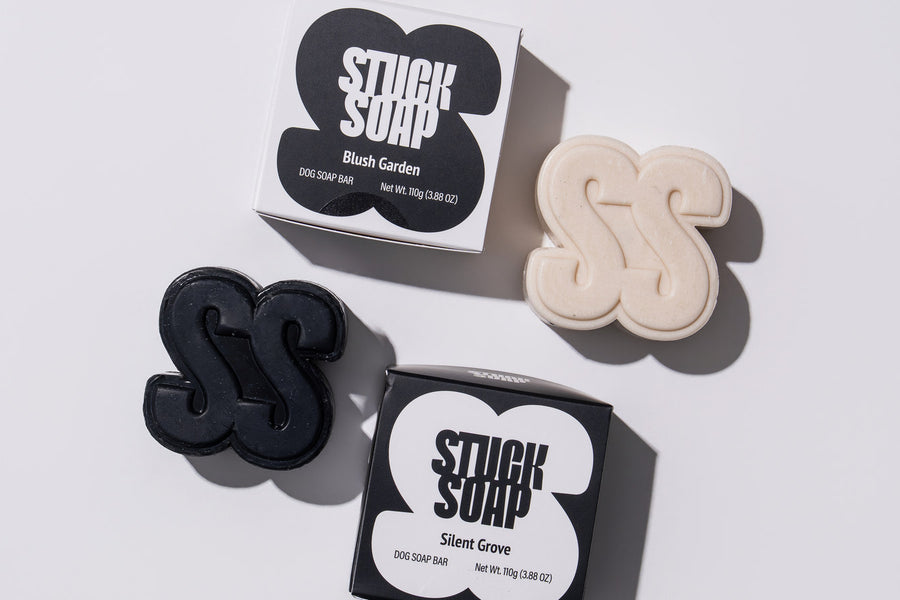
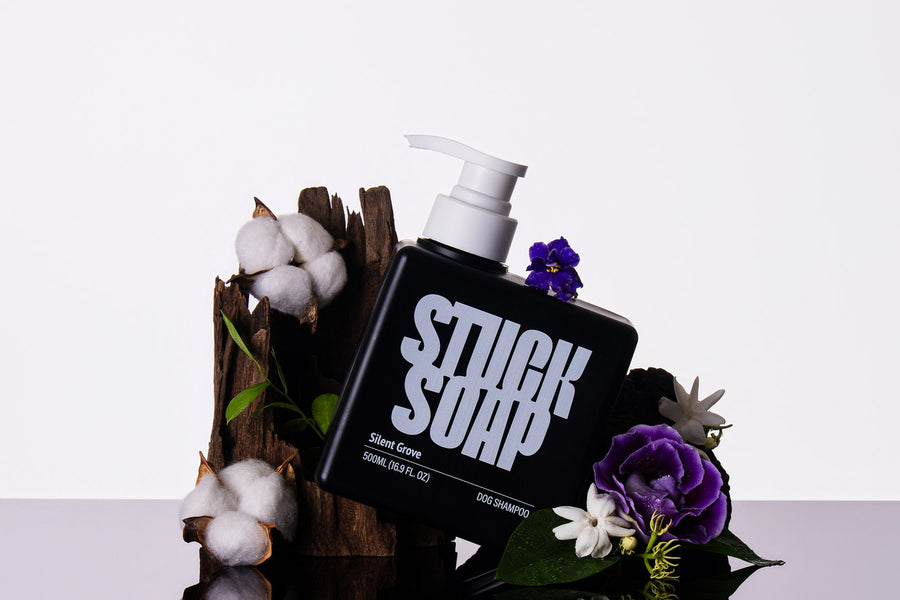
We make a Liquid Shampoo and a Shampoo Bar in two scents, Silent Grove and Blush Garden, built around Green Tea, Camellia Oil, and Centella Asiatica. Vegan, pH-balanced for dog skin, high-concentrate so one pump goes further than you expect, with a fine-bubble lather that helps product travel down through a thick coat rather than sitting on top of it.
What we do not make is a deshedding shampoo, and we're not going to imply ours performs like one. STUCK SOAP is non-medicated cosmetic grooming. It is the gentle wash step in the sequence above: a clean, sebum-balancing, skin-barrier-friendly bath that gets the coat ready for the dry and the rake without stripping the skin during the weeks it's already under stress.
The deshedding still comes from your dryer and your rake. That's true no matter whose bottle is on the shelf. If you want a wash step that treats your dog's skin kindly while you do the real work, that's what we built, and you can find it at stucksoap.com.
Frequently asked questions
Does deshedding shampoo work on all dogs?
No. Deshedding shampoo is designed for double-coated breeds like Huskies, German Shepherds, and Golden Retrievers, where dead undercoat packs beneath the guard hairs. Single-coated dogs such as Poodles, Maltese, and most doodle crosses shed minimally and gain little from the category. Those dogs benefit more from detangling and mat prevention than from a deshedding formula.
How much less will my dog shed after a deshedding bath?
Less hair lands on your furniture, but your dog is not producing less hair. The bath, dry, and brush sequence pulls out dead undercoat that would otherwise fall out gradually over the following one to two weeks. The effect is real but temporary, and it fades as new hair completes its natural growth cycle.
Why did my deshedding shampoo seem to do nothing?
Almost always the drying step. Deshedding happens when a force dryer blows dead hair out of a fully dry, lifted coat, followed by raking. If a double-coated dog air dries or is only towel dried, the loosened undercoat stays packed in place and drops around the house over the next two weeks instead.
Can I use deshedding shampoo every week?
Frequent bathing during coat blow can leave skin dry and reactive, especially in autumn when indoor heating and low humidity already stress the skin barrier. Most double-coated dogs do better with less frequent baths plus regular dry brushing between them. If your dog has any skin condition, ask your veterinarian how often to bathe.
Is heavy shedding ever a medical problem?
Yes. Bald patches, symmetrical thinning, scabs, sores, persistent scratching, odor, or a sudden change in shedding volume all warrant a veterinary visit. Hypothyroidism, parasites, allergic skin disease, and nutritional deficiency can present first as coat changes. No shampoo treats these conditions, and grooming should never delay a diagnosis.
What tool works best after a deshedding bath?
An undercoat rake for dense double coats, and a slicker brush for finishing and surface tangles. Both work on a completely dry coat, never a damp one, since wet undercoat mats and tears. Work in small sections along the spine, ruff, britches, and tail base, where dead undercoat packs most heavily.
Does brushing alone work without any bath?
Yes, and it is the most underrated part of the routine. Regular dry raking removes substantial dead undercoat with no product at all. Bathing helps by adding slip so hair releases with less pulling, and force drying accelerates the process dramatically. Brushing is the constant, and the bath makes each session more productive.
Sources
- Merck Veterinary Manual, Hair Loss (Alopecia) in Dogs: https://www.merckvetmanual.com/dog-owners/skin-disorders-of-dogs/hair-loss-alopecia-in-dogs
- American Kennel Club, Dog Shedding: What to Expect and How to Manage It: https://www.akc.org/expert-advice/health/dog-shedding-what-to-expect-and-how-to-manage-it/
- VCA Animal Hospitals, Hypothyroidism in Dogs: https://vcahospitals.com/know-your-pet/hypothyroidism-in-dogs
- Cornell University Riney Canine Health Center: https://www.vet.cornell.edu/departments-centers-and-institutes/riney-canine-health-center
Ready for coat blow season
Fall undercoat release is a skin event as much as a hair event. If you want a gentle, pH-balanced, high-concentrate wash to anchor the bath step while your dryer and rake do the rest, our Liquid Shampoo and Shampoo Bar are at stucksoap.com in Silent Grove and Blush Garden.