


You have probably noticed Korean skincare taking over your own bathroom shelf. Gentle cleansers, barrier-first thinking, ingredient lists you can actually pronounce. Now the same philosophy is showing up in the pet aisle, and Korean dog shampoo has become one of the fastest-growing categories in premium grooming.
But "Korean" on a label does not automatically mean better. What actually matters is the formulation philosophy behind it, and that philosophy is genuinely different from how most mass-market pet shampoo has been made for decades.
Here is what separates a K-Beauty dog shampoo from a conventional one, what the science supports, and what to look for on a label so you can tell the real thing from the marketing.
Table of Contents
What Is Korean Dog Shampoo, Exactly?
Korean dog shampoo is not a regulated category. There is no certification body handing out K-Beauty badges. What the term describes is a formulation approach borrowed from Korean human skincare and applied to canine coats.
That approach has four consistent hallmarks: gentle surfactants instead of harsh detergents, a pH matched to the animal's actual skin chemistry, botanical actives chosen for a specific function rather than for label appeal, and a focus on supporting the skin barrier rather than simply stripping the coat clean.
The context helps explain why this happened in Korea first. South Korea's pet grooming products market generated roughly $119.5 million in 2024 and is projected to reach $187.4 million by 2030, growing at about 7.8% annually. Korea is also among the fastest-growing pet grooming markets globally, with premium and skincare-adjacent products leading that growth.
When a country that already leads the world in cosmetic chemistry turns its attention to pets, the result is predictable: formulators started asking the same questions they ask about human skin. What is the pH? What does the barrier need? What is the gentlest way to clean this?
Why Your Dog's Skin Needs a Different Formula Than Yours
This is the part most pet owners never hear, and it is the single strongest argument for taking dog shampoo formulation seriously.
Your dog's skin is dramatically thinner than yours. Canine epidermis is roughly three to five cell layers thick. Human epidermis is at least 10 to 15 layers. That thin outer wall is the entire physical barrier between your dog and the outside world.
The pH is completely different. Human skin sits in an acidic range, around pH 4.5 to 5.5. Canine skin is much closer to neutral, generally reported around pH 6.5 to 7.5. A 2022 study in Veterinary Dermatology found that canine skin pH also varies meaningfully by anatomical location, age, and other individual factors, which is why "one pH for every dog" is an oversimplification even within the canine range.
Dogs have fewer ceramides. Ceramides are the lipid mortar holding skin cells together. Canine skin has a leaner lipid profile than human skin, and research on canine epidermal lipids has found meaningful variation between body sites and between healthy and atopic dogs.
Put those three facts together and you get a clear picture. Your dog has a thinner wall, a different chemistry, and less mortar holding it together. A product formulated for human skin, or a pet product formulated mainly for foam and fragrance, is working against all three.
This is exactly the gap K-Beauty formulation philosophy was built to address, just in a different species. For a broader look at that shift, see our overview of how K-Beauty is changing dog grooming.
5 Things K-Beauty Formulas Do Differently
1. Gentle surfactants instead of sulfates
Conventional pet shampoos often lean on sodium lauryl sulfate (SLS) or sodium laureth sulfate (SLES). These produce the dramatic, satisfying suds people associate with "clean," but they are aggressive detergents that strip protective oils along with the dirt.
Korean formulations typically use milder plant-derived surfactants: coco-glucoside, decyl glucoside, cocamidopropyl betaine, and similar coconut- or sugar-derived cleansers. They lather more modestly and clean just as effectively without flattening the lipid layer your dog needs.
If your dog gets itchy or flaky a day or two after every bath, harsh surfactants are one of the first things worth ruling out. Our guide to dog shampoo ingredients to avoid covers the rest.
2. pH formulated for canine skin, not human skin
A K-Beauty dog shampoo should be built around the near-neutral range dogs actually live in, not the acidic range human products target. This is not a marketing detail. Repeatedly shifting the surface pH of already-thin skin makes it easier for bacteria and yeast to establish themselves.
3. Botanical actives with a defined job
The difference between a real K-Beauty formula and a product with botanicals sprinkled on the label is function. Each active should be there for a reason.
Three ingredients show up consistently in Korean formulations because they each do specific work:
- Centella Asiatica (cica) — Korea's most-used calming botanical, valued for soothing reactive, irritated skin. More on centella for dogs.
- Green tea extract — a polyphenol-rich antioxidant that helps defend against environmental oxidative stress. More on green tea for dogs.
- Camellia oil — Korea's traditional "liquid gold," a lightweight conditioning oil prized for coat softness and shine. More on camellia oil for dogs.
All three are grown on Jeju Island, and all three are in STUCK SOAP's formulas. That is the practical version of ingredient-first thinking: fewer actives, each earning its place.
4. Cleansing method, not just cleansing product
K-Beauty treats washing as a technique, not just a product. The Korean idea of double cleansing, adapted for dogs, means a thorough rinse and a controlled second pass instead of one aggressive scrub. It produces a cleaner coat with less friction on the skin. We break the method down in our guide to double cleansing for dogs.
5. Fragrance as a finish, not a cover-up
Mass-market pet shampoo often uses heavy synthetic fragrance to mask odor. That is a cosmetic fix for a skin problem, because most persistent dog odor comes from microbial activity on a disrupted skin surface.
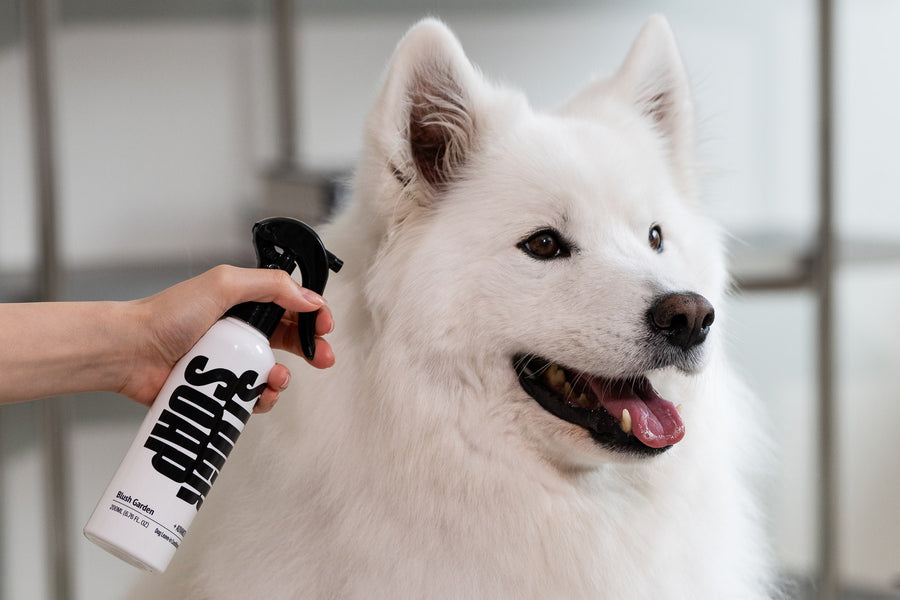
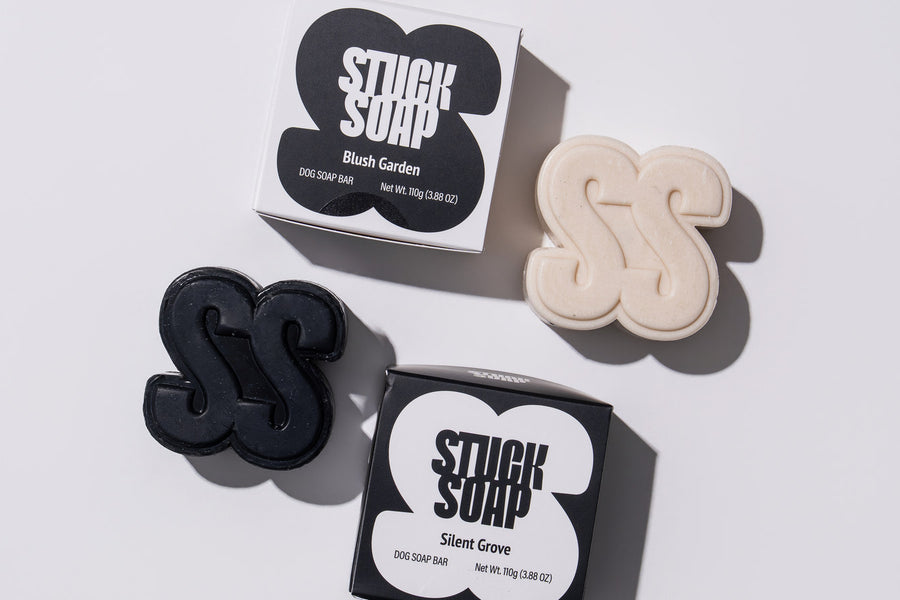
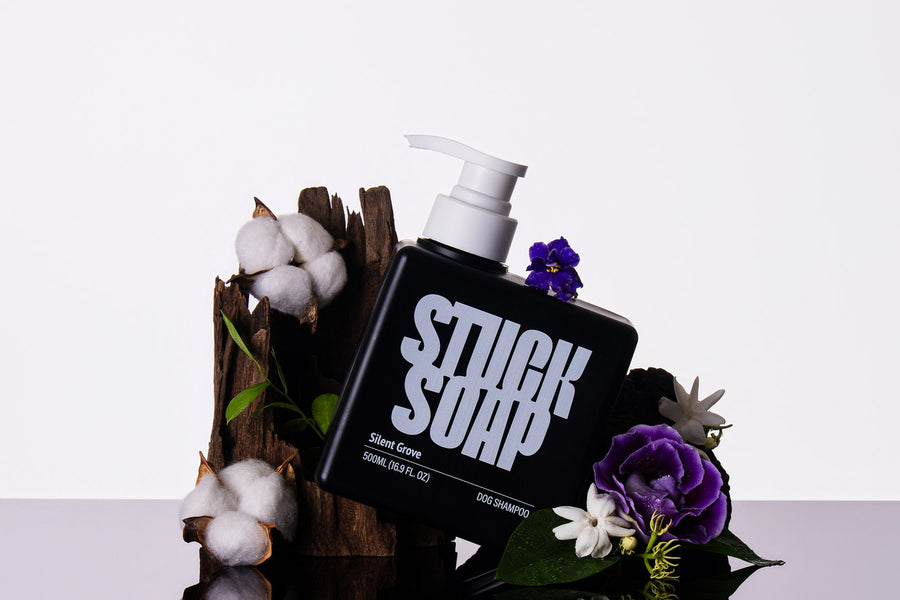
The K-Beauty approach treats scent as a light finishing note over a coat that is genuinely clean. STUCK SOAP's Silent Grove (sandalwood and musk) and Blush Garden (radiant floral) are built that way, restrained rather than perfumed.
What Korean Dog Shampoo Won't Do
Worth saying plainly, because this category attracts overclaiming.
A K-Beauty shampoo is a cosmetic product. It is not a medicated shampoo and it is not a treatment. If your dog has active hot spots, a suspected yeast or bacterial infection, hair loss, or persistent scratching, that is a veterinary conversation, not a shopping decision. Medicated shampoos containing chlorhexidine, miconazole, or benzoyl peroxide exist for specific diagnosed conditions and are prescribed for a reason.
It also will not fix a diet problem. Coat quality tracks nutrition closely, and no topical product compensates for an inadequate one.
What a well-formulated gentle shampoo does do is remove a source of ongoing irritation from your dog's routine, which is a meaningful thing when it happens two to four times a month for a decade.
How to Read a Korean Dog Shampoo Label
Five practical checks, in order of how much they tell you:
1. Scan the first five ingredients. INCI lists run in descending order of concentration. If the cleansing agent is a glucoside or betaine, you are looking at a gentle formula. If it is a sulfate, you are not, regardless of what the front of the bottle says.
2. Look for a stated pH. Brands that formulate for canine pH usually say so. Vagueness here is informative.
3. Check where the botanicals sit. Actives listed after the fragrance and preservative are usually present at token levels. Actives listed in the upper half are doing work.
4. Watch for essential oil overload. "Natural" and "safe for dogs" are not the same thing. Concentrated tea tree, and several citrus and pine oils, carry real toxicity concerns for pets. Gentle beats potent here.
5. Confirm it is actually made for dogs. Some Korean human skincare gets repackaged for the pet market. The pH difference alone makes that a bad idea.
For a deeper walkthrough, see how to read dog shampoo labels like a pro.
Frequently Asked Questions
Is Korean dog shampoo actually better than regular dog shampoo?
Not automatically. What matters is the formulation, not the country. Korean formulations tend to use gentler plant-derived surfactants, canine-appropriate pH, and functional botanicals, which suits dogs' thin skin well. A conventional shampoo built to the same standard would perform similarly. Read the ingredient list rather than the origin claim.
What pH should dog shampoo be?
Dog skin is near-neutral, generally reported around pH 6.5 to 7.5, compared with human skin at roughly pH 4.5 to 5.5. Dog shampoo should be formulated toward that near-neutral canine range. Individual values vary by body site, age, and breed, so treat any single number as an approximation rather than a rule.
Can I use Korean human shampoo on my dog?
No. Human shampoo is formulated for acidic human skin and applying it to your dog's near-neutral, much thinner skin can disrupt the barrier and leave it more vulnerable to irritation and infection. This applies to K-Beauty human products just as much as any other.
Are K-Beauty dog shampoos safe for puppies and sensitive skin?
Gentle, sulfate-free, pH-appropriate formulas are generally a reasonable choice for sensitive skin, and mild fragrance-light options suit puppies once they are old enough to bathe. Always patch test a new product on a small area first, and check with your veterinarian if your dog has a diagnosed skin condition.
Does a shampoo bar work as well as liquid Korean dog shampoo?
Yes, when it is formulated properly. A well-made bar delivers the same gentle surfactants and botanicals in a concentrated, zero-waste format, and many owners find bars easier to control on the coat. The format matters less than the formulation behind it.
The Bottom Line
Korean dog shampoo is worth paying attention to, not because of where it comes from but because of how it is built. Thinner skin, near-neutral pH, and fewer ceramides mean your dog's coat has less margin for error than yours does, and a formulation philosophy built around gentleness and barrier support is a genuinely good match for that biology.
Ignore the flag on the label. Read the first five ingredients, check the pH, and see whether the botanicals are doing real work. That is the whole test.
Sources & References
- Influence of age, sex, body condition score, rectal temperature, anatomical location and hair on skin pH in dogs — Veterinary Dermatology (Wiley)
- Canine epidermal lipid sampling by skin scrub revealed variations between different body sites and normal and atopic dogs — PubMed Central
- Age-related evaluation of skin barrier parameters in retrievers — Frontiers in Veterinary Science
- Can You Use Human Shampoo on Dogs? — PetMD
- Skin: The Difference Between Canine and Human Skin — Vetwest Veterinary Clinics
- South Korea Pet Grooming Products Market Size & Outlook — Grand View Research
Give Your Dog the K-Beauty Spa Treatment
STUCK SOAP was formulated the way Korean skincare is formulated: gentle plant-based cleansers, a pH built for canine skin, and three Jeju Island botanicals chosen to do real work. Centella to calm, green tea to protect, camellia oil to soften and shine. Available as a high-concentrate liquid shampoo or a zero-waste bar, in Silent Grove or Blush Garden.
Shop Stuck Soap →Vegan · pH-Balanced · Jeju Island Botanicals · Zero Waste