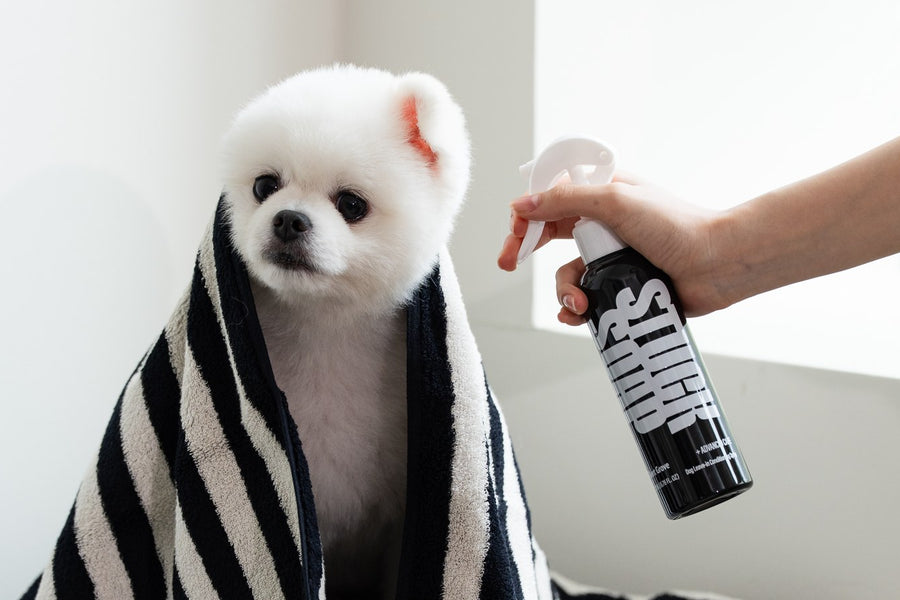


To use a leave-in conditioner on your dog, shake the bottle, mist lightly over the coat from about a hand's length away, brush it through, and let the coat air-dry for a few minutes. There is nothing to rinse. This guide covers how to use leave-in conditioner on dogs in the three moments it earns its place: before brushing, after walks, and before bed, with distance, amount, areas to keep clear, and drying time for each.
Our October newsletter put the idea in six words: between baths, don't start over. Refresh. This is the follow-along version, written so you can stand next to your dog with a bottle in hand and just do it. If you want the background first, we've already covered what a leave-in conditioner actually does and how it fits into a weekly between-bath routine. Here, we skip the theory and get to technique.
How to Use Leave-In Conditioner on Dogs in Five Steps
A leave-in conditioning spray is a no-rinse mist applied to the hair (not the skin) to help a coat feel softer, brush more easily, and smell fresher between full baths. The core routine is the same in every situation:
- Shake the bottle so the formula is evenly mixed.
- Part the coat with your free hand if your dog is fluffy or double-coated, so the mist lands on hair rather than sitting on the surface.
- Mist lightly from roughly a hand's length to a forearm's length away, one zone at a time.
- Brush it through in the direction the hair grows.
- Let it air-dry for a few minutes before your dog lies down or heads outside.
What changes from one moment to the next is how much you use, where you focus, and how long you wait.
| Situation | Distance | Amount | Keep clear of | Drying time |
|---|---|---|---|---|
| Before brushing | Hand's length to forearm's length | A few light passes per zone, focused on tangle-prone areas | Eyes, nose, mouth, any broken or irritated skin | Brush while slightly damp, then a few minutes to finish drying |
| After walks | Forearm's length | One or two light passes over back, chest, and legs | Face, paw pads, any scrapes or red patches | A few minutes; towel off rain or mud first |
| Before bed | Forearm's length | The lightest of the three: a pass or two, or a few spritzes onto your hands | Face, ears, any area your dog has been licking or scratching | Fully dry before your dog settles on bedding |
Those numbers are a practical rule of thumb used by most groomers for any leave-in mist, not a label requirement. Start on the light side. You can always add a pass; you can't take one back.
Before Brushing: Prep and Settle the Coat
This is where a leave-in does the most visible work. A dry coat drags against bristles, which is exactly when tangles tighten and static lifts the fur. A light mist gives the brush something to glide on.
Distance
Hold the bottle a hand's length to a forearm's length from the coat. Any closer and the spray pools in one wet spot. On long or curly coats, lift a section and mist the underside too.
Amount
Work in zones: neck and chest, back, sides, hindquarters, tail, legs. A few light passes per zone is plenty. Spend a little extra on the places that knot first, like behind the ears (spray onto your hand, not toward the head), the armpits, the collar line, and the backs of the thighs. The coat should feel faintly damp to the touch, never soaked.
Areas to avoid
Keep the spray away from the eyes, nose, and mouth. For the head and face, mist a little onto your palm or a soft cloth and smooth it over the fur instead of spraying anywhere near your dog's face. Skip any patch that looks red, broken, or raw.
Drying time and when to brush
Don't wait for the coat to dry completely. Brush while it is still slightly damp, which is when the mist helps the most, then give it a few minutes to air-dry. For how often that brushing should happen in the first place, see our guide to how often you should brush your dog.
Regular brushing helps by "removing dirt, spreading natural oils throughout her coat, preventing tangles and keeping her skin clean and irritant-free."
ASPCA, Dog Grooming Tips
A leave-in doesn't replace brushing. It makes brushing easier, which is what gets it done more often.
After Walks: A Quick Refresh
Walks bring home dust, pollen, and that outdoor smell that settles into fur. A full bath every time isn't practical. A refresh is the in-between step: tidy up, mist, brush, done.
Distance
Stay at about a forearm's length. You want a light, even veil over the outer coat, and a little more distance spreads the mist wider.
Amount
Before you spray, brush or wipe off any loose dirt and towel off rain or mud. Then one or two light passes over the back, chest, and legs is usually enough. Brush through so nothing sits on top. If the coat is still wet from the weather, towel it first.
Areas to avoid
Paw pads are skin, so keep the spray off them and clean feet with a damp cloth instead. Skip the face, and check legs and belly for small scrapes, burrs, or red patches picked up on the trail. If a paw smell lingers no matter what, our piece on why dog paws smell like corn chips explains what's going on.
Drying time
Give it a few minutes before your dog flops on the couch. Dense or double coats take a little longer.
One honest note: a refresh helps a coat that smells like the outdoors. It isn't a fix for odor that comes from somewhere else. We broke down the difference in what causes dog odor.
Before Bed: A Light Care Step
The bedtime mist is the gentlest of the three: a little product, a slow brush, and a quick look over the coat at the end of the day.
Distance
Keep a forearm's length, or mist into your own hands and stroke the coat, which is quieter for dogs who startle at a trigger spray.
Amount
Use the least of all three situations. A pass or two over the back and sides, or a few spritzes onto your palms, is enough.
Areas to avoid
Stay clear of the face and ears. Skip any area your dog has been licking or scratching during the day, since that's worth watching rather than covering up. If your dog tends to lick its fur right after grooming, mist less and brush it through thoroughly.
Drying time
Let the coat dry fully before your dog settles onto bedding, usually a few minutes for a light application.
How to Use Leave-In Conditioner on Dogs by Coat Type
Coat type changes how much product you need and how you get it where it belongs. Not sure which category your dog falls into? Our dog coat types guide sorts it out.
| Coat type | Passes per zone | Technique tip |
|---|---|---|
| Smooth, short | One light pass | Mist onto your hands and stroke it on for even coverage |
| Medium or wiry | One to two | Mist, then brush with the grain |
| Long or silky | Two to three | Lift sections and mist mid-length to ends; focus on tangle spots |
| Double coat | Two to three | Part the outer coat so mist reaches the hair beneath, then line-brush |
| Curly | Two to three | Work in small sections and brush while slightly damp |
These are starting points. Adjust by feel: if the coat looks wet or feels heavy, you used too much.
Common Mistakes, and When to Skip It
Mistakes that undercut the routine
- Soaking instead of misting. A drenched coat takes longer to dry and feels heavy.
- Spraying straight at the skin. A leave-in belongs on the hair.
- Spraying near the face. Use your hand or a cloth for the head, every time.
- Skipping the brush. Brushing is what spreads the mist evenly.
- Using it to cover a smell that keeps coming back. A refresh is for everyday outdoor smell, not for odor with a cause.
When to skip the spray and see your vet
If your dog's skin is red, broken, flaky, itchy, or has hot spots, keep the spray off those areas and call your veterinarian. Hot spots in particular are easy to miss under fur.
"These painful, itchy, smelly sores may be obvious or may be hidden under matted fur."
VCA Animal Hospitals, Hot Spots in Dogs
The American Kennel Club notes that hot spots are among the most common skin conditions in dogs and tend to show up more in warm months (AKC, Hot Spot Treatments and Prevention on Dogs). Brushing is when you actually see the skin. Also check in with your vet for odor that persists after a bath, smells coming from the ears or mouth, signs of fleas or other parasites, or any sudden change in coat texture or shedding. For sensitive dogs, the logic behind patch-testing a shampoo applies: try any new product on a small area first.
Practical Takeaways
- Shake, mist lightly, brush through, no rinse. That is the whole method.
- Keep roughly a hand's length to a forearm's length between bottle and coat.
- Before brushing gets the most product; before bed gets the least.
- Brush while slightly damp, then give it a few minutes to air-dry.
- Red, broken, flaky, or itchy skin means skip the spray and see the vet.
The spray this guide was written around
We wrote these steps with the STUCK SOAP Leave-In Conditioning Spray in Silent Grove in hand, and they apply just the same to the Blush Garden version. It's a lightweight, no-rinse mist in a 200 mL (6.76 fl oz) trigger bottle. Silent Grove leans earthy, with sandalwood and soft musk; Blush Garden is floral, with bright florals and pink pepper. The fragrance follows IFRA standards for leave-on products.
Three patented actives went into the formula, each for a specific reason. Mung Bean Sprout Extract (Korean patent 10-1841429), from germinated mung bean, was chosen for calming sensitive skin. Tannin Complex HR (10-0955389) was chosen for sebum and coat balance; our article on tannins for dog skin covers the ingredient in more depth. ODOR-BYE (10-2746186) was chosen to address odor at its source rather than perfume over it. The label directions are simple: shake, mist lightly, brush through, no rinse, as often as your dog needs.
Frequently Asked Questions
How far away should I hold a leave-in spray from my dog?
A practical rule of thumb is a hand's length to a forearm's length from the coat. Closer than that concentrates the mist in one wet patch, while much farther wastes most of it. For long or double coats, part the hair with your free hand so the mist reaches the hair beneath the surface.
How much leave-in conditioner should I use on my dog?
Start with a few light passes per zone, such as neck, back, sides, and legs, and add more only if the coat still feels dry or catches on the brush. The coat should feel faintly damp, never soaked. Short coats usually need one pass; long, curly, or double coats may need two or three.
Can I spray leave-in conditioner on my dog's face?
No, keep the spray away from your dog's eyes, nose, and mouth. Instead, mist a small amount onto your palm or a soft cloth and smooth it over the fur on the head and around the ears. This gives you control and avoids startling your dog with a trigger spray close to its face.
How long does leave-in conditioner take to dry on a dog?
A light application usually air-dries within a few minutes, though dense or double coats take a little longer. Brush while the coat is still slightly damp for the smoothest result. Before bed, make sure the coat is fully dry before your dog settles onto bedding, and towel off any rain first after walks.
Can I use a leave-in spray on my dog every day?
The STUCK SOAP Leave-In Conditioning Spray can be used daily or between baths, as often as your dog needs. Keep each application light, spray the hair rather than the skin, and brush it through. If you notice redness, flaking, itching, or broken skin anywhere, keep the spray off that area and check with your vet.
Should I use leave-in conditioner on a wet or dry coat?
Either works, with a distinction. After a bath, apply it to a towel-dried coat rather than a dripping one. Between baths, mist it over a dry coat. If your dog comes in soaked from rain, towel off first and wait until the coat is just damp before you spray and brush it through.
Sources
- ASPCA: Dog Grooming Tips
- VCA Animal Hospitals: Hot Spots in Dogs
- American Kennel Club: Hot Spot Treatments and Prevention on Dogs
Between baths, don't start over. One bottle, a brush, and a few minutes is all the routine asks. Find Silent Grove and Blush Garden at stucksoap.com. Refresh Their Coat