


Walk down any pet store aisle and you'll find a shampoo for everything. Deshedding shampoo. Whitening shampoo. Detangling shampoo. A conditioner, a leave-in spray, a coat gloss, a deodorizing mist, a paw balm, and a "between baths" foam for the days you didn't bathe them.
Here's the question almost nobody asks: does your dog need any of it? A minimalist dog grooming routine starts from the opposite assumption. Instead of asking what else you could add, it asks what you could remove without your dog's skin noticing, and what's left is usually a very short list.
This isn't laziness dressed up as philosophy. It's the same course correction that happened in Korean skincare a few years ago, and it's the reason the country that invented the 10-step routine is now the loudest voice telling people to do less.
Table of Contents
- What Is "Skip-Care," and Why Did K-Beauty Invent It?
- Why More Products Isn't Better for Dog Skin
- The Over-Bathing Problem
- The Minimalist Dog Grooming Routine: 4 Steps That Matter
- What to Look For in a Multitasking Dog Shampoo
- How to Audit Your Dog's Grooming Shelf
- Frequently Asked Questions
- Sources & References
What Is "Skip-Care," and Why Did K-Beauty Invent It?
Skip-care is a Korean beauty term that means exactly what it sounds like: skipping the steps that aren't doing anything for you. It emerged as a direct response to the 10-step routine that made K-Beauty famous worldwide.
The reasoning was straightforward. Korean consumers, who had adopted elaborate layering more enthusiastically than anyone, started noticing that more steps didn't always mean better skin. Sometimes it meant irritated skin. So the culture corrected itself.
Skip-care doesn't mean neglect. It means choosing multi-tasking formulas that do the work of three products, and cutting everything that exists mainly to be bought. The typical skip-care routine is three to five steps: a good cleanser, one optional treatment, a moisturizer, and sunscreen. Everything else is negotiable.
The trend has real commercial weight behind it. Industry analysts tracking "skinimalism" project the category growing at roughly a 9.8% compound annual rate through 2034, and 2026 trend reports consistently name simplification as a defining consumer demand rather than a passing aesthetic.
What makes this interesting for pet owners is the underlying logic. Skip-care isn't about buying less because less is virtuous. It's about the fact that skin has a limit, and past that limit, additional products stop helping and start interfering. Dog skin has that limit too. It's just lower.
Why More Products Isn't Better for Dog Skin
Your dog's skin is not a smaller version of yours. It's structurally different in ways that make the case for minimalism stronger, not weaker.
It's thinner. The canine epidermis is significantly thinner than human epidermis, with fewer cell layers standing between the outside world and living tissue. There's simply less buffer.
It's a different pH. Dog skin sits in a roughly neutral range, generally cited between 6.2 and 7.4, while human skin is distinctly acidic. Products formulated for human skin are the wrong chemistry from the start, and every product you add is another chance to push that balance off.
It doesn't sweat the same way. Dogs regulate temperature and skin condition largely through sebum and coat, not eccrine sweat glands across the body. That sebum layer is functional infrastructure. Strip it and you're not "cleaning" so much as dismantling.
Put those together and a picture emerges: dog skin is more sensitive to disruption and slower to recover from it than human skin. The routine a K-Beauty enthusiast might get away with layering on their own face is genuinely a bad idea on a dog. If minimalism is the smart move for human skin, it's the obvious move for canine skin.
The Over-Bathing Problem
The single most common way well-meaning owners damage their dog's skin is by washing it too often.
Veterinary dermatology sources describe over-bathing as one of the most frequently overlooked contributors to recurring skin problems. Every bath temporarily shifts the skin's surface chemistry. Do it often enough with a product that isn't pH-appropriate, and the skin becomes measurably more hospitable to bacterial and fungal overgrowth. The irony writes itself: you bathe more because the dog is itchy, and the dog is itchy because you bathe more.
The American Kennel Club's guidance is refreshingly blunt on this point: bathe as infrequently as you reasonably can, because too-frequent washing removes natural oils and leaves the coat dry and harsh. For most dogs, that lands somewhere in the four-to-eight week range, with adjustments up or down for coat type and lifestyle.
Genuine exceptions exist. Oily-coated breeds like Basset Hounds may need weekly baths, and dogs on a veterinarian's medicated protocol should follow that protocol, full stop. But the default assumption should be less, not more. Here's how to read the signals:
- Signs you're over-bathing: flaking, dull coat, increased scratching in the days after a bath, patchy dryness, redness at friction points
- Signs it's actually bath time: visible dirt, a persistent odor that returns quickly after brushing, greasy texture you can feel on your hand, post-swim residue
Notice that "it's been two weeks" isn't on either list. Calendars are a bad reason to bathe a dog.
The Minimalist Dog Grooming Routine: 4 Steps That Matter
Strip the shelf down to what earns its place, and this is what survives.
1. Brushing (the step everyone under-rates)
Brushing is the highest-leverage thing you can do for your dog's coat, and it costs nothing per use. The AKC notes that regular brushing removes dead hair, distributes natural oils along the coat, helps prevent skin infections, and stimulates new growth.
Read that again: distributes natural oils. Brushing does much of what people buy coat glosses and conditioning sprays to do, using oil your dog already produces, for free. A slicker brush followed by a comb, at least weekly, replaces several products outright.
2. One good shampoo, used less often
Not a shampoo per problem. One well-formulated, pH-balanced shampoo, used when your dog is actually dirty. This is the skip-care principle in its purest form: replace five specialized products with one that's formulated properly in the first place.
3. Thorough rinsing and drying
Underrated and free. Shampoo residue left in the coat is a leading cause of post-bath itching, and a damp undercoat is where odor and yeast get comfortable. Rinse longer than feels necessary, then dry thoroughly, especially in the folds, armpits, and under a double coat.
4. Targeted care, only when there's a target
Paw balm in winter if your dog's pads are actually cracking. Ear cleaner if your dog is actually prone to ear issues. Medicated products if a vet actually prescribed them.
The word doing the work in each of those sentences is "actually." Products bought for hypothetical problems tend to create real ones.
That's the whole routine. Brush, wash occasionally with something good, rinse and dry properly, and treat real problems when they appear. Everything else on the shelf is optional at best.
What to Look For in a Multitasking Dog Shampoo
If your routine is going to lean on one product, that product has to be worth leaning on. Skip-care logic raises the bar for what remains rather than lowering it.
Four things to check:
pH formulated for dogs, not humans. This is non-negotiable and it's the reason human shampoo, baby shampoo included, doesn't belong on your dog.
Ingredients that support the barrier rather than strip it. This is where K-Beauty formulation thinking earns its reputation. Centella Asiatica, K-Beauty's signature calming botanical, is valued for its soothing properties on compromised skin. Green tea brings antioxidant polyphenols. Camellia oil, Korea's long-treasured beauty oil, conditions without heaviness.
A short, legible ingredient list. If you can't tell what most of it is doing there, that's information.
Genuinely does more than one job. Cleaning, conditioning, and odor control in a single step is what lets you delete the other bottles.
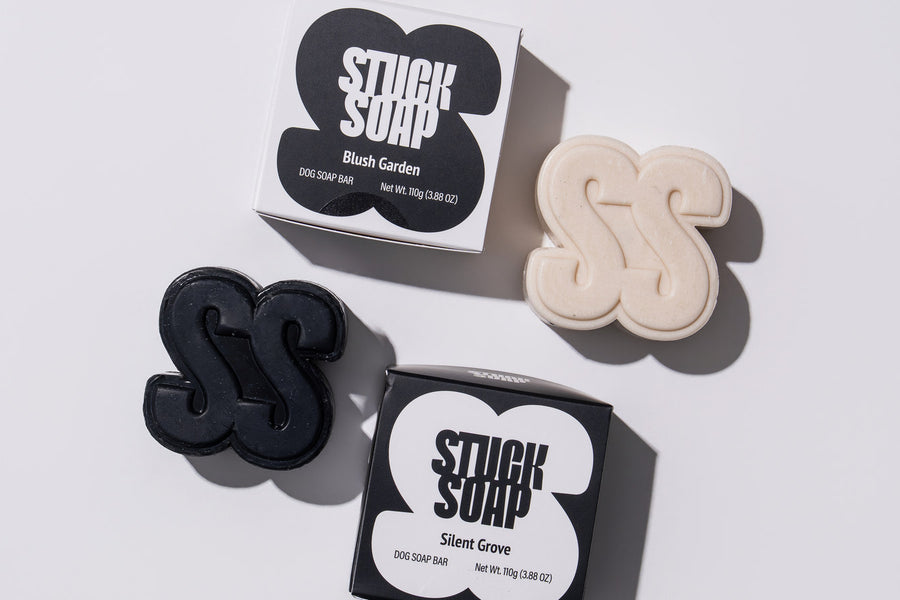
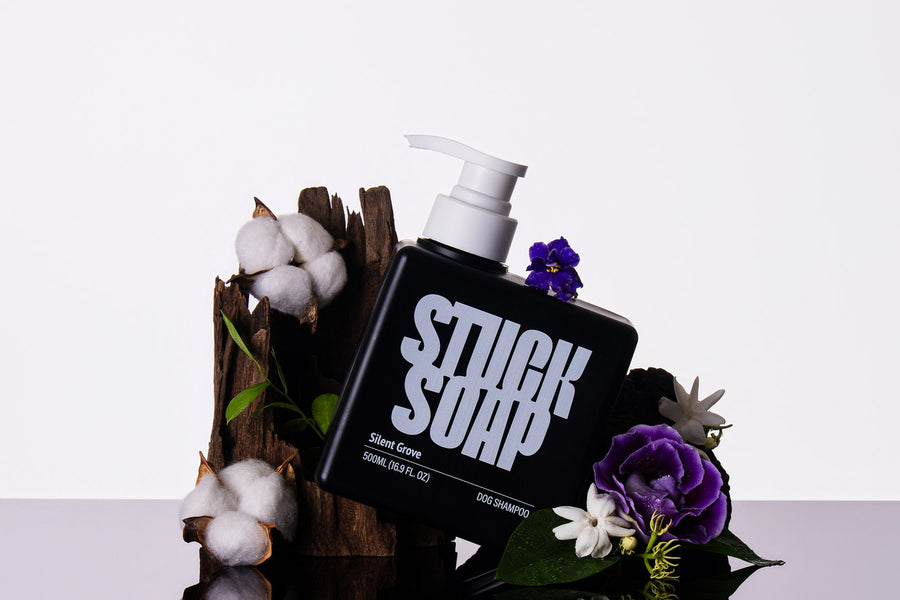
This is roughly the brief we built STUCK SOAP around. The Liquid Shampoo is a high-concentrate formula designed for deep cleaning and odor control in one pass, and the Shampoo Bar is pH-balanced to support sebum control and the skin barrier with no plastic bottle attached. Both are vegan, plant-based, and built on Jeju Island botanicals: green tea, camellia oil, and Centella Asiatica.
The point isn't that you need our bottle specifically. It's that if one product is doing all the work, it should be formulated like it knows that.
How to Audit Your Dog's Grooming Shelf
Try this. Take everything out and sort it into three piles.
Pile one: things you use. Products you've reached for in the last two months. Keep them, but check the pH and ingredient list on each one.
Pile two: things you bought for a problem that resolved. The anti-itch spray from that one bad spring. The deshedding treatment from a shedding season two years ago. If the problem is gone, the product is clutter.
Pile three: things you bought because they were on the shelf. Be honest. Most shelves have several. These go.
Then run the replacement test on what's left: could a proper shampoo plus a brush do this job? For coat gloss, detangler, deodorizing spray, and most "conditioning" products, the answer is usually yes.
What tends to survive an honest audit is a brush, a comb, one shampoo, a towel, and maybe two situational items. That's not a compromise. That's a complete routine.
Frequently Asked Questions
What is a minimalist dog grooming routine?
A minimalist dog grooming routine reduces grooming to the steps that measurably help: regular brushing, occasional bathing with one well-formulated pH-balanced shampoo, thorough rinsing and drying, and targeted products only for problems your dog actually has. It borrows K-Beauty's skip-care philosophy of using fewer, better-chosen products rather than layering many.
Does using fewer grooming products mean my dog will smell?
Usually the opposite. Persistent dog odor is most often caused by an unbalanced skin barrier, residual shampoo left in the coat, or a damp undercoat, and adding more scented products masks the smell rather than fixing the cause. Regular brushing plus proper rinsing and drying addresses odor at its source.
How often should I actually bathe my dog?
Most dogs do well with a bath every four to eight weeks, adjusted for coat type and lifestyle. The AKC advises bathing as infrequently as reasonably possible to preserve natural oils. Bathe when your dog is genuinely dirty or smelly rather than on a fixed calendar schedule, and follow your veterinarian's protocol if one has been prescribed.
Is skip-care just an excuse to groom my dog less?
No. Skip-care removes redundant products, not necessary care. Brushing frequency typically goes up in a minimalist routine, not down, because brushing does the work that several bottled products claim to do. What decreases is the number of products, not the attention.
Can I use my own K-Beauty products on my dog?
No. Human skin is acidic while dog skin sits closer to neutral, generally cited around pH 6.2 to 7.4, so human formulations are the wrong chemistry regardless of how gentle they are. Dogs also groom themselves orally, which makes ingredient safety a different question entirely. Use products formulated specifically for dogs.
The Shortest Routine That Works
K-Beauty spent a decade teaching the world to layer, then spent the next few years teaching it to stop. That's not a contradiction. It's what happens when a culture pays close enough attention to notice that the skin was asking for less the whole time.
Your dog's skin has been asking the same thing, with fewer layers of buffer to absorb the mistake. Brush more. Bathe less. Choose one shampoo that's actually formulated for the animal you're using it on. Let the rest go.
The best grooming routine isn't the most thorough one. It's the shortest one that works.
Sources & References
- How Often Should You Bathe Your Dog? — American Kennel Club
- How to Groom a Dog at Home — American Kennel Club
- Dog Grooming Tips — ASPCA
- How Often Should I Bathe My Dog? — Animal Friends Dermatology
- What Is Skip-Care? Everything You Need to Know — HELLO! Magazine
- Beauty Trends 2026: Consumers Demand Skinimalism — Drug Store News
Give Your Dog the K-Beauty Spa Treatment
If your routine comes down to one shampoo, it should be one worth keeping. STUCK SOAP is pH-balanced for dog skin and built on Jeju Island botanicals: green tea, camellia oil, and Centella Asiatica. Deep cleaning, conditioning, and odor control in a single step, so the rest of the shelf can go.
Shop Stuck Soap →Vegan · pH-Balanced · Jeju Island Botanicals · Zero Waste