


How to Tell When Your Dog Is Actually Rinsed
Your dog is rinsed when the coat stops feeling slippery under your fingers and the water running off runs clear instead of cloudy. Those two signals, checked at the skin rather than the surface, are the most reliable way to catch shampoo residue on your dog before the towel comes out. Everything else in this article is detail on where to check, how long it takes, and why the spot you probably skipped is the one that itches three days later.
Most people rinse until the visible suds are gone. Visible suds are a terrible finish line. Foam sits on the outer coat and disappears fast, while the actual cleanser is down at the skin, held there by hair density, undercoat, and body heat. A dog can look perfectly clean and still be carrying a film of surfactant along the chest and the back of the thighs. That film is what starts the scratching.
How to Spot Shampoo Residue on Your Dog in Under a Minute
Three quick tests, run in order, will tell you almost everything. None of them require equipment.
The finger test
Push your fingers down through the coat until you feel skin, then drag them slowly against the direction of hair growth. Clean, rinsed hair feels slightly grabby, a little squeaky, with some drag. Hair still holding cleanser feels slick, like the fingers are gliding on something. Do this at the chest first. The chest is the single most under-rinsed part of a dog, because water runs off the back and down the sides while the chest sits in the shadow of the ribcage and never gets direct flow.
The runoff test
Cup a hand under the belly line, press the coat gently, and watch the water leaving your fingers. Cloudy, faintly milky, or slightly foamy water means you are not finished. Clear water means that section is done. Press rather than just look, because the rinse water sitting on the surface is almost always clearer than the water trapped in the undercoat.
The dry check
Towel a small section of the shoulder and rub it dry between your palms. If the hair separates cleanly and feels light, you are fine. If it clumps into stringy sections, feels tacky, or leaves a faint slick on your palms, there is product left. This is also the point where residue starts affecting how the coat dries, which is why it shows up again in how you dry your dog after a bath.
What Shampoo Residue Actually Is
Shampoo residue is the film of surfactants, thickeners, fragrance carriers, and conditioning agents that stays bound to the hair and skin after rinsing stops too early. It is not dirt and it is not a coating you can see. Surfactants work by grabbing oil at one end and water at the other, and they only leave the coat when enough clean water passes through to carry them off. Cut the water short and they stay put, still chemically active, still holding onto sebum and dust.
That last part matters. Residue does not sit inert. It keeps attracting the exact things you just washed off, which is one reason a dog can go from clean to greasy in two days. If your dog also comes out of the tub smelling worse than expected, incomplete rinsing is a prime suspect, and we covered the rest of that puzzle in why your dog smells bad after a bath.
Why Insufficient Rinsing Is the Most Common Cause of Post-Bath Itching
Ask any groomer what causes the Tuesday scratching after a Sunday bath and you will hear the same answer before you finish the sentence. Not allergies. Not the shampoo brand. Rinsing.
The mechanism is straightforward. A dog's skin barrier is thinner than human skin and depends on a lipid layer to hold moisture in and irritants out. Residual surfactant sits on that layer and keeps working at it, gradually stripping more oil than the bath itself did. The dog feels tightness and dryness, scratches, breaks the surface slightly, and the cycle accelerates. Add a warm dryer and the whole thing intensifies. If you want the underlying biology, we walked through it in how the canine skin barrier works.
One important boundary: this article is about technique, not diagnosis. If you have corrected your rinsing, given it two or three baths, and your dog is still scratching, licking paws, or developing red patches, stop troubleshooting at home and book a veterinarian. Persistent itching has a long list of causes that no rinse technique will touch, and the Merck Veterinary Manual's owner section on canine skin disorders gives a sense of how wide that list gets.
Where Residue Hides on a Dog
Water obeys gravity, which means every low point on a standing dog is a collection basin. Rinse from above and you will miss all of them.
- Chest and sternum. The worst offender. Blocked from above by the neck and shoulders.
- Armpits and groin. Skin-on-skin folds that trap lather and rarely see direct flow.
- Back of the thighs and hindquarters. Dense in most breeds, and physically behind the dog while you are working in front of it.
- Base of the tail. Thick, oily, and the last place anyone checks.
- Belly line and inner legs. Where every rinse from the back eventually drains to and stops.
- Behind and under the ears. Small area, high sensitivity, frequently missed.
Get a hand physically under the dog for the chest, groin, and belly. Lift each rear leg and rinse the inner thigh directly. Rinsing the hindquarters properly means standing beside or behind the dog, not reaching over the back and hoping.
Coat Type Changes How Long Rinsing Takes
The single biggest predictor of rinse time is not size, it is coat density. A 70-pound smooth-coated dog rinses faster than a 12-pound doodle mix. The table below reflects typical working times at moderate water pressure, with hands actively moving through the coat rather than passive spraying.
| Coat type | Example breeds | Typical rinse time | Where residue hides |
|---|---|---|---|
| Short smooth | Beagle, Boxer, Pug | 1 to 2 minutes | Skin folds, armpits |
| Short double | Labrador, Corgi | 3 to 4 minutes | Chest, undercoat at hips |
| Long double | Golden Retriever, German Shepherd | 5 to 8 minutes | Ruff, tail base, thighs |
| Curly or wool | Poodle, Bichon, doodle crosses | 6 to 10 minutes | Everywhere, especially mid-shaft |
| Wire | Terrier types, Schnauzer | 3 to 5 minutes | Furnishings, beard, leg hair |
| Silky long | Yorkie, Maltese, Shih Tzu | 3 to 5 minutes | Belly, behind ears, armpits |
Use those numbers as a floor, not a target. The tests beat the clock every time. And if your dog will not stand still long enough for a proper rinse, that is a separate problem worth solving first, which is the whole point of our guide on bathing a dog that hates water.
Formula Type Changes How Hard Rinsing Is
Not all products leave the coat at the same rate. This is a mechanical property of the formula, not a quality judgment, and knowing which category you are working with tells you how much rinsing to budget.
| Formula type | Rinse difficulty | Why |
|---|---|---|
| High-concentrate, fine-bubble cleanser | Lower | Less total product is deposited on the coat to begin with |
| Standard diluted shampoo | Moderate | Higher volume of product per wash, more water needed to clear it |
| Heavy conditioning or 2-in-1 | Higher | Designed to leave a softening film, so "slippery" is not a reliable finish signal |
| High-sulfate value formulas | Moderate to high | Foam volume is high and the lather clings to dense undercoat |
| Shampoo bar | Lower to moderate | Applied directly with control, though dense coats still need thorough flushing |
The one exception to the slipperiness rule is worth repeating. If you are using a deliberate conditioning product, some slip is intended and permanent. Read the label, and lean on the runoff test instead. Water clarity is honest regardless of formula.
Formula pH belongs in the same conversation, since a product matched to canine skin gives the barrier less to recover from in the first place. We broke that down in the science of pH-balanced dog shampoo.
A Rinse Sequence That Actually Finishes the Job
- Start at the neck and work backward, letting gravity carry suds toward the tail rather than fighting it.
- Rinse the back and sides until runoff is clear, roughly a third of your total time.
- Get a hand under the chest and rinse upward into the sternum, moving your fingers constantly.
- Lift each front leg and flush the armpit directly. Repeat on the other side.
- Move behind the dog. Rinse the hindquarters, back of the thighs, and tail base while parting the coat with your free hand.
- Lift each rear leg and rinse the inner thigh and groin.
- Rinse the belly line last, since everything above has drained into it.
- Run the finger test at the chest, the rear, and behind the ears. If any of the three feels slick, rinse that area again.
- Do one final pass over the entire dog, from neck to tail, with clean water and no expectations. This pass catches what the first eight missed.
Water temperature should stay lukewarm throughout. Hot water opens the coat and feels efficient, but it also strips more lipid and leaves the skin drier before you have even started drying. The American Kennel Club's grooming library is a reasonable general reference on bath basics if you want a second read on the fundamentals.
Practical Takeaways
Four things change outcomes more than anything else on this list.
Use less product. Nearly every over-rinsing problem starts as an over-application problem. Dilute in water first, work it through with your hands, and use the smallest amount that produces even lather. Less product in means less product to get out.
Rinse longer than feels necessary. The point where you think you are finished is usually about 60 percent of the way there on a dense coat. Budget the extra minute.
Check with hands, not eyes. Foam is a surface phenomenon. Residue is a skin phenomenon. Only one of them tells you the truth.
Adjust frequency to the dog, not the calendar. Over-bathing compounds every barrier problem that under-rinsing creates, and we sorted through the variables in how often you should actually bathe your dog. Several other habits in this category show up in our roundup of common dog bathing mistakes.
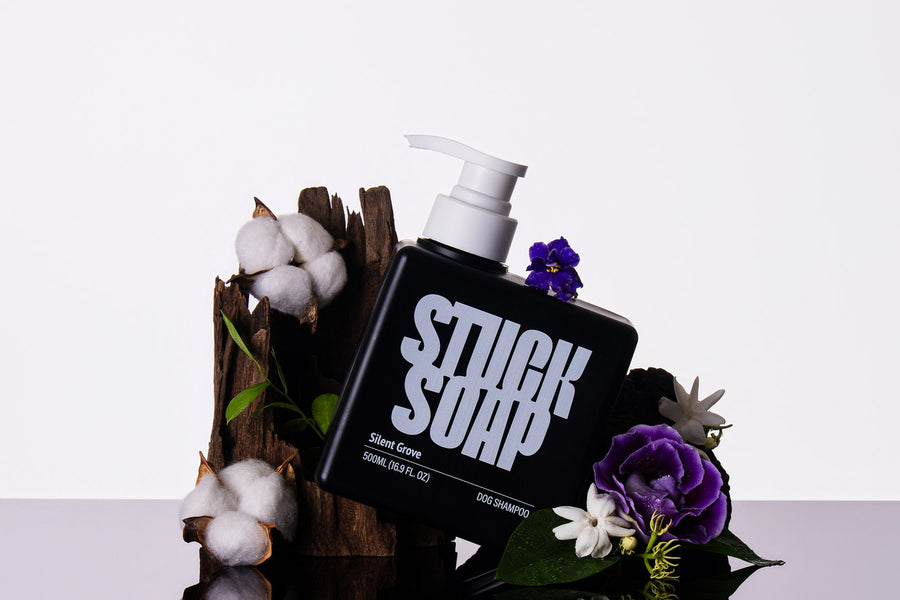
On the product side, our own directions say to rinse thoroughly until no residue remains, and we mean it literally rather than as label boilerplate. STUCK SOAP is built as a high-concentrate, fine-bubble cleanser with green tea, camellia oil, and centella asiatica, pH-balanced for dog skin, which means one pump covers most dogs and less product goes onto the coat in the first place. Less deposited product is simply less to flush out. That is a mechanical advantage, not a shortcut, and it does not replace a single step in the sequence above.
Frequently Asked Questions
How do I know if my dog is fully rinsed?
Run wet fingers against the coat direction at the chest, armpits, and hindquarters. Fully rinsed hair feels squeaky and slightly grabby, not slick or soapy. The water leaving the coat should run clear with no cloudiness and no new foam appearing when you press the skin.
Can shampoo residue on a dog cause itching?
Leftover surfactant sitting against the skin is one of the most common reasons a dog scratches more after a bath than before it. Residue can keep the coat feeling gummy and attract dirt faster. If scratching continues after your rinsing improves, ask your veterinarian rather than guessing at the cause.
How long should rinsing take?
Plan on rinsing at least as long as you spent lathering, and usually longer. A short smooth coat may clear in one to two minutes. A double coat or a thick curly coat often needs four to eight minutes of steady water and hands working down to the skin.
Does the slippery feeling mean shampoo is still there?
Usually yes, on a plain cleansing shampoo. Slickness under your fingers generally means surfactant is still suspended in the water on the hair. Heavy conditioning formulas are the exception, since some are designed to leave a soft coating on purpose, so read the label before judging by feel alone.
Which body parts are missed most often?
The chest, the armpits, the groin, the back of the thighs, the base of the tail, and the belly line. These are the low points where suds drain and pool, and they are also the spots most owners rinse from above instead of getting a hand underneath the dog.
Should I use less shampoo to make rinsing easier?
Often, yes. Most owners use more product than the coat needs, which lengthens rinse time and raises the odds of leftovers. Dilute the shampoo in water first, work it in with your hands, and start with the smallest amount that still produces an even lather across the body.
Sources
- American Kennel Club, Grooming resources: akc.org/expert-advice/grooming
- Merck Veterinary Manual, Skin Disorders of Dogs (owner edition): merckvetmanual.com
- American Veterinary Medical Association, Pet Care: avma.org/resources-tools/pet-owners/petcare
Clean Rinse, Calm Skin
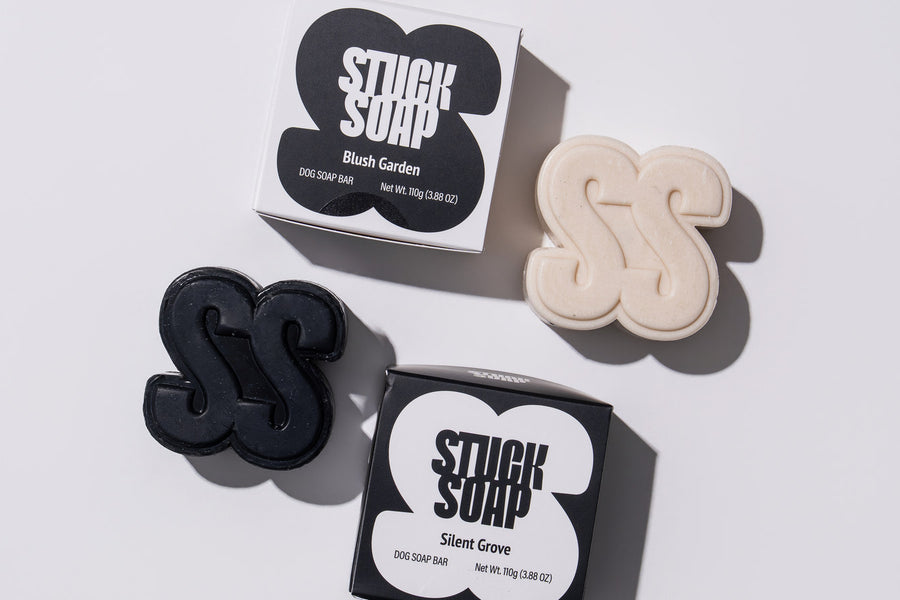
Better rinsing starts with using less product to begin with. Explore the STUCK SOAP Liquid Shampoo and Shampoo Bar in Silent Grove and Blush Garden at stucksoap.com.