


How Much Dog Shampoo to Use: A Dosage Chart by Weight and Coat
For most dogs, one to four pumps of a concentrated shampoo per bath is enough: roughly 2 ml for a 10-pound smooth-coated dog, and about 7 ml for a 60-pound double-coated one. Coat density, how dirty the dog actually is, and whether you lather once or twice all shift that number, which is why how much dog shampoo to use has never had one clean answer. What follows is a chart you can calibrate against, the physical reason over-application backfires, and the arithmetic behind the claim that a single pump can carry an entire bath.
The short answer on how much dog shampoo to use
Think in pumps, not squeezes. A standard cosmetic pump on a 500 ml bottle delivers roughly 1.5 to 2 ml per full stroke. That is an approximation, and it holds only when you press the head all the way down, so every number in this article uses 1.75 ml per pump as a working midpoint. Check your own bottle once against a measuring spoon if you want precision.
Volume scales with surface area, not body weight, which is why a 60-pound Greyhound and a 60-pound Chow Chow are not remotely the same job. Weight is a proxy. Coat is the correction factor.
Why "a good squeeze" fails as a unit
Bottle geometry, viscosity, water temperature, and grip strength all change what a squeeze delivers. People routinely dispense three to five times what they intended, then blame the shampoo when the coat dries flat. A pump head removes most of that variance for free. If you use a bar instead, the equivalent control is contact time rather than volume, which we covered in the bar versus liquid comparison.
Dosage chart: how much dog shampoo to use by weight and coat
This chart assumes a concentrated formula, a normally dirty dog, and one lathering pass. Amounts are per bath, not per pass, unless you are double cleansing.
| Dog weight | Short, smooth single coat | Dense double coat | Long, thick, or curly coat |
|---|---|---|---|
| Under 10 lb (under 4.5 kg) | 1 pump (about 1.5 to 2 ml) | 1 to 1.5 pumps (about 2 to 3 ml) | 2 pumps (about 3 to 3.5 ml) |
| 10 to 25 lb (4.5 to 11 kg) | 1 to 2 pumps (about 2 to 3.5 ml) | 2 pumps (about 3.5 ml) | 2 to 3 pumps (about 3.5 to 5 ml) |
| 25 to 50 lb (11 to 23 kg) | 2 pumps (about 3.5 ml) | 3 pumps (about 5 to 5.5 ml) | 3 to 4 pumps (about 5 to 7 ml) |
| 50 to 75 lb (23 to 34 kg) | 3 pumps (about 5 ml) | 4 pumps (about 7 ml) | 4 to 5 pumps (about 7 to 9 ml) |
| 75 lb and up (34 kg and up) | 4 pumps (about 7 ml) | 5 to 6 pumps (about 9 to 10.5 ml) | 6 to 7 pumps (about 10.5 to 12 ml) |
Assumption stated for checking: 1 full pump stroke equals approximately 1.75 ml. Multiply the pump count by your own measured stroke volume if it differs.
How to read the chart
Pick the row by weight, then the column by what your hand tells you when you push against the coat. If your fingers reach skin in under a second, you are in the left column. If you have to part the hair to find skin, you are in the middle. If the coat holds water like a sponge and takes twenty minutes to wet through, you are on the right.
When to move up a row
Add one pump, not three, when the dog rolled in something, when the coat is genuinely greasy rather than merely dusty, or when hard water is fighting your lather. Mineral-heavy water binds surfactant and suppresses foam, a problem worth solving at the tap rather than at the bottle, as we explain in the hard water piece. Persistent greasiness that returns within days is a different conversation, handled in the oily coat guide.
What too much shampoo actually does
Over-application is not a moral failing about waste. It changes the physics of the bath in three specific ways.
Surfactant load versus available soil
Shampoo cleans because surfactant molecules carry two ends: one that likes oil, one that likes water. As dermatology literature puts it, a detergent molecule "contains both lipophilic (oil-attracting) and hydrophilic (water-attracting) sites" (D'Souza and Rathi, Indian Journal of Dermatology, 2015). Those molecules gather into micelles that trap sebum and dirt and hold them in suspension until the rinse carries them off.
The catch is that the soil on your dog is a fixed quantity. Once every available oil droplet is packaged into a micelle, extra surfactant has nothing left to bind. It stays on the coat as free molecules, still fully active, still attracted to whatever they touch next, including the lipids on the skin surface.
Rinse water is the real constraint
Surfactant leaves the dog only when enough water flows through the coat to dilute it below the concentration at which micelles form. Triple the dose and you roughly triple the rinse volume required. Most people do not triple their rinse. They rinse for the same ninety seconds they always do, decide the dog looks clean, and stop. The shortfall is invisible while wet and obvious once dry. Our post on why a fully rinsed dog can still have residue covers the tell-tale signs.
Redeposition, and the straw-coat effect
What remains behind dries into a thin film along the hair shaft. That film scatters light instead of reflecting it, which reads as dull. It roughens the cuticle, which reads as straw-like and tangles under a brush. And because leftover surfactant keeps a mild affinity for skin lipids, the skin can feel tight, look flaky, and itch as it re-equilibrates. Less shampoo, rinsed properly, produces a glossier coat than more shampoo rinsed adequately. That is the whole mechanism.
The concentration math behind "one pump is enough"
A concentrate is not marketing language, it is a ratio. If a formula delivers full lather at 3.5 ml where another needs 10 ml, the first one is doing the same work with roughly a third of the volume. The consequence shows up in bottles, not in adjectives.
Cost per bath, worked out
Below, every dog is double cleansed: a light first pass to loosen surface oil, a fuller second pass to clean. That is the more demanding assumption, so the numbers are conservative. Bottle prices are shown as a range so you can plug in whatever you actually paid.
| Dog profile | Shampoo per bath (both passes) | Baths per 500 ml bottle | Cost per bath at $30 | at $40 | at $50 |
|---|---|---|---|---|---|
| 8 lb, smooth coat (1 + 1 pump) | 2 pumps, 3.5 ml | 142 | $0.21 | $0.28 | $0.35 |
| 25 lb, double coat (1 + 2 pumps) | 3 pumps, 5.25 ml | 95 | $0.32 | $0.42 | $0.53 |
| 55 lb, double coat (2 + 4 pumps) | 6 pumps, 10.5 ml | 47 | $0.64 | $0.85 | $1.06 |
| 85 lb, long coat (3 + 6 pumps) | 9 pumps, 15.75 ml | 31 | $0.97 | $1.29 | $1.61 |
Method: 500 ml divided by ml per bath equals baths per bottle, rounded down. Bottle price divided by baths per bottle equals cost per bath. Pump volume assumed at 1.75 ml.
Dilute versus concentrated, in neutral terms
Compare categories rather than brands. Suppose a dilute formula needs three times the volume to reach the same lather. Our 55-pound double-coated dog goes from 10.5 ml to 31.5 ml per bath, and a 500 ml bottle drops from 47 baths to 15. At a $20 sticker price, that works out to $1.33 per bath, higher than the $1.06 per bath of a $50 concentrate. Neither category is dishonest. They are simply priced per bottle while you buy per bath, and those are different units.
Bathing every two weeks, a 47-bath bottle runs close to two years for that dog. Worth saying plainly: this argument only holds if you actually dose at the chart. Pour freely and the concentrate advantage disappears immediately.
How to apply the right amount, step by step
- Brush the dry coat first. Loose hair and debris absorb shampoo you would rather spend on skin.
- Soak to the skin with warm water. A dry undercoat repels product and drives up your dose.
- Dispense your chart amount into a wet palm, or into a cup with a splash of water to pre-dilute for long coats.
- Emulsify between both hands until you see fine, dense foam before touching the dog.
- Work from the neck along the back, then down the legs and underside, massaging skin rather than scrubbing hair.
- Give it two to three minutes of contact time. Time replaces volume. This is the step people skip.
- Rinse until the water runs clear and the coat squeaks faintly under your fingers, then rinse the belly, armpits, and tail base once more.
Drying matters as much as rinsing for the final look, and the drying guide walks through it. If bath day itself is chaos, the mess-free method helps.
Reading the feedback your dog gives you
Signs you overshot
Rinse water still foaming after two minutes. A coat that feels slightly waxy when dry. Dullness in daylight. Flaking along the spine a day or two later. Drop one pump next bath and extend the rinse.
Signs you undershot
Lather collapsing within seconds. Skin that never felt slippery under your fingers. A coat that smells faintly of dog again by evening. Add one pump, or add a first loosening pass instead, which is the logic behind the K-beauty double cleanse. Two small doses outperform one large one because the first pass removes the surface oil that was blocking the second.
Where the chart stops
These are calibrated starting ranges, not rules. Puppies, seniors, freshly clipped coats, and dogs with unusually fine or unusually coarse hair all sit somewhere off the grid, and a first bath deserves its own approach, covered in the puppy bathing guide. Skin behaves independently of coat, a distinction we made in dog skin types, not coat types.
Dosage is also not a treatment. Broken skin, hot spots, persistent scratching, odor that returns within a day, hair loss, or anything that looks infected belongs with your veterinarian, not with a chart. Veterinary guidance on topical care distinguishes cleansing shampoos from medicated ones, and a cosmetic grooming product is squarely in the first category.
What to carry into the next bath
Measure once, in pumps, and write the number on a sticky note by the tub. Give contact time instead of volume. Rinse longer than feels necessary. Adjust by a single pump, never by feel alone. Most of the problems people blame on a shampoo are dosage and rinse problems, and both are free to fix. The rest of the common ones are collected in our bathing mistakes roundup.
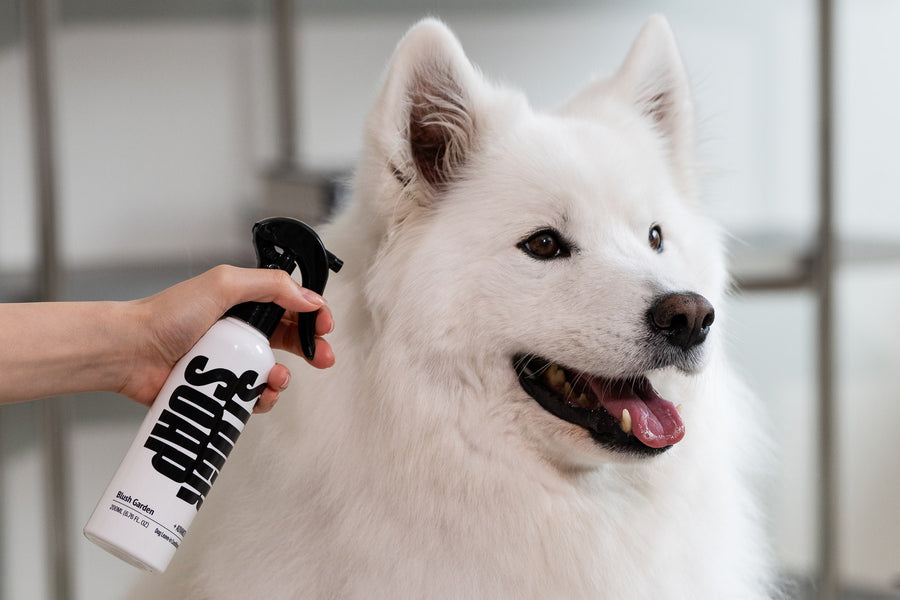
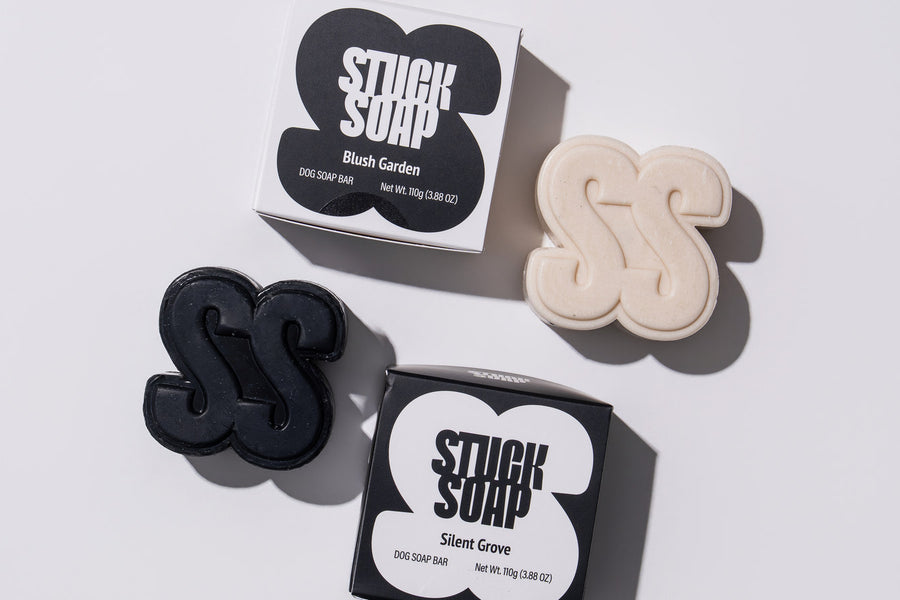
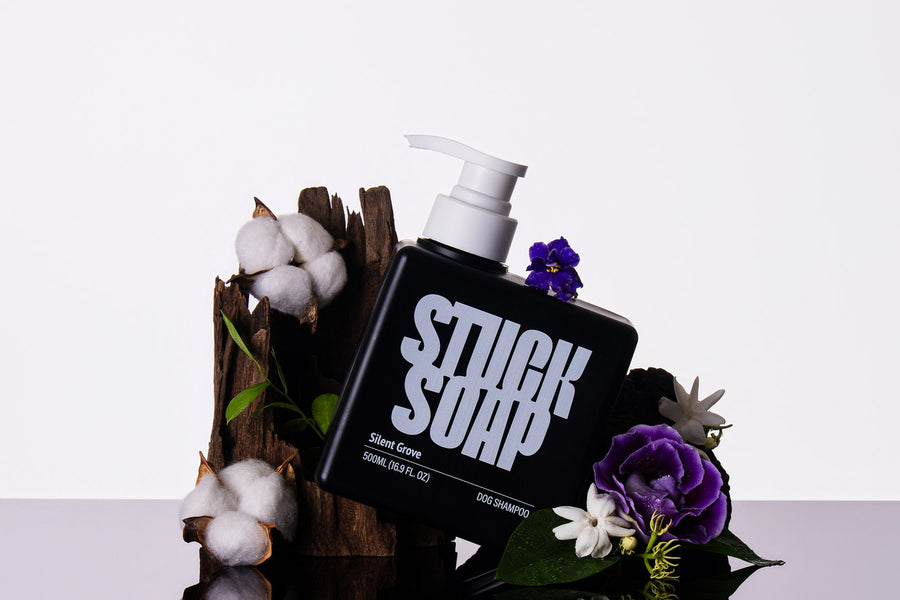
STUCK SOAP builds its Liquid Shampoo 500ml as a high-concentrate, pH-balanced, vegan formula with green tea, camellia oil, and centella asiatica, in Silent Grove or Blush Garden. The fine-bubble lather is what makes one pump viable on a small dog: the foam structure carries the surfactant across the coat instead of concentrating it in one spot. There is a zero-waste bar as well, for anyone who prefers counting seconds to counting pumps.
Frequently asked questions
How much dog shampoo should I use on a 50-pound dog?
A 50-pound dog with a short, smooth coat generally needs two to three pumps of a concentrated shampoo, roughly 3.5 to 5 ml. A dense double coat at the same weight needs three to four pumps. Start at the lower figure, lather fully, and add a single pump only if the foam collapses within seconds.
Is one pump of shampoo really enough for a dog?
For a small, smooth-coated dog under 10 pounds, one pump of a concentrated formula is genuinely enough, roughly 1.5 to 2 ml. It works only if you emulsify the product in wet hands first and give it two to three minutes of contact time. Larger or denser coats need proportionally more.
What happens if I use too much dog shampoo?
Extra surfactant has no remaining soil to bind, so it stays free on the coat and requires far more rinse water to remove. What is left dries into a film along the hair shaft, which scatters light and reads as dull, roughens the cuticle, and can leave skin feeling tight or flaky.
Should I dilute dog shampoo before applying it?
Pre-diluting in a cup of warm water helps considerably on long, thick, or curly coats, where undiluted product tends to sit in one spot. Dilution spreads the same dose across more surface area and shortens rinse time. For short coats, emulsifying between wet palms achieves the same distribution without an extra step.
How long does a 500 ml bottle of dog shampoo last?
It depends entirely on dose. At 3.5 ml per bath for a small smooth-coated dog, a 500 ml bottle yields about 142 baths. At 10.5 ml for a 55-pound double-coated dog using two lathering passes, it yields about 47. Divide 500 by your per-bath millilitres to get your own figure.
Does coat type matter more than body weight?
Coat density often matters more, because shampoo covers surface area rather than mass. A 60-pound smooth-coated dog and a 60-pound double-coated dog can differ by two pumps or more. Use weight to select your row on the chart, then let coat density decide which column you actually belong in.
Can too much shampoo hurt my dog's skin?
Poorly rinsed product commonly leaves skin feeling tight, dry, or flaky, and it can make an existing itch more noticeable. That is a cosmetic and comfort issue, not a diagnosis. Broken skin, hot spots, persistent scratching, hair loss, or signs of infection should be assessed by your veterinarian.
Sources
- American Kennel Club, How to Bathe Your Dog: Tips for Safely Giving Your Pet a Bath
- Merck Veterinary Manual, Principles of Topical Treatment in Animals
- D'Souza P, Rathi SK, Shampoo and Conditioners: What a Dermatologist Should Know? Indian Journal of Dermatology, 2015;60(3):248-254
Get the dose right on your next bath day
Bookmark the chart, count your pumps, and see what a properly dosed bath does to your dog's coat by the time it dries. Browse the shampoo and bar at stucksoap.com.