


If your dog shampoo suddenly barely lathers, the most likely culprit is not the bottle. It is your tap water. The relationship between hard water and dog coat washing is chemical, not mysterious: dissolved calcium and magnesium bind to cleansing agents before they get a chance to lift dirt, which kills foam, drops cleaning performance, and leaves a mineral film sitting on the hair shaft. Move the same bottle from Portland to Phoenix and it behaves like a different product.
This is one of the quietest sources of bad product reviews in the entire pet category. An owner buys a shampoo, loves it for eight months, moves apartments, and writes that the formula "changed." Nothing changed except the pipes.
What Hard Water Actually Is
Definition: Water hardness is the concentration of dissolved calcium and magnesium in water, expressed either in grains per gallon (gpg) or in milligrams per liter (mg/L, equivalent to ppm) of calcium carbonate. One grain per gallon equals about 17.1 mg/L.
Rain falls soft. It picks up hardness on the way to your faucet by moving through limestone, chalk, and gypsum. That is why hardness maps look like geology maps: the mineral-heavy Southwest and the limestone belt through the Midwest run hard, while surface-water systems fed by granite watersheds in the Pacific Northwest and Northeast run soft. The USGS Water Science School uses four bands: soft below 60 mg/L, moderately hard 61 to 120, hard 121 to 180, and very hard above 180.
You are not guessing at this. Every community water system in the United States publishes an annual Consumer Confidence Report, and hardness is usually in it. The EPA's CCR portal will point you to yours.
How Hard Water and Dog Coat Chemistry Actually Interact
Where the lather goes
Cleansing agents work because one end of the molecule likes water and the other end likes oil. In hard water, calcium and magnesium ions grab those molecules first. The surfactant gets consumed neutralizing the minerals instead of surrounding sebum and dirt, and foam is the visible casualty. Lather is not the cleaning itself, but it is a decent live readout of how much active cleanser is still free to work.
So the owner does the natural thing: adds more product. That partially works, because eventually there is enough surfactant to satisfy the minerals and still clean. It also creates the second problem.
The residue that stays behind
When traditional soap meets hard water, the calcium and magnesium salts that form are not water soluble. That is soap scum, the same ring you scrub off a bathtub, and on a dog it deposits along the hair shaft as a dulling film. Add the extra product an owner used to force lather, and the coat now carries both mineral deposit and unrinsed cleanser. The result feels stiff, looks flat, refuses to shine under light, and sometimes goes greasy again within a day or two because the residue attracts dirt.
Research on human skin has looked at the same interaction, with published work in the dermatology literature examining how water hardness affects surfactant deposition and skin barrier measures. You can browse that body of work through PubMed. The mechanism is not exotic and it does not stop at the species line.
If you have ever finished a bath convinced you rinsed thoroughly and still found the coat tacky the next morning, our guide on how to tell when your dog is actually rinsed covers the touch tests that catch it.
Hard Water and Dog Coat Trouble by US City
These are typical reported ranges compiled from municipal water quality reports and the USGS national hardness overview. They are ranges, not promises. Blended sources, seasonal supply shifts, and neighborhood-level distribution mean your address can sit outside the range for your city. Always confirm with your own utility's report.
| City | Typical range (gpg) | Typical range (mg/L as CaCO₃) | USGS class |
|---|---|---|---|
| Portland, OR | under 1 | ~5 to 20 | Soft |
| Boston, MA | ~1 to 2 | ~15 to 35 | Soft |
| New York, NY | ~1 to 2 | ~15 to 35 | Soft |
| Seattle, WA | ~1 to 3 | ~20 to 50 | Soft |
| Atlanta, GA | ~1 to 3 | ~20 to 50 | Soft |
| San Francisco, CA | ~1 to 4 | ~20 to 70 | Soft to moderately hard |
| Denver, CO | ~3 to 7 | ~50 to 120 | Moderately hard |
| Minneapolis, MN | ~4 to 6 | ~70 to 100 | Moderately hard |
| Miami, FL | ~4 to 8 | ~70 to 140 | Moderately hard to hard |
| Dallas, TX | ~4 to 8 | ~70 to 140 | Moderately hard to hard |
| Houston, TX | ~5 to 9 | ~85 to 155 | Moderately hard to hard |
| Chicago, IL | ~7 to 9 | ~130 to 150 | Hard |
| Los Angeles, CA | ~6 to 12 | ~100 to 200 | Hard to very hard |
| Tampa, FL | ~7 to 12 | ~120 to 200 | Hard to very hard |
| Indianapolis, IN | ~10 to 18 | ~170 to 300 | Very hard |
| San Antonio, TX | ~10 to 20 | ~170 to 340 | Very hard |
| Phoenix, AZ | ~12 to 19 | ~200 to 330 | Very hard |
| Las Vegas, NV | ~13 to 19 | ~220 to 320 | Very hard |
Look at the spread. A shampoo dosed for Seattle water is being asked to do a structurally different job in Las Vegas, where roughly ten times as much dissolved mineral is in play before the first drop of product hits the coat.
The Review That Says "It Stopped Working"
Read enough pet shampoo reviews and a pattern shows up. "Barely foams." "Worked great, then stopped." "Had to use half the bottle." Those reviews cluster geographically far more than they cluster by formula, and they spike after moves, after a utility switches source water, and after someone starts bathing in a garage utility sink fed by a different line than the bathroom.
Three quick checks tell you whether water is your variable:
- Does it foam in the sink but not the tub? Different fixtures sometimes draw from different lines or run through different filters.
- Did it change when you moved? Same bottle, new zip code, new behavior. That is water, not formula.
- Does it work at the groomer? Many salons run softened or recirculating systems and dilute concentrates by measure rather than by eye.
Reframing this correctly matters because the wrong diagnosis leads to the wrong fix. Owners who blame the formula start rotating products, and rotation on an already residue-loaded coat rarely improves anything. Owners who correctly identify hard water fix it with technique, usually for free.
The Final Rinse: The Technique That Fixes Most of It
The final rinse is where hard water problems get solved, and it is the step almost everyone shortens because the dog is over it and so are you. Budget more rinse time than wash time.
Step by step
- Wet longer than feels necessary. Two to three minutes of saturation on a double coat. Dry undercoat under a wet topcoat is why shampoo seems to vanish.
- Dilute the dose before it touches the dog. Put the product in a cup or bottle with warm water, shake, then apply. Pre-diluted cleanser distributes evenly instead of concentrating in three spots and going nowhere else.
- Do not chase foam. In hard water, low lather is expected. Judge by how the coat feels under your fingers, slick and mobile, not by the size of the bubbles.
- Rinse in sections, from the skin out. Part the coat with your free hand and drive water at the skin. Chest, armpits, belly, groin, and the base of the tail hold the most residue and get the least attention.
- Rinse until the water runs clear, then rinse for another sixty seconds. The squeak test is not reliable on dogs. The finger-squeegee test is: pull a section of wet hair between two fingers. Slippery means product is still there. Clean means clean.
- Optional final pour. For small and medium dogs, a gallon of distilled or reverse osmosis water poured over the coat as the last step is a cheap way to confirm whether hardness was the issue. If the coat dries noticeably softer and brighter, you have your answer.
A tub-side setup that lets you do all of this without a wrestling match makes the difference between doing it right and cutting it short. Our 10-minute prep checklist is built for exactly that, and if the goal is fewer steps overall, the skip-care routine strips the process to what actually earns its place.
Two Formulation Answers to Hard Water
Hard water is a formulation problem as much as a technique problem, and it points at two design decisions worth understanding as a shopper.
Concentration
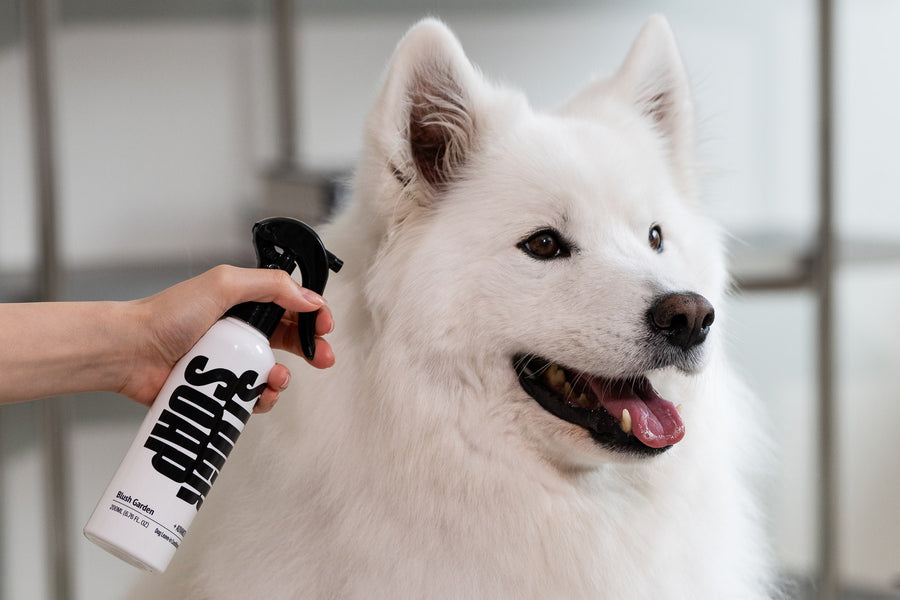
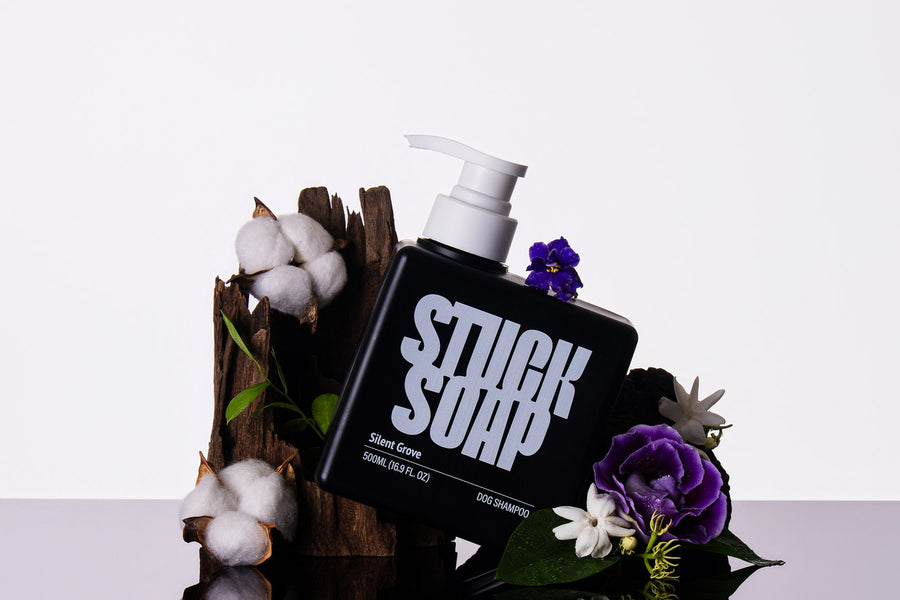
A high-concentrate formula is designed so a small dose carries enough active cleanser to do the job. The practical benefit in hard water is margin: when some of the cleanser is consumed by calcium and magnesium, a concentrate still has enough left to work. The practical risk is the opposite failure. People under-dose concentrates, see no foam, conclude the product is weak, and blame the formula rather than the water. Both STUCK SOAP scents, Silent Grove and Blush Garden, are built as concentrates where a single pump is the intended starting dose for a small dog, diluted in water before application.
Format
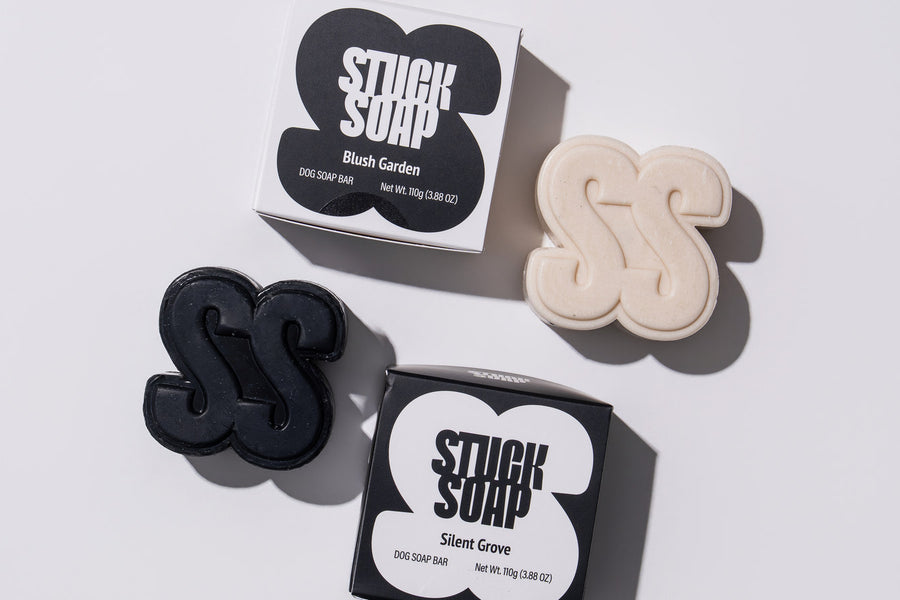
Bars are worth understanding on their chemistry rather than their shape. Traditional soap made by saponification reacts with hardness minerals and forms the insoluble film we call soap scum. Synthetic detergent (syndet) cleansing bars are built from different surfactants and do not form that curd in the same way, which is why they generally hold up better in hard water. This is a category distinction, not a rule about any particular bar, so the ingredient list is what tells you which one you are holding. Bars also happen to solve a different problem entirely, which is packaging waste, and that is why a zero-waste bar sits alongside the 500ml liquid in the STUCK SOAP lineup.
None of this makes any product immune to hard water. Water chemistry is upstream of everything in the bottle. What good design does is give you margin, and what good technique does is remove what is left.
When It Is Not the Water
Hard water explains dull coats, weak lather, and film. It does not explain everything, and it is worth being blunt about the line.
Persistent scratching, red or inflamed skin, hot spots, hair loss, scabs, odor that returns within a day of bathing, or any open sore is a veterinary matter. Those signs point at allergies, parasites, endocrine conditions, or infection, and no rinse technique addresses them. Take them to your veterinarian. The Merck Veterinary Manual pet owner section and the AVMA's pet owner resources are reasonable places to read up before that appointment, not substitutes for it.
STUCK SOAP is a cosmetic grooming product, vegan and pH-balanced for dog skin, formulated with Green Tea, Camellia Oil, and Centella Asiatica for sebum control and skin-barrier support. It is not medicated and it treats nothing.
Practical Takeaways
- Look up your hardness before you replace a product. Your utility's annual report has the number.
- In hard water, stop using foam as your gauge. Judge by feel.
- Dilute concentrated product in water before applying so it distributes instead of clumping.
- Spend more time on the final rinse than on the wash. Rinse the skin, not the surface.
- Test a distilled-water final pour once. It isolates the variable in a single bath.
- Read cleansing bases on labels, not marketing words like "natural" or "gentle."
- Route real skin symptoms to your veterinarian and keep grooming decisions separate from medical ones.
Two other pieces round this out: how long a dog realistically stays clean after a bath, which sets expectations residue quietly wrecks, and why grooming should sort dogs by skin type rather than coat type, which changes how you read your own results.
Frequently Asked Questions
How do I know if I have hard water at home?
Check your water utility's annual Consumer Confidence Report, which most US systems publish online and which usually lists hardness in grains per gallon or mg/L. A cheap aquarium or pool test strip also works. Visible clues include cloudy film on glassware, chalky buildup at faucets, and shampoo that refuses to foam.
Does hard water damage my dog's skin?
Hard water is not a diagnosis. It can leave mineral and cleanser residue that makes a coat feel dull, stiff, or gritty, and heavy residue can contribute to itchiness. Persistent scratching, redness, sores, or hair loss are separate issues that belong with your veterinarian, not with a rinse adjustment.
Will using more shampoo fix hard water?
Somewhat, and that is the trap. Extra product does neutralize some hardness minerals, but it also increases how much has to be rinsed out, so residue climbs. A better sequence is wetting the coat longer, diluting the normal dose in water first, and extending the final rinse considerably.
Is distilled water worth using for the final rinse?
For a small or medium dog, a gallon of distilled or reverse osmosis water poured over the coat at the end is a cheap experiment. For a large dog it gets impractical fast. Treat it as a one-time test to confirm water is the variable, not as a permanent routine.
Do shampoo bars work in hard water?
It depends entirely on the cleansing base. Traditional soap made by saponification reacts with calcium and magnesium and leaves a curd-like film. Synthetic detergent bars are built differently and generally hold up better. Format alone tells you nothing useful, so read the ingredient list rather than judging by shape.
Does a shower filter soften water?
Usually not. Most inline shower filters target chlorine and sediment rather than dissolved calcium and magnesium, so hardness passes straight through. Actual softening requires ion exchange or reverse osmosis at the plumbing level. Check what a given filter is rated to remove before expecting it to change your lather.
Why does the same shampoo work at the groomer but not at home?
Groomers often run softened or filtered water, use recirculating bathing systems, and dilute concentrates by measure rather than by eye. Different water plus different dilution produces a different result from the identical bottle. It is one of the clearest signals that water chemistry changed, not the formula.
Sources
- US Geological Survey, Water Science School: Hardness of Water
- US Environmental Protection Agency: Consumer Confidence Reports (CCR)
- American Kennel Club: Grooming expert advice
- Merck Veterinary Manual: Pet Owner Version
- American Veterinary Medical Association: Pet Owner Resources
- PubMed: published literature on water hardness and skin barrier function
Before You Blame the Bottle
Check your hardness number, dilute your dose, and give the final rinse the time it deserves. If you want a concentrate built for that kind of routine, in Silent Grove or Blush Garden, both the 500ml liquid and the zero-waste bar are at stucksoap.com. And if you are still deciding what belongs in your dog's routine at all, start with what makes K-Beauty formulas different.