


The short answer to how to wash sand off a dog: brush the dry coat out first so the grit falls away instead of turning to paste, then rinse with cool fresh water from the neck back for a full five to ten minutes, opening the coat with your fingers as you work. The rinse is the step almost everyone shortens, and it matters more after the ocean than after the pool, because salt keeps working on the skin long after the fur feels clean.
A beach day looks like the easiest wash of the summer. The dog is already wet, so you hose off the worst of it in the driveway, towel the shoulders, and call it done. Two days later the coat feels chalky at the roots, there's a raw pink line where the harness sat, and your dog will not stop licking one back foot.
Salt Is the Problem. Sand Is the Damage.
Two separate problems, two separate fixes. A beach rinse is not the same job as a lake rinse or a backyard-pool rinse.
Salt residue: the sodium chloride left in the coat and on the skin after seawater evaporates. It is invisible, it does not smell, and it stays put until fresh water dissolves it.
Sand abrasion: mechanical wear caused by hard mineral grit trapped against skin, moving with every step, breath, and shake.
Rinsing solves the first. Brushing before the rinse solves most of the second. Reverse the order and water turns loose sand into paste that packs into the undercoat.
The general mechanics of rinsing, towel work, and drying live in the post-swim rinse and dry protocol. This piece covers only what the ocean does that a pool does not.
Why Saltwater Dries Skin More Than Pool Water
Pool water mostly evaporates. Chlorine can leave skin tight and dull a coat, and it irritates some dogs, but the residue is thin.
Saltwater behaves differently. As the water evaporates on the walk back to the car, the salt stays. It crystallizes in place: at the roots, along the spine, in the ruff, in every fold. Salt is hygroscopic, it pulls moisture toward itself, and the moisture nearest to hand is in your dog's skin. The drying does not stop when the coat looks dry. It runs for hours, in sun and wind, with salt sitting against the skin barrier the whole time.
An ocean day is not a wetter pool day. It is a slow dehydrating event that keeps running until you rinse it off. If your dog already runs dry or flaky, read the skin barrier basics alongside this.
| Water source | What stays in the coat as it dries | How it behaves on skin | Realistic rinse |
|---|---|---|---|
| Ocean saltwater | Salt crystals, fine sand, marine debris | Keeps drawing moisture out for hours after the coat looks dry | 5 to 10 minutes, coat opened by hand |
| Chlorinated pool | Chlorine residue, dissolved solids | Can leave skin tight and the coat dull, but residue is light | 3 to 5 minutes |
| Lake or pond | Silt, algae, plant matter | Mainly a debris and odor problem | 3 to 5 minutes |
| Your own tap water | Calcium and magnesium if the supply is hard | Leaves a film that makes a coat feel unrinsed no matter how long you go | See hard water and dog coats |
How to Wash Sand Off a Dog Without Grinding It Into the Coat
Order matters more than technique here.
- Let the coat dry, or at least stop dripping. Wet sand smears, dry sand falls. Fifteen minutes in the shade does it, or let the drive home handle it.
- Shake and brush outdoors. Use a slicker or a rubber curry against the lie of the coat, then with it. Most of the sand leaves at this stage if you let it.
- Start the rinse at the neck and work back. Cool water, low pressure. Never blast a face or ears.
- Open the coat as you rinse. Fingers in, part the hair, let water reach the skin. On a double coat, water runs over the top layer and never touches the roots unless you make it.
- Do the folds, the tail base, the armpits, and the groin deliberately. These trap both salt and sand and they are the spots people skip.
- Finish with the feet, one at a time. Sand in a paw is the single most common reason a beach day turns into a limp.
- Dry properly, especially the folds and between the toes. Details in the complete drying guide.
How to Wash Sand Off a Dog's Paws and Between the Toes
Hold the paw, spread the toes with your thumb, and direct water into each gap rather than over the top of the foot. You are flushing a channel, not wetting a surface. Dry between the toes with a towel corner afterward. Grit left in there moves with every step, and a dog licking one foot all evening is usually telling you something is still in it.
Sand Works Like Sandpaper
Sand is not soft. It is broken quartz and shell, and the grains have edges. Trapped between skin and moving fur, or skin and skin, it abrades.
Where the friction concentrates
Skin folds on wrinkled and short-faced breeds. Armpits and groin, where legs pass close to the body. Under a collar, harness strap, or life jacket, where gear holds grit against skin all session. Between the toes and around the pad edges. These spots take thousands of small passes over a long day, and the red patch shows up hours later, once the sand is already out.
Brushing before the rinse is not optional on a double or curly coat. Packed wet sand in an undercoat keeps working long after the bath.
Hot Sand and Paw Pads
Dry sand in direct sun gets hotter than owners expect. A dog crossing open beach at two in the afternoon faces the same math as a dog crossing asphalt. The back-of-the-hand test applies: if you cannot hold your palm flat on the sand for seven seconds, it is too hot for pads. Full version of that logic in the hot pavement paw safety guide.
Wet pads soften. Soft pads on hot, abrasive sand wear faster than dry ones. Keep the walk between water and shade short, and use the wet band near the tideline where you can.
The Rinse Most People Cut Short
Ask an owner how long they rinsed and they will say "a few minutes." Time it once and it is usually ninety seconds. That is enough to make a coat look clean and nowhere near enough to get salt out of an undercoat.
| Coat type | What most people do | What the coat actually needs |
|---|---|---|
| Short, single coat | 60 to 90 seconds | 3 to 4 minutes |
| Double coat (Husky, Shepherd, Corgi) | 2 minutes over the top | 8 to 12 minutes, coat parted by hand |
| Curly or wool coat (Poodle, Doodle, Bichon) | 2 to 3 minutes | 8 to 12 minutes, section by section |
| Wrinkled or folded skin | General hose-down | Add 2 minutes of targeted fold work, then dry each fold |
Better than any clock: the feel test. Run your fingers through the wet coat at the roots. If it feels gritty, tacky, or slick in a way plain water does not explain, keep going. Coat type drives this far more than size does, and skin type versus coat type is the place to sort that out.
The Body Check for Shell and Glass Cuts
Beaches hide sharp things: broken shell, oyster edges, glass, fish hooks, bottle caps buried an inch down. A dog running flat out will not react to a small cut, and salt water plus adrenaline means it may not bleed much at first.
Run your hands over the whole dog while the coat is wet, when nicks are easiest to see. Check each pad, the webbing between toes, the nail beds, the belly, the ears, and the muzzle.
Call your veterinarian rather than handling it at home for: a cut that keeps bleeding after a few minutes of gentle pressure, a wound that gapes, anything embedded, a limp that outlasts the drive home, redness or swelling overnight, or a paw your dog will not stop licking. Those are diagnostic questions, not grooming questions.
Seawater ingestion belongs in the same category. The American Kennel Club puts it simply: "Try to limit the amount of salt water your dog may drink as it can make them sick." Offer fresh water often so your dog is not thirsty enough to try, and call your vet or a poison control line if you see vomiting, diarrhea, wobbliness, or unusual thirst after a beach day.
Practical Takeaways
- Brush dry, then rinse. Reversing that order packs sand into the undercoat.
- Assume the ocean dried your dog's skin. A beach day is not a pool day.
- Rinse two to four times longer than instinct says, and judge by feel at the roots.
- Rinse folds, armpits, groin, tail base, and between the toes on purpose. Water does not find them on its own.
- Watch hot sand the same way you watch hot pavement.
- Do a hands-on body check while the coat is still wet, and route anything sharp, bleeding, embedded, or persistent to your veterinarian.
- Dry the folds and the toes. Trapped damp undoes a good rinse.
When a Wash Makes Sense
Most beach days need a rinse, not a lather. Wash when your dog rolled in something, smells of algae or dead marine matter, or still feels sticky once the rinse is done. Frequent shampooing on top of an already dry, salt-stripped coat works against you, the same trap covered in the summer skin problems guide.
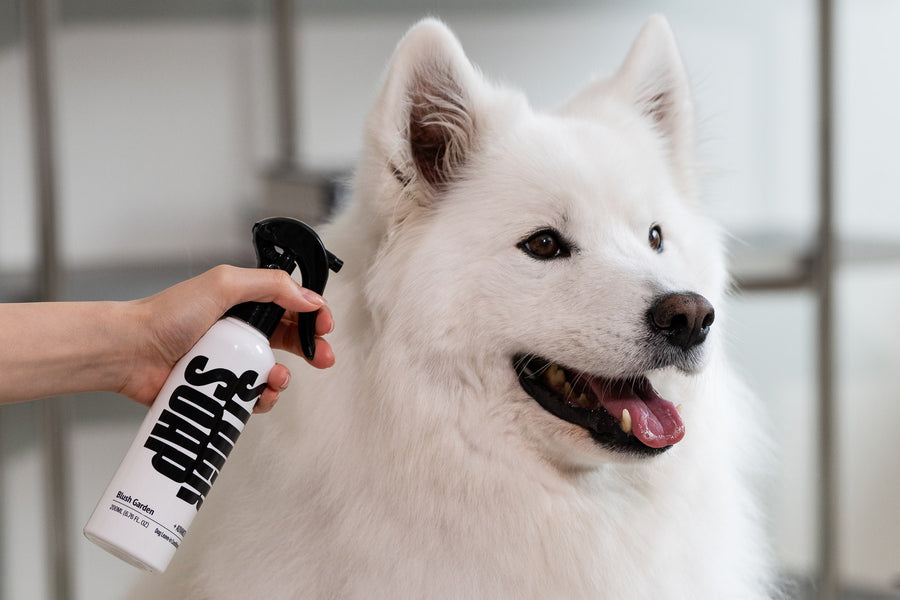
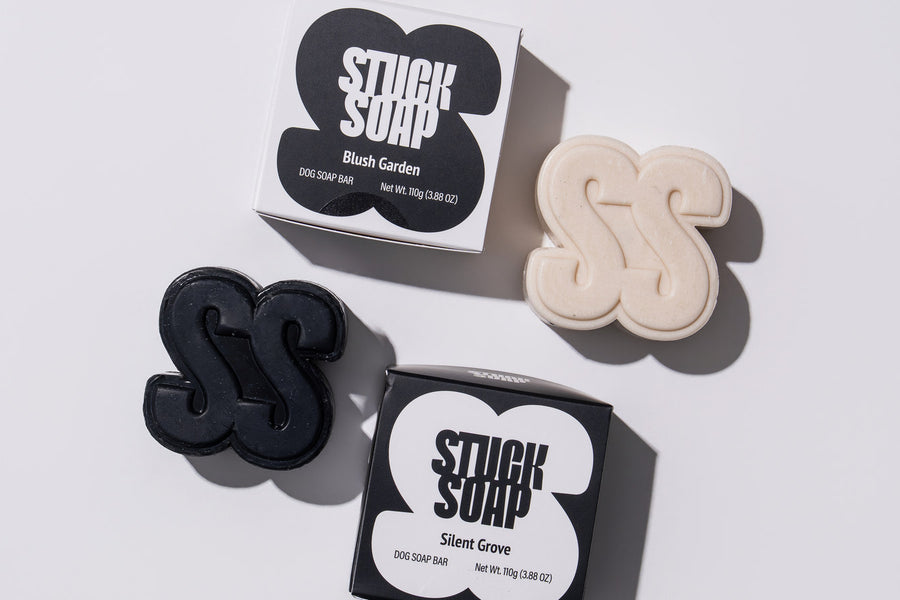
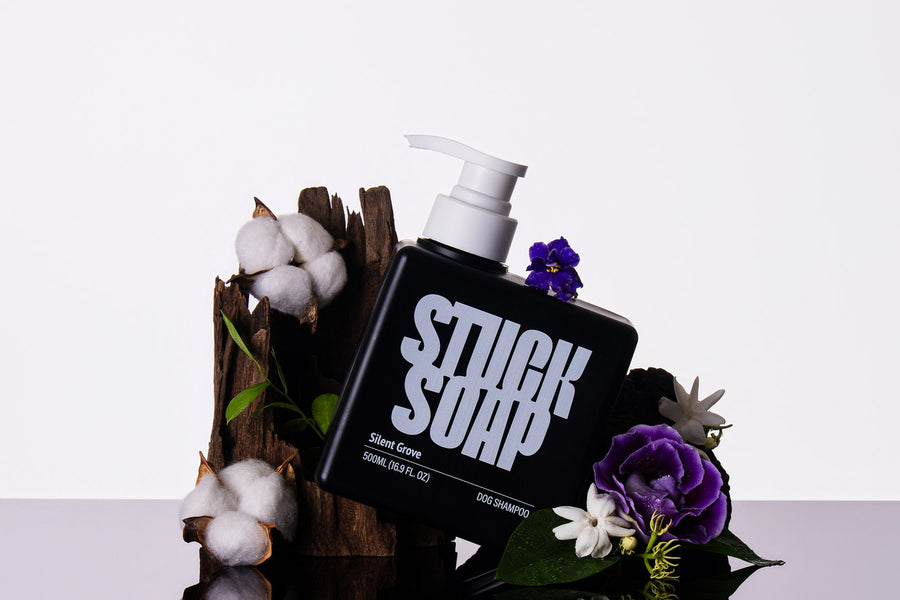
When you do wash, the product should be built for dog skin rather than borrowed from the human shelf. STUCK SOAP makes a pH-balanced, vegan grooming line in two forms, a 500ml liquid shampoo and a zero-waste bar, formulated with Green Tea, Camellia Oil, and Centella Asiatica for sebum control and skin-barrier support. The fine-bubble lather is the useful part after a beach day: it moves through a packed coat and rinses out cleanly, and the formula is concentrated enough that one pump covers most dogs. Two scents, Silent Grove (earthy) and Blush Garden (floral). It is a cosmetic grooming product, not a treatment for a skin condition.
Frequently Asked Questions
How do you wash sand off a dog without giving a full bath?
Let the coat dry, then brush or towel the loose sand out before any water touches it. Follow with a plain fresh-water rinse, no shampoo, working your fingers through the coat and between the toes. Most beach days need a thorough rinse rather than a full lather.
Is saltwater harder on a dog's skin than pool water?
Salt stays behind as the coat dries and keeps drawing moisture out of the skin, so an ocean day tends to leave a coat drier and duller than a pool day. Chlorine can irritate too, but salt residue is more persistent and needs a longer rinse.
How long should I rinse my dog after the beach?
Plan on five to ten minutes of running fresh water for most dogs, longer for double or curly coats that hold salt near the skin. Judge by feel rather than by clock: when the wet coat stops feeling faintly gritty or tacky under your fingers, the rinse is done.
Should I shampoo my dog after every beach trip?
Not usually. A thorough fresh-water rinse handles most beach days, and washing too often can leave the coat dry. Reach for a gentle, pH-balanced dog shampoo when your dog rolled in something, smells of algae or dead marine matter, or feels sticky after rinsing.
What is the best way to get sand out from between a dog's toes?
Hold the paw, spread the toes gently, and run water directly into each gap rather than over the top of the foot. Then dry between the toes with a towel corner. Sand left in that space keeps rubbing with every step and can turn a clean paw sore.
My dog drank seawater at the beach. What should I do?
Offer fresh water and stop the beach session. Swallowing a large amount of seawater can make a dog seriously ill, so call your veterinarian or a poison control line if you see vomiting, diarrhea, wobbliness, or unusual thirst. Do not wait to see whether it passes.
How do I know if a cut from a shell needs a vet?
Any cut that keeps bleeding after a few minutes of gentle pressure, gapes open, has something embedded in it, or sits on a weight-bearing pad needs a veterinarian. Same for limping that lasts past the drive home, or redness and swelling that appear the next day.
Sources
- American Kennel Club, Taking Your Dog to the Beach: Tips & Safety
- American Kennel Club, What If My Dog Eats Sand? Dangers of Sand Ingestion in Dogs
- Merck Veterinary Manual, Salt Toxicosis in Animals
- ASPCA, Animal Poison Control Center
Clean Coat, Calm Skin
Beach season is hard on a coat, and the wash afterward should not be. STUCK SOAP's pH-balanced Liquid Shampoo and zero-waste Shampoo Bar are made with Green Tea, Camellia Oil, and Centella Asiatica, in Silent Grove or Blush Garden. Shop the line at stucksoap.com.