


Hypoallergenic, fragrance-free, and unscented are three different claims, and only one of them describes something you can verify on the back of the bottle. In the hypoallergenic vs fragrance free dog shampoo question, "hypoallergenic" has no federal definition in the United States, "fragrance-free" generally means no fragrance materials were added, and "unscented" often means a masking fragrance was added so the product smells like nothing at all.
If you are scrolling a product page with a sensitive-skinned dog in mind, that distinction changes what you should be reading. One of those three words is a reassurance with no threshold behind it. The other two describe formulation choices, imperfectly, and neither is policed by a federal agency. The ingredient list is the only part of the package that has to tell you something specific.
What "Hypoallergenic" Legally Means on a Dog Shampoo
Functionally, nothing. The US Food and Drug Administration has been blunt about this for human cosmetics: "There are no Federal standards or definitions that govern the use of the term 'hypoallergenic.'" The agency adds that the word means whatever a particular company wants it to mean.
No test has to be run. No allergen threshold has to be cleared. No panel of dogs has to be patch-tested. A brand can print the word on a bottle on Monday and ship it on Tuesday.
The rule that was struck down
This is not an oversight that nobody noticed. In 1974 the FDA tried to fix it, proposing that a cosmetic could only be labeled hypoallergenic if human studies showed a significantly lower rate of adverse skin reactions than comparable products. The US Court of Appeals for the District of Columbia invalidated the regulation, reasoning that the agency had not shown consumers understood the term the way the rule defined it. The word went back to being whatever the manufacturer says.
What the word does not tell you
Even where a brand has tested its formula, "hypoallergenic" describes a comparison, not an absolute. It cannot mean "will not cause a reaction," because allergy is a property of the individual animal, not the bottle. A dog sensitized to oat protein will react to an oat-based shampoo marketed as gentle.
Fragrance-Free vs Unscented: Not Synonyms
These two get used interchangeably in copy, and they mean different things in practice.
- Fragrance-free
- Generally understood to mean no fragrance materials were added to the formula for the purpose of scenting it. The product may still have a faint smell from its raw materials, because surfactants and plant oils have odors of their own.
- Unscented
- Generally understood to mean the finished product has no perceptible smell. That result can be achieved by leaving fragrance out, or by adding a masking fragrance that neutralizes the raw ingredient odor.
The FDA makes exactly this point for human products, noting that items labeled unscented may contain fragrance ingredients added to mask the unpleasant smell of other ingredients. Neither term is federally defined or enforced for cosmetics. The Federal Trade Commission polices deceptive advertising claims broadly and expects marketers to have a reasonable basis for what they assert, but there is no term-specific standard that says what a bottle must contain before it can say "unscented."
Why one word on a label can stand for dozens of chemicals
On US human cosmetic labels, the single entry "Fragrance" (or "Parfum") is permitted to represent a complex mixture of many component chemicals, because fragrance formulas are treated as trade secrets under the Fair Packaging and Labeling Act. That is a legitimate commercial protection, and it is also the reason an ingredient list can look short and clean while withholding the part most relevant to a sensitive dog.
So a nine-ingredient label is not automatically simpler than a twenty-ingredient one. It may just be the one that consolidated more of its chemistry behind a single word. Our guide to reading natural vs chemical shampoo labels covers that pattern.
Hypoallergenic vs Fragrance-Free Dog Shampoo, Side by Side
| Label term | Federally defined for cosmetics? | What it commonly means | What it does not tell you | How to verify it |
|---|---|---|---|---|
| Hypoallergenic | No. FDA states there are no federal standards or definitions. | The manufacturer believes the product causes fewer reactions than comparable products. | What was tested, on how many animals, against what comparison, or which allergens were excluded. | You cannot verify it from the label. Ask the brand for its substantiation. |
| Fragrance-free | No federal definition, though the claim itself must not be deceptive. | No fragrance materials were added to scent the product. | Whether a masking or "odor neutralizing" agent is present under another name. | Scan the ingredient list for Fragrance, Parfum, Aroma, and named essential oils. |
| Unscented | No federal definition. | The finished product has no noticeable smell. | Whether that result came from omitting fragrance or from adding one to mask odor. | Same scan. An unscented product listing Fragrance is masked, not fragrance-free. |
Read down the last column and the pattern is obvious. Two of the three claims can be cross-checked against the ingredient list in about fifteen seconds. The third cannot be checked at all.
The Regulatory Gap Sitting Under Every Pet Shampoo Label
There is a second layer here, and it is why pet labels run looser than human ones. A non-medicated dog shampoo is not a cosmetic in the federal sense, since that statutory definition covers articles applied to the human body. The FDA describes grooming aids such as unmedicated dog shampoo as being like cosmetics for people, but they sit outside the cosmetic labeling regime. The EPA only enters when a product makes a pesticidal claim, which is why flea and tick shampoos are EPA-registered and your everyday bottle is not.
The practical result: no federal agency pre-approves the ingredient list or the marketing claims on an ordinary dog shampoo. We covered that gap at length in who actually regulates dog shampoo in the US.
Why STUCK SOAP Does Not Use the Word "Hypoallergenic"
We could print it. It would cost us nothing, no agency would stop us, and it would almost certainly help conversion. We do not, and the reason is the whole point of this article: a claim you cannot verify is worth less than a list you can read.
A claim you cannot check vs. a list you can
Our position is to publish the complete ingredient list for every product, in full INCI form, and to disclose the scent components rather than consolidating them behind a single "Fragrance" entry. If your dog has a known sensitivity, that list is the thing that lets you make a decision in thirty seconds without emailing us. A reassurance word would not.
This is also why we write about specific ingredients rather than category adjectives. Green tea, camellia oil, and centella asiatica are things you can look up, cross-reference, and rule in or out. "Gentle formula" is not.
And yes, our shampoo is scented
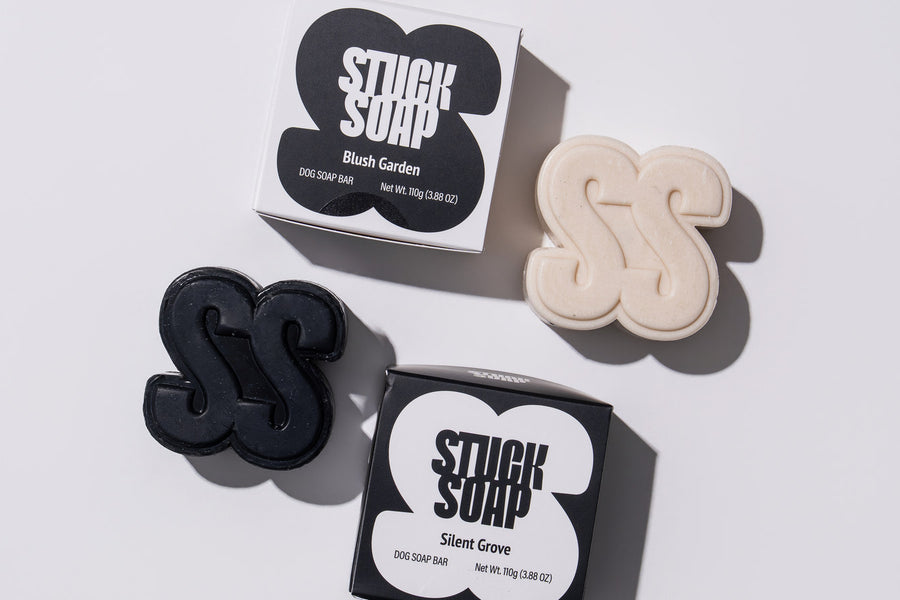
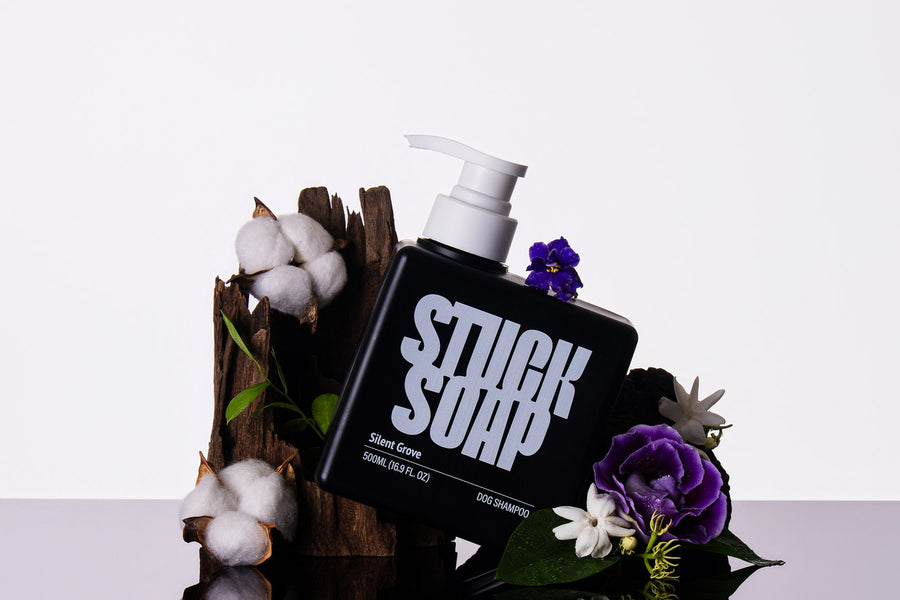
STUCK SOAP is a scented line. There are two scents, Silent Grove and Blush Garden, and we say so on every page. That means this: if you need a genuinely fragrance-free dog shampoo, our products are not that product. We would rather tell you now than have you find out in the tub.
A brand that scents its products and then leans on soft allergy language is doing the thing this article is about. We would rather show the formula, name the scent, and let you decide whether a scented grooming product fits your dog. On what a scent does and does not do on a coat, see how long a dog shampoo scent actually lasts.
How to Evaluate a Shampoo for a Sensitive-Skinned Dog
Skip the front of the bottle entirely. Here is the sequence that gives you real information.
- Find the full ingredient list. If a brand does not publish one, that is your answer. Move on.
- Search it for Fragrance, Parfum, and Aroma. Any of these means undisclosed scent chemistry, regardless of what the front says.
- Check for named essential oils. Lavender, citrus, and tea tree are fragrance materials even when a label positions them as botanicals. Tea tree warrants a conversation with your vet before use on dogs.
- Cross-reference against your dog's known triggers. If a previous reaction was documented, you are looking for that specific ingredient, not a category word.
- Read the functional claims, not the emotional ones. pH formulated for canine skin, surfactant system, dilution and rinse instructions. Those describe how the product behaves.
| If the front says | The back should show | Red flag |
|---|---|---|
| Fragrance-free | No Fragrance, Parfum, Aroma, or named aromatic oils in the list | Any of those present, or no list published at all |
| Unscented | Either no fragrance materials, or a disclosed masking agent | "Fragrance" listed with no explanation of its role |
| Hypoallergenic | Nothing is required, so look for a stated testing method | The word with no substantiation anywhere on the site |
If your dog reacted after a bath, that is a vet conversation
Worth stating plainly, because a lot of these decisions get made in the wrong place. If your dog is itching, breaking out, or losing coat, the next step is a veterinarian, not a different shampoo.
Canine allergic skin disease is dominated by environmental atopy and flea allergy, not by grooming products. Diagnosis takes tools a shopper does not have: intradermal or serum allergy testing through a dermatology referral, and for suspected food reactions an elimination diet trial running eight to twelve weeks. A reaction to a product is more often irritant contact dermatitis, meaning the formula was harsh or poorly rinsed, than a true allergy. Merck's veterinary guidance on topical treatment notes that animals should be monitored for irritant or allergic contact dermatitis, and that switching between similar bases can make matters worse.
Either way, the word on the front of the bottle told you nothing about the odds. A shampoo is grooming, not treatment. For the fuller version, see our pieces on hives after a bath and ingredient selection for allergy-prone dogs.
If You Genuinely Need a Fragrance-Free Product
Some dogs and some households need one: post-surgical recovery, a dog on a dermatology protocol, an owner with a fragrance sensitivity of their own. If that is you, require the following.
- A published, complete ingredient list with no Fragrance, Parfum, or Aroma entry.
- No named aromatic essential oils used at scenting levels.
- The phrase "fragrance-free" rather than "unscented," with an ingredient list that backs it up.
- A pH appropriate for canine skin, which is a separate question from scent. Our explainer on pH-balanced dog shampoo covers why.
- If a vet is involved, sign-off on the specific product rather than the category.
You will not find that in our range, and we would rather say so than bury it. What you will find at stucksoap.com is a scented, vegan, pH-balanced line with the full formula published for both the 500ml liquid shampoo and the zero-waste bar.
Practical Takeaways
- "Hypoallergenic" has no federal definition for cosmetics in the US and no threshold a product must clear.
- "Fragrance-free" and "unscented" are not synonyms. Unscented can mean a masking fragrance was added.
- A single "Fragrance" entry can represent many undisclosed chemicals, protected as trade secret.
- No federal agency pre-approves the claims or ingredient list on a non-medicated dog shampoo.
- The ingredient list is the only verifiable claim on the package. Read it first.
- Suspected allergy is a veterinary question, not a product swap.
Frequently Asked Questions
Is a hypoallergenic dog shampoo safer than a fragrance-free dog shampoo?
Not inherently. "Hypoallergenic" has no federal definition, so it tells you nothing verifiable about the formula. "Fragrance-free" describes an actual formulation choice you can check against the ingredient list. For a sensitive-skinned dog, a claim you can verify is more useful than one you cannot.
Does "unscented" mean there is no fragrance in a dog shampoo?
No. Unscented usually means the finished product has no noticeable smell, which manufacturers sometimes achieve by adding a masking fragrance that covers raw ingredient odor. Fragrance-free is the stronger claim. Confirm either one by scanning the ingredient list for Fragrance, Parfum, Aroma, and named essential oils.
Who regulates hypoallergenic claims on pet shampoo in the United States?
No agency pre-approves them. Non-medicated dog shampoos fall outside the federal cosmetic definition, which covers products applied to the human body, and the EPA only steps in for pesticidal products such as flea and tick shampoos. The FTC can act against deceptive advertising, but reviews nothing in advance.
My dog got itchy after a bath. Was it the shampoo?
Possibly, but a reaction to a grooming product is more often irritant contact dermatitis than a true allergy, and canine allergic skin disease is most commonly environmental or flea-related. Stop using the product, rinse thoroughly, and bring the ingredient list to your veterinarian rather than swapping to another bottle.
Is STUCK SOAP shampoo fragrance-free or unscented?
Neither. STUCK SOAP is a scented line with two options, Silent Grove and Blush Garden, and we state that plainly rather than softening it. If you need a genuinely fragrance-free product, ours is not it. What we do offer is the complete ingredient list, published, including the scent components.
Can a scented shampoo work for a dog with sensitive skin?
That depends on the individual dog and is a question for your veterinarian, not a label. What matters is whether you can see every ingredient and check it against your dog's history. A disclosed scent you can evaluate is a different situation from an undisclosed one you cannot.
Sources
- US Food and Drug Administration, "Hypoallergenic" Cosmetics
- US Food and Drug Administration, Fragrances in Cosmetics
- US Food and Drug Administration, "Trade Secret" Ingredients
- US Food and Drug Administration, FDA's Role in Protecting Animal Health
- US Environmental Protection Agency, EPA's Regulation of Flea and Tick Products
- Federal Trade Commission, Health Claims
- Merck Veterinary Manual, Principles of Topical Treatment in Animals
- Merck Veterinary Manual, Atopic Dermatitis in Dogs
- American Veterinary Medical Association, Allergies in Pets
Read the List, Then Decide
STUCK SOAP publishes the full formula for its 500ml liquid shampoo and zero-waste shampoo bar, including the scent components, so you can evaluate it the way you would evaluate any claim on a label. Vegan, pH-balanced for canine skin, formulated with green tea, camellia oil, and centella asiatica. Two scents, named and disclosed.