

To read a dog shampoo ingredient list, start at the top: ingredients are listed from highest to lowest concentration, so the first five names tell you what the product mostly is. Then check how fragrance is declared, how the botanicals are named, and what sits at the very bottom, where low-concentration ingredients and colorants go.
Learning how to read dog shampoo ingredients takes about ten minutes, and after that the back of a bottle reads like a recipe card. Below is the technique, the one rule that reshuffles the bottom half of every list, and a real label to practice on.
Why Korean shoppers read the back of the bottle first
In Korea, turning a skincare product around before buying it is close to a reflex. Ingredient-checking apps that break out every component are part of everyday shopping, and beauty conversations often start with "what is in it" rather than "what does it promise." The front of the bottle is marketing. The back is structure.
That habit transfers neatly to the dog aisle. Your dog cannot read a label, so the person holding the bottle does the checking. For the broader idea, see skin-first dog grooming and the K-beauty philosophy. Here we stay on the mechanics.
What an INCI list is (and who writes the names)
INCI stands for International Nomenclature of Cosmetic Ingredients. It is a standardized naming system maintained by the Personal Care Products Council (PCPC), which assigns one agreed name to each ingredient so the same substance reads the same way on labels worldwide. "Sodium Chloride" instead of "salt" is INCI at work. Three naming patterns help:
- Botanicals use Latin names plus the plant part. Genus, species, then plant part: Camellia Sinensis Leaf Water comes from green tea leaves; Camellia Japonica Seed Oil from camellia seeds. Some brands add the common name in parentheses.
- Colorants use Color Index (CI) numbers. A five-digit code such as CI 42090 identifies a specific dye.
- Chemical names describe structure, not quality. A long name is not a warning sign.
On human cosmetics in the US, the order and format of that list are set by federal rule (21 CFR 701.3). Non-medicated dog shampoos sit outside the FD&C Act's definition of a cosmetic, which covers products applied to the human body, so many pet brands follow the same format voluntarily rather than by legal requirement. If you want the full picture of who checks dog shampoo labels, read are dog shampoos regulated in the US. This article assumes a brand has chosen to follow the convention and shows you how to read it.
How to read dog shampoo ingredients in five steps
- Find the first five. Ingredients above 1% are listed in descending order of concentration. The first five usually make up most of a shampoo, so they tell you what it essentially is.
- Name the cleanser. Somewhere in the top three or four you should find the primary surfactant, the ingredient that does the actual washing. Note whether a second surfactant follows it.
- Locate fragrance. In the US convention, a fragrance blend can be declared with the single word "Fragrance" (or "Parfum"). Check whether individual fragrance allergens are named near the end.
- Find the preservative, then lower your expectations about order. Preservatives and pH adjusters are typically used at low levels, so once you reach them you are often below the 1% line, where order may be arbitrary.
- Read the bottom for colorants and the botanicals' real position. CI numbers go last. Ask where the plant ingredients the front label talks about actually sit.
The first five rule: what the top of the list tells you
Whatever appears in positions one through five is what you are mostly buying. In a liquid shampoo, water nearly always comes first because it is the base everything dissolves in. The interesting part is positions two through five.
| Position on the list | What usually lives here | What it tells you |
|---|---|---|
| 1 | Water (or a botanical water used as the base) | The product is a liquid; nothing unusual |
| 2 to 4 | Primary surfactant, humectant, secondary surfactant | How the shampoo cleans and how it balances that cleaning |
| 5 to 8 | Fragrance, foam boosters, solvents, thickeners | Texture, lather and scent design |
| Middle | Botanical waters, extracts, conditioning polymers | Supporting ingredients; often near or below 1% |
| Below the preservative | pH adjusters, chelators, oils, extracts | Often 1% or less, and order may not follow concentration |
| Last | CI-numbered colorants | The liquid is tinted; colorants go last by convention |
One naming lesson trips up a lot of readers. A sulfonate (for example, Sodium C14-16 Olefin Sulfonate) is not a sulfate (for example, Sodium Lauryl Sulfate). The names look alike and both are anionic surfactants, meaning cleansing agents with a negative charge, but they are different chemical families. Knowing that is a reading skill, not a verdict on either one. For how much foam actually matters, see does dog shampoo need to lather.
Below the 1% line: fragrance, allergens and colorants
Here is the rule that changes how you read the second half of every list. Under 21 CFR 701.3, ingredients present at 1% or less may be listed in any order after those above 1%, and color additives may then be listed in any order after everything else (the FDA Cosmetics Labeling Guide lays this out clearly). The label does not mark where that 1% line falls.
So once you are past the main surfactants and humectants, position stops being a reliable ranking. An extract in position twelve might be present at a higher level than one in position ten. Position reflects concentration only above the line, and it never reflects importance.
That gives you a reading signal. When a front label leads with a long roster of plants and every one appears in the last few slots, you are likely looking at small amounts. Not automatically a problem, but worth knowing.
How fragrance is declared
Under the US convention, a fragrance blend can appear as one word, "Fragrance," even if it contains dozens of components. The FDA's page on fragrances in cosmetics explains why. The EU takes a different approach: its cosmetics rules require certain fragrance allergens to be named individually when they exceed set thresholds, and that list was expanded in 2023 (see the European Commission's cosmetics overview). That is why some labels end with names like Limonene, Linalool or Geraniol. Those are fragrance components called out separately, not extra perfume added on top. What "fragrance-free" and "hypoallergenic" mean on the front is a separate question, covered in hypoallergenic vs. fragrance-free dog shampoo labels.
Colorants close the list
CI numbers at the end mean the liquid has been tinted. Colorants may sit after everything else regardless of concentration, so their position says nothing about amount.
A worked example: reading the Silent Grove shampoo label
Here is the full ingredient list from our STUCK SOAP Silent Grove Dog Shampoo (500 ml), exactly as it appears on the product page:
WATER, SODIUM C14-16 OLEFIN SULFONATE, GLYCERIN, COCAMIDOPROPYL BETAINE, FRAGRANCE, 1,2-HEXANEDIOL, LAURAMIDE DEA, CAMELLIA SINENSIS LEAF WATER, SODIUM CHLORIDE, POLYQUATERNIUM-10, CITRIC ACID, ETHYLHEXYLGLYCERIN, DISODIUM EDTA, POLYQUATERNIUM-7, BUTYLENE GLYCOL, CENTELLA ASIATICA EXTRACT, CAMELLIA JAPONICA SEED OIL, SODIUM BENZOATE, CI 19140/TARTRAZINE, CI 42090/BRILLIANT BLUE FCF
Step one, the first five:
| # | INCI name | Functional role |
|---|---|---|
| 1 | Water | Solvent and base of the liquid |
| 2 | Sodium C14-16 Olefin Sulfonate | Primary anionic surfactant (a sulfonate, not a sulfate) |
| 3 | Glycerin | Humectant, draws and holds water |
| 4 | Cocamidopropyl Betaine | Secondary amphoteric surfactant, paired with the primary cleanser |
| 5 | Fragrance | Scent blend, declared as a single word |
Together, those five describe a water-based foaming cleanser with a two-surfactant system, a humectant high on the list and a designed scent.
Steps two through four, the supporting cast. 1,2-Hexanediol is a solvent and humectant that also supports preservation. Lauramide DEA boosts foam and helps thicken. Camellia Sinensis Leaf Water is green tea leaf water, a botanical water. Sodium Chloride is a viscosity adjuster, since salt thickens surfactant blends. Polyquaternium-10 and Polyquaternium-7 are conditioning polymers. Citric Acid adjusts pH. Ethylhexylglycerin works alongside the preservative system. Disodium EDTA is a chelator that binds minerals in water. Butylene Glycol is a solvent and humectant that often carries extracts. Sodium Benzoate is a preservative.
Step five, the botanicals and the bottom. Centella Asiatica Extract and Camellia Japonica Seed Oil sit in the lower part of the list, and green tea leaf water sits in the middle. That is normal for extracts and oils in a rinse-off cleanser: position reflects concentration, not importance. (If you are curious why those three were chosen, our ingredient deep dives on green tea, camellia oil and centella asiatica cover them.) The two CI numbers at the end are colorants, since the liquid is tinted.
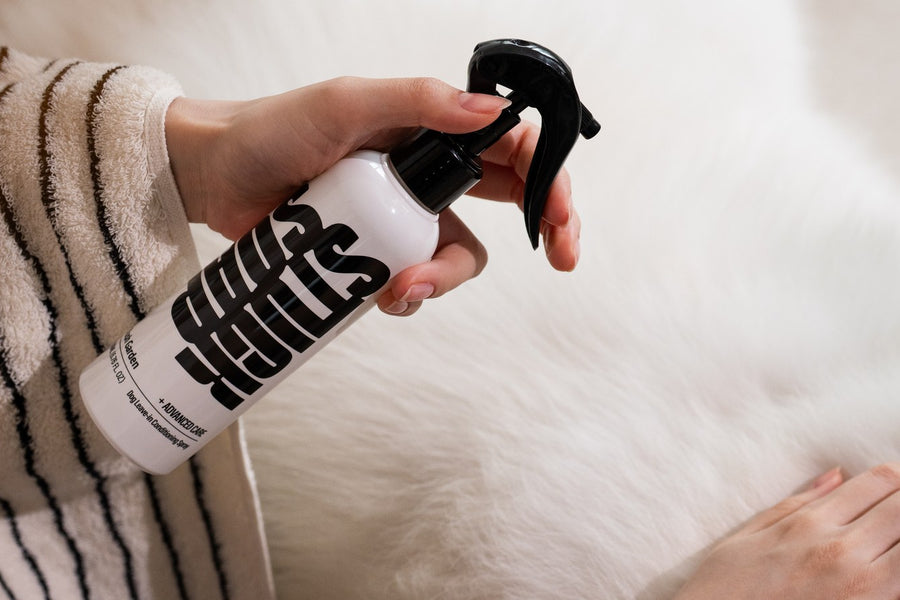
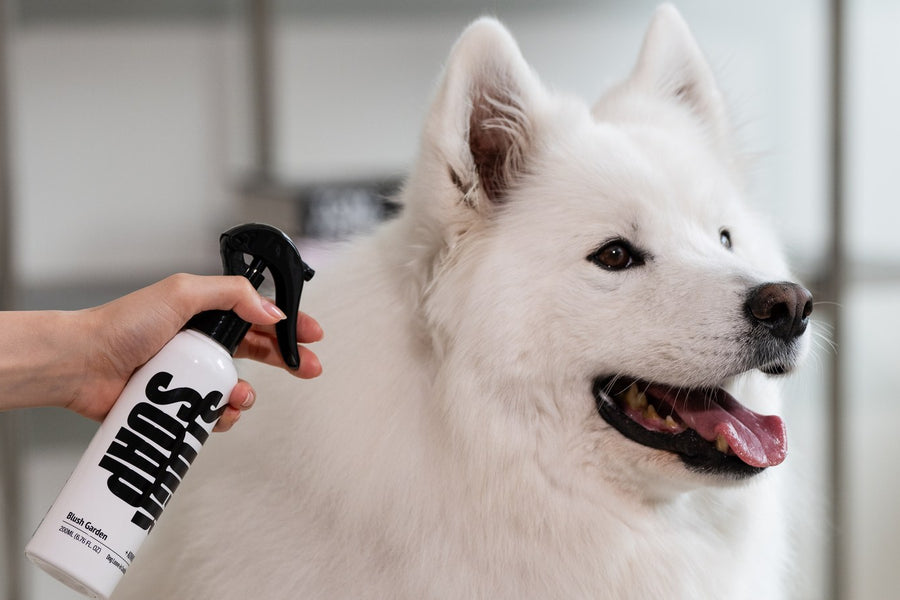
For contrast, our Leave-In Conditioning Spray ends its list with named fragrance components: Limonene, Citral and Linalool in Blush Garden, and Alpha-Isomethyl Ionone and Geraniol in Silent Grove. That is the EU-style allergen callout on a real label.
Practical takeaways for how to read dog shampoo ingredients at the store
- Trust the top, question the bottom. Positions one through five are a reliable ranking. Everything after the preservative probably is not.
- Match the front to the back. If the front label leans on an ingredient, find it on the list and note where it sits.
- Look for named allergens. If your dog has reacted before, the named components at the end are the most specific information you will get.
- Use the list, then patch test. A label tells you what is in the bottle, not how your individual dog's skin will respond. Our guide to patch testing a dog shampoo before bath day covers the next step.
- Send skin problems to the vet. Persistent itching, redness or flaking are veterinary questions, and no grooming shampoo is a treatment.
For choosing a shampoo once you can read the list, see how to choose the best dog shampoo.
Frequently asked questions
What is the first five rule for dog shampoo ingredients?
The first five rule says the first five ingredients on a list describe what a product essentially is, because ingredients above 1% appear in descending order of concentration. In a liquid dog shampoo, those five usually include water, the main cleanser, a humectant, a secondary cleanser and often fragrance or a texture ingredient.
Are dog shampoo ingredients always listed in order of concentration?
Only partly. When brands follow the US cosmetic labeling convention, ingredients above 1% go in descending order, but ingredients at 1% or less may appear in any order after them, and colorants can follow in any order. The label does not show where that 1% line falls, so lower positions are not a reliable ranking.
Why does fragrance appear as one word on a shampoo label?
Under the US labeling convention, a fragrance blend can be declared with the single word "Fragrance" or "Parfum," even though it contains many components. Some labels also name individual fragrance allergens such as Limonene or Linalool near the end, which follows the EU approach of calling out specific allergens above set thresholds.
Is a sulfonate the same as a sulfate in dog shampoo?
No. Sulfonates, such as Sodium C14-16 Olefin Sulfonate, and sulfates, such as Sodium Lauryl Sulfate, are different chemical families, although both are anionic surfactants that clean by lifting oil and dirt. The similar spelling is a naming coincidence, so read the full INCI name rather than judging an ingredient by its first syllable.
Why are botanical extracts listed near the bottom of a shampoo label?
Plant extracts and oils are usually used at low concentrations in a rinse-off cleanser, so they tend to fall in the middle or lower part of the list. Below the 1% line, order does not have to follow concentration, so position tells you roughly how much is present, not how important the ingredient is to the formula.
What do CI numbers mean on a dog shampoo ingredient list?
CI numbers are Color Index codes that identify specific colorants. A label might show CI 42090 alongside a common name such as Brilliant Blue FCF. Colorants are allowed to be listed last, after every other ingredient, regardless of their concentration, so seeing them at the end simply means the liquid has been tinted.
Can reading the ingredient list tell me if a shampoo is safe for my dog?
A list tells you what is in the bottle, not how your individual dog will react. Use it to spot ingredients you already know to avoid, then do a small patch test before the first full bath. If your dog has ongoing itching, redness or flaking, ask your veterinarian, since skin problems need a professional diagnosis.
Sources
- eCFR: 21 CFR 701.3, Designation of ingredients
- US FDA: Cosmetics Labeling Guide
- US FDA: Fragrances in Cosmetics
- Personal Care Products Council: INCI
- European Commission: Cosmetics sector overview
Read our labels, then decide. Every STUCK SOAP shampoo, bar and spray lists its full ingredients on the product page, so you can run the first five rule before you buy. Browse the lineup at stucksoap.com.