


To patch test dog shampoo, apply a small, diluted amount to a coin-sized spot on your dog's inner thigh, leave it on for the length of a normal wash, rinse it off, and watch that spot for 24 hours. If the skin stays the same color and texture as the area around it and your dog ignores the spot entirely, the product has passed a basic tolerance check and is reasonable to use in a full bath.
That is the whole procedure. The reason it deserves an article is that almost nobody does it, and the people who skip it end up posting photos of a red belly at 11 p.m., asking the internet what went wrong.
What a Patch Test Is, and What It Cannot Tell You
A patch test is a small-area tolerance check: you expose a limited patch of skin to a product under controlled conditions and observe whether that skin reacts before you commit the whole dog to it. It is a screening habit, not a diagnosis.
The distinction matters. A patch test tells you whether a specific product, at bath-strength dilution, irritates a specific dog's skin over the next day. It does not tell you why your dog is itchy, whether the itch is seasonal, whether there is a food component, or whether a yeast or bacterial issue is already underway. Those questions belong to a veterinarian with a scraping, a cytology slide, and a history. Skin allergies in dogs commonly trace back to fleas, food, or environmental allergens, and sorting between them takes clinical work, not a home test (American Kennel Club).
Contact reactions are their own category, and they are the category a patch test is actually built for. The Merck Veterinary Manual describes contact hypersensitivity as a reaction that "usually occurs as a result of contact with sensitizing chemicals incorporated in plastic food dishes, plastic collars, and drugs placed on the skin." Shampoo is a chemical placed on the skin. It belongs in the same conversation.
The K-Beauty Habit Worth Carrying Into Grooming
In Korean skincare, patch testing is not a precaution for the anxious. It is a step. Ask anyone who has built a routine around actives: new bottle arrives, a dab goes on the inner forearm, and the rest waits a day. Nobody treats this as an insult to the brand. It is simply how you introduce something to skin you care about.
Dog grooming has not inherited that habit, and the gap is strange, because dogs have thinner epidermis than we do and no way to say "that stings." A dog's only feedback mechanism is behavioral: licking, scratching, or a sudden interest in one patch of leg.
Carrying the habit over costs you one small step and one day of patience. That is the entire price.
Yes, this applies to STUCK SOAP
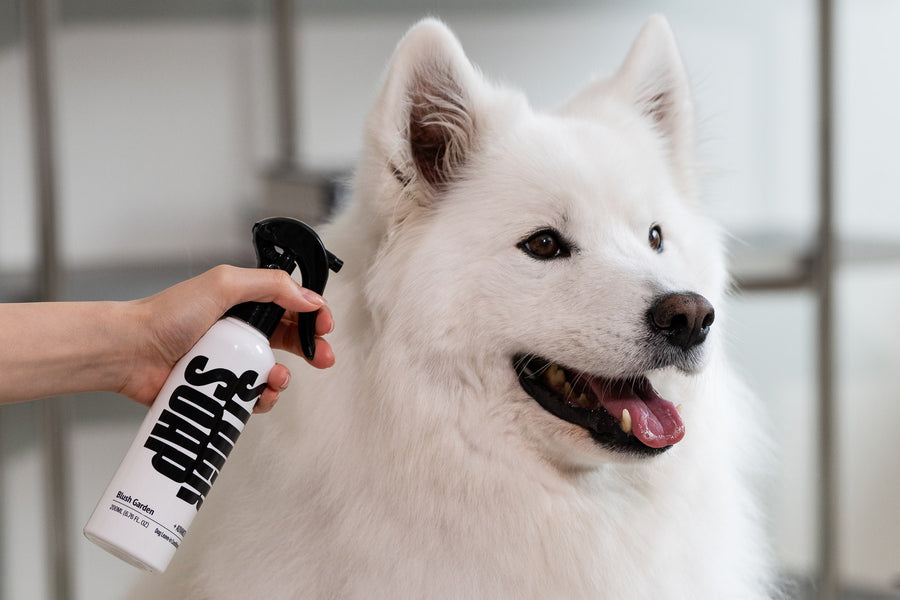
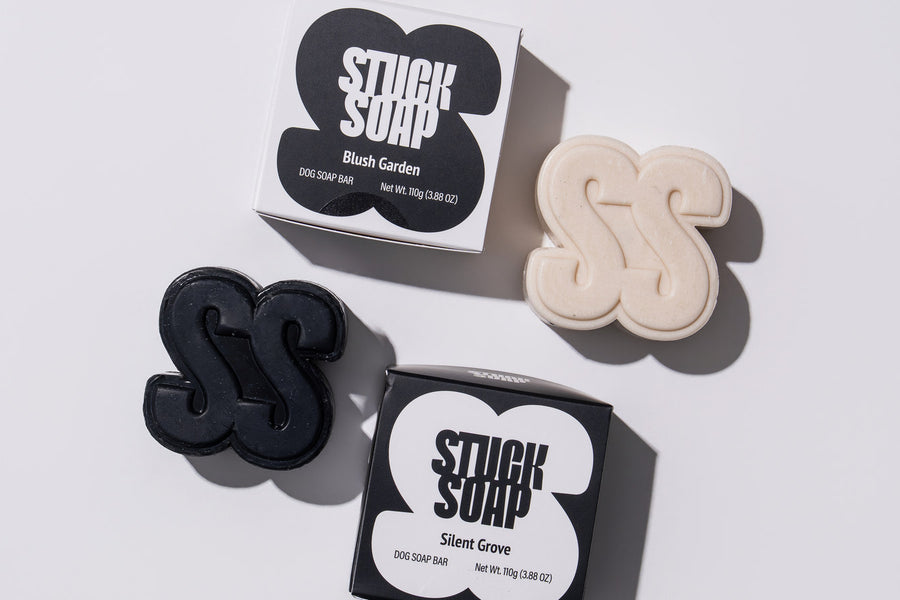
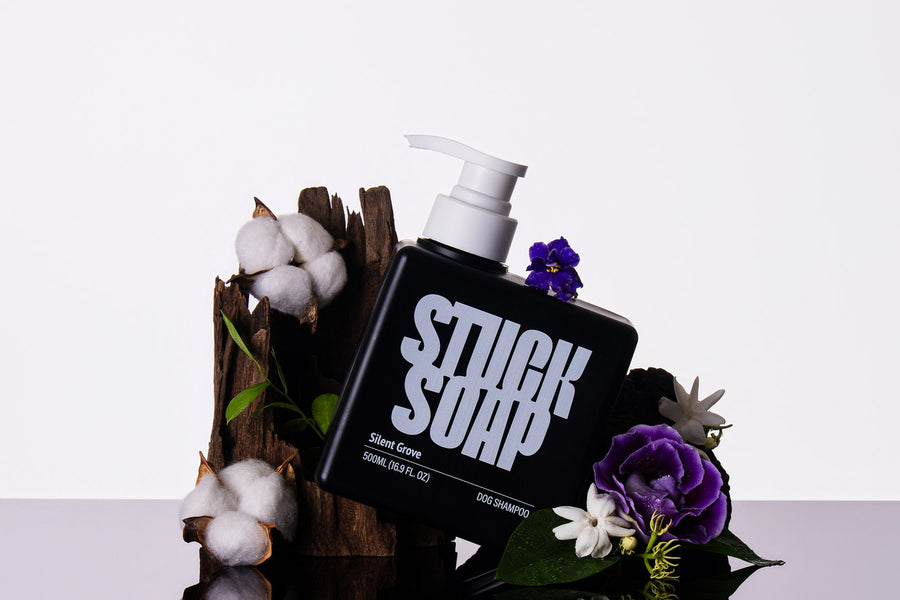
We would rather say this plainly. Patch test our shampoo before you use it on your dog. Every product on our shelf, the Liquid Shampoo and the Shampoo Bar, in Silent Grove or Blush Garden, gets the same treatment as anything else in your cabinet.
We formulate vegan, pH-balanced for dog skin, with Green Tea, Camellia Oil, and Centella Asiatica, and we are proud of the formula. None of that makes any product on earth universally tolerated. Individual dogs react to individual ingredients, including gentle ones, including botanicals. A brand that tells you its product needs no testing is telling you something about its marketing, not its chemistry.
How to Patch Test Dog Shampoo, Step by Step
Do this on a calm day, not the day you have already booked a groomer or planned a bath. Give yourself the full 24 hours.
- Pick the site. The inner thigh is the standard choice: thin skin, sparse coat, visible without shaving, and awkward for most dogs to reach with their mouth. The inner forearm is a workable second option on heavy-coated breeds.
- Read the label first. Confirm the product is formulated for dogs and check whether it is a cosmetic wash or a medicated one, since the two carry different instructions and different risks.
- Dilute to bath strength. Mix roughly one part shampoo to ten parts lukewarm water in a cup. Concentrated shampoo sitting undiluted on skin will irritate almost anything, and a false positive is as useless as a false negative. For a bar, work a light lather in your wet hands and use that.
- Wet the test area. Dampen a patch about the size of a quarter with lukewarm water.
- Apply a small amount. Massage the diluted product into that patch with a fingertip. You want a thin film, not a puddle.
- Leave it the same length of time you would in a real bath. For most washes that is three to five minutes. Testing for thirty seconds when you plan to leave it on for five minutes does not tell you anything useful.
- Rinse thoroughly. Run lukewarm water over the patch until the water runs clear and the skin no longer feels slick, then pat dry with a clean towel. Residue skews the result and can cause irritation on its own.
- Observe for 24 hours. Check at 1 hour, 4 hours, 12 hours, and 24 hours. Photograph the site at the start, because "is that redder than before?" is hard to answer from memory.
Keep the dog from licking the site during the observation window. A dog that grooms the patch for twenty minutes will produce redness that has nothing to do with your shampoo.
What to Watch For Across 24 Hours
Reactions do not all arrive at the same speed. Irritant responses tend to show early. Allergic contact responses are slower, which is exactly why the window runs a full day rather than an hour.
| Checkpoint | What to look at | Expected on a pass | Flag it if |
|---|---|---|---|
| During application | Behavior | Neutral, mild curiosity | Flinching, pulling the leg away, sudden yelp |
| 1 hour | Color and texture | Matches surrounding skin | Pink flush, warmth, raised texture |
| 4 hours | Color, swelling, licking | No change, dog ignores the site | Persistent redness, focused licking or chewing |
| 12 hours | Bumps, dryness, flaking | Skin looks and feels normal | Small bumps, scaling, tightness |
| 24 hours | Everything above | Fully unremarkable | Any lingering redness, bumps, or scratching |
If all five checkpoints come back clean, proceed to a normal bath. If you want the rest of that bath to go well, it helps to know how long to leave shampoo on a dog and how to confirm you have actually rinsed all of it out, since residue causes a meaningful share of post-bath irritation that gets blamed on the formula.
Stop Criteria: The Reactions That Mean Discontinue
This is the part most guides leave vague. Vague is not useful at 2 a.m. Here is the decision table.
| What you see | What it usually means | What to do |
|---|---|---|
| Faint pink that fades within an hour | Mechanical rubbing from application | Continue observing. Not a fail on its own. |
| Redness still present at 4 hours | Irritant response | Stop. Rinse again, discontinue the product. |
| Dog repeatedly licks or chews the site | Itching or stinging | Stop. Rinse, discontinue, prevent further licking. |
| Raised bumps, welts, or hives | Hypersensitivity response | Stop and call your vet the same day. |
| Swelling of the site, muzzle, or eyelids | Systemic allergic reaction | Emergency. Vet or ER now. |
| Vomiting, drooling, weakness, labored breathing | Systemic reaction | Emergency. Vet or ER now, bring the bottle. |
| Oozing, crusting, or open skin | Broken barrier, possible infection | Stop. Veterinary exam required. |
The rule underneath the table: anything that is still visible or still bothering the dog at the 4-hour mark ends the trial. You do not owe a product a second chance on the same skin. If hives show up after a bath and you are trying to work out whether the wash or the season caused them, we walked through that reasoning in hives after a bath.
When to Skip the Patch Test Dog Shampoo Step and Call the Vet
A patch test assumes you are starting from healthy skin. When you are not, testing wastes a day and can make things worse. Go to a veterinarian first, before any new product, if any of these are true:
- Open sores, scabs, oozing, or bleeding anywhere on the coat
- Hot spots, hair loss in patches, or a visible rash already in progress
- A yeasty or unusually strong odor from the skin or ears
- Itching intense enough to disrupt sleep or cause self-injury
- Known drug or ingredient allergies, or a prior reaction to any topical product
- Puppies under 8 weeks, dogs recovering from surgery, or dogs on prescription topicals
- Your vet has already prescribed a therapeutic wash for a diagnosed condition
That last point deserves emphasis. If a veterinarian has prescribed a medicated shampoo, follow their protocol, not a blog. The difference between a therapeutic wash and a cosmetic one is not marketing, and we covered the split in medicated versus regular dog shampoo. General dermatitis in dogs has many drivers, including external irritants, allergens, trauma, and infection (Merck Veterinary Manual), and a home tolerance check cannot distinguish between them.
Practical Takeaways
Mistakes that produce a useless result
- Testing undiluted product. You are testing a concentration your dog will never actually meet.
- Testing on the back. Thick coat hides exactly the signal you are looking for.
- Rinsing badly. Leftover surfactant keeps working after you stop watching.
- Calling it at one hour. The slow reactions are the ones that matter most.
- Testing three new products at once. If something reacts, you have learned nothing about which one.
Retest whenever the variable changes: a reformulation, a new scent, a long gap since the last bath, or a dog whose skin has shifted with age or season. Coat type is a poor predictor here, which is why we argue that owners should think in terms of skin types rather than coat types. Label language is a poor predictor too, since terms like hypoallergenic carry less weight than most shoppers assume, a point worth understanding before you trust a front panel (hypoallergenic versus fragrance-free).
When you are ready to bring something new into the rotation, our Liquid Shampoo and Shampoo Bar are non-medicated cosmetic grooming products built around Green Tea, Camellia Oil, and Centella Asiatica, pH-balanced for dog skin and formulated for a fine-bubble lather that rinses clean. One pump is enough. And yes: patch test them first, exactly as described above. We would rather you spend a day checking than a week regretting.
Frequently Asked Questions
How long should a patch test on a dog last?
Twenty-four hours is the practical standard. Most irritant reactions appear within one to four hours, but delayed contact hypersensitivity can take a full day to surface. Check the spot at four hours, at twelve, and again at twenty-four before you commit to a full bath with the new product.
Where is the best place to patch test on a dog?
The inner thigh. The skin there is thin, lightly furred, and easy to see without shaving, which makes redness obvious. It is also awkward for most dogs to reach with their mouth, so the test area stays undisturbed. The inner forearm works as a second choice for deep-coated breeds.
Does a passed patch test mean my dog is not allergic to the shampoo?
No. A patch test checks short-term tolerance on one small area. It cannot rule out a reaction that builds over repeated exposures, and it cannot detect a food or environmental allergy that happens to flare on bath day. Treat a clear result as a green light, not a guarantee.
Should I patch test a shampoo my dog has used before?
Not every bath, but yes after any change. Reformulations, new scent versions, a different production batch, or a gap of several months since the last wash all justify a quick retest. Sensitization can develop against a product a dog previously tolerated, so a familiar label is not automatic clearance.
What if my dog reacts during the patch test?
Rinse the area immediately with lukewarm water for at least a minute, pat dry, and stop using the product. Photograph the spot and note the time. Mild redness that fades within a few hours needs monitoring only. Swelling, hives, or any breathing change is an emergency veterinary call.
Do I need to patch test a shampoo bar the same way?
Yes, and the method barely changes. Work the bar into a small amount of lather in your hands rather than rubbing it directly on the test area, then apply that lather to the inner thigh. Bars concentrate the same surfactants and botanicals a bottle does, so the same rules apply.
Sources and References
- American Kennel Club, Dog Skin Allergies: What to Know
- Merck Veterinary Manual, Hypersensitivity Diseases in Animals
- Merck Veterinary Manual, Dermatitis and Dermatologic Problems in Dogs
Ready to introduce something new, carefully? Browse the Liquid Shampoo and Shampoo Bar in Silent Grove and Blush Garden at stucksoap.com, then give the inner thigh one small test before bath day. This article is general grooming guidance and is not veterinary advice. For any active skin condition, talk to your veterinarian.