


Self Serve Dog Wash Tips: The Playbook for a Groomer-Level Result
The self serve dog wash tips that actually change your result come down to two things: bring your own shampoo instead of using the wall dispenser, and spend most of your paid session on drying rather than washing. The bay itself is worth every dollar for the raised tub, the warm water on tap, and the high-velocity dryer. The generic product on the wall is the one part of the setup you should replace.
Anyone who has stood in a wet bay at 4 p.m. on a Saturday knows the pattern. You pay, you fill the tub, you pump a few handfuls of whatever is loaded in the dispenser, you scrub for ten minutes, you rinse, and then you spend twenty-five minutes chasing water around a dog with a dryer you have never used before. You go home with a damp dog and a soaked shirt. The bay did not fail you. The plan did.
What a Self-Serve Dog Wash Bay Actually Gives You
A self-serve dog wash is a pay-per-session bathing station, usually found inside a pet supply store, a standalone self-wash shop, or the front room of a grooming salon. You get a raised tub with a ramp or a lift door, a temperature-controlled sprayer, towels, aprons, a high-velocity dryer, and a floor drain that is not your bathroom floor.
That last item is the real product. The reason a bay is worth booking is that it moves the mess out of your house and it moves your dog up to waist height, which saves your back and gives you real control over the coat. If you have ever tried to work on a seventy-pound dog in a standard tub, the difference is not subtle. We wrote a whole piece on that problem in how to wash a big dog without a bathtub, and a self-serve bay solves most of it for the price of a sandwich.
What the bay does not give you is a product chosen for your dog. It gives you a product chosen for every dog.
Self Serve Dog Wash Tips Start With Your Own Shampoo
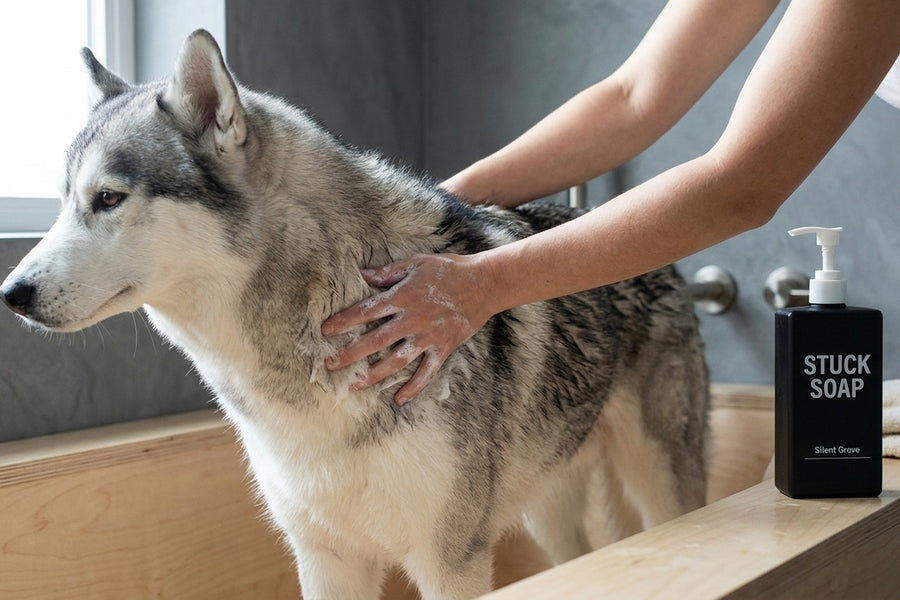
House shampoo at a self-serve bay is a bulk, general-purpose formula fed through a dilution system so it can serve a Chihuahua and a Newfoundland from the same line. That is a sensible business decision and a poor grooming decision. Dilution is set for volume and cost, not for the density of the coat standing in front of it. On a thick double coat, heavily diluted product tends to sit on the guard hairs and never reach skin, which is why owners scrub hard, rinse fast, and still smell dog three days later.
A concentrated shampoo you brought yourself behaves differently. You control the dose, the lather, and the formula. One pump of a high-concentrate product with a fine-bubble lather will carry through a coat that a bucket of thin suds slides right off. If you are not sure why your lather keeps disappearing, getting shampoo through a double coat covers the mechanics.
Match the Formula to the Coat, Not to the Room
Coat type should drive your choice. Oily, dense coats need sebum control and a formula that rinses clean. Fine or short coats need something gentle enough not to strip. Dogs that get bathed often need a pH-balanced product built for dog skin, which sits in a different range than human skin. The American Kennel Club's grooming guidance is a good starting reference on coat-specific care, and our dog shampoo ingredient guide walks through what to read on a label.
When the Bay Is the Wrong Place
A wash bay is cosmetic grooming. It is not a treatment room. Persistent scratching, hot spots, open or weeping sores, bald patches, or a sudden change in odor are reasons to call your veterinarian before you book anything. The Merck Veterinary Manual's section on canine skin disorders is a reasonable place to understand what you may be looking at, but understanding is not diagnosis. Get the skin evaluated, then bathe on whatever schedule and with whatever product your vet recommends.
Pack the Bay Bag Before You Leave the House
Most wasted sessions are lost in the first four minutes, when someone realizes the leash is soaked, the treats are in the car, and the brush is at home. Pack once, keep the bag in the trunk, and restock it after every visit.
- Your shampoo. A bar or a small decanted bottle. Nothing full-size, nothing glass.
- A slicker brush or undercoat rake. Brush the dog dry, in the parking lot or at home, before a single drop of water touches the coat. Water turns a loose tangle into a locked mat.
- One extra towel. The house towels are thin and there are never enough.
- High-value treats. Small, soft, and already broken up. You will need both hands later.
- A non-slip mat if your dog is nervous on wet steel, plus cotton balls if your vet has shown you how to protect the ears.
- A change of shirt for you. This is not optional advice. Ask anyone who has used a force dryer.
Running the Session: A Realistic Timeline
Sessions at most bays are either untimed with a flat fee or metered in blocks. Either way, treating the visit as a sequence rather than a scramble is what separates a clean dog from a damp one. Here is how a session tends to divide for a medium dog with a normal coat.
| Stage | Time | What you are doing | Common mistake |
|---|---|---|---|
| Setup and settle | 3 to 5 min | Dog in the tub, leash clipped, treats out, water temperature set | Starting the sprayer before the dog has stopped bracing |
| Pre-soak | 4 to 6 min | Saturating to skin, working against the lay of the coat | Wetting only the top layer |
| Lather | 5 to 8 min | Working your own shampoo down the legs, chest, belly, and tail base | Using far too much product, then fighting the rinse |
| Rinse | 6 to 10 min | Rinsing until the water runs clear and the coat squeaks slightly | Stopping at the first sign of clear water |
| Towel | 3 min | Pressing, not rubbing, to pull the bulk of the water | Rubbing, which creates tangles |
| Force dry | 15 to 30 min | Systematic drying, section by section | Random waving, then quitting at damp |
The rinse deserves more respect than it usually gets. Residue left in a coat attracts dirt and can leave skin feeling tight and itchy, which is exactly the outcome you paid to avoid. Our guide on how to tell when your dog is fully rinsed gives you a check you can run in about ten seconds.
The Force Dryer Is What You Came For
A high-velocity dryer, sometimes called a force dryer, pushes a large volume of room-temperature or slightly warm air at high speed. It does not bake water out of a coat the way a human hair dryer does. It physically blows water off the hair shaft and pushes it out of the undercoat. That distinction matters, because it tells you how to aim.
Distance, Angle, Direction
You are herding water, not evaporating it. Start at the top of the dog and push water downward and outward toward the extremities. Keep the nozzle moving. Hold it close enough that you can see the coat parting to the skin, and angle it so the air travels along the body rather than straight into it.
| Coat | Nozzle distance | Air setting | Direction of travel |
|---|---|---|---|
| Short, single coat | 6 to 10 in | Low to medium | With the lay of the coat, neck to tail |
| Double coat | 2 to 4 in | Medium to high | Against the lay, in small sections, until the skin shows |
| Curly or wavy | 4 to 8 in | Medium | Root to tip, one section at a time, brushing as you go |
| Face and ears | Do not aim here | Off or lowest | Towel only, or a cupped hand as a shield |
Two habits waste more session time than anything else. The first is waving the nozzle across the whole dog like a spray can, which moves water in circles. The second is quitting at "mostly dry," which leaves the undercoat wet and produces that damp-basement smell by evening. Finish one section completely, then move on. There is more detail in our complete guide to drying a dog after a bath.
If Your Dog Hates the Noise
Turn the dryer on and set it down before you point it anywhere. Let the motor run for thirty seconds while your dog eats treats. Then start at the chest or shoulder, never the head, in bursts of a few seconds with a pause between. Dogs that panic at the dryer usually panicked at the first blast to the face, and they remember it. The same patience that works for bathing a dog that hates water applies here.
What It Costs: Self-Serve, Groomer, or Home
Prices vary by region and by dog size, so treat these as typical US ranges rather than quotes. The useful comparison is not just the per-bath number. It is what you are buying with it.
| Option | Typical cost per bath | Your time | Upfront cost | Best for |
|---|---|---|---|---|
| Self-serve wash bay | $12 to $25, plus your own shampoo | 40 to 75 min including travel | None | Maintenance baths, large dogs, thick coats, muddy weeks |
| Full-service groomer | $60 to $150 and up, size and haircut dependent | Drop off and pick up | None | Haircuts, nails, ears, dogs that need professional handling |
| Bathing at home | Roughly $1 to $4 in product | 45 to 90 min including cleanup | $40 to $250 for a dryer, tub gear, brushes | Small dogs, frequent light baths, dogs that hate car rides |
Run the math over a year and the picture gets clearer. A dog bathed twice a month costs roughly $290 to $600 a year in self-serve sessions, versus roughly $1,400 to $3,600 at a full-service groomer for the same frequency. Home bathing is cheapest on paper and most expensive in bathroom cleanup, drain clogs, and the dryer you eventually buy anyway. Plenty of owners land on a mix: self-serve for routine washes, a groomer every few months for the trim. If home is your default, bathing a dog without making a mess is worth reading first.
More Self Serve Dog Wash Tips for the Regulars
Once you have done four or five sessions, the small things start to matter. Go at off-peak hours, because a quiet room is a calmer dog and nobody is waiting on your dryer. Brush before you drive, not after you park. Bring your own product decanted small, because a full 500ml bottle is heavy, it tips, and it does not fit anywhere useful in a wet bay.
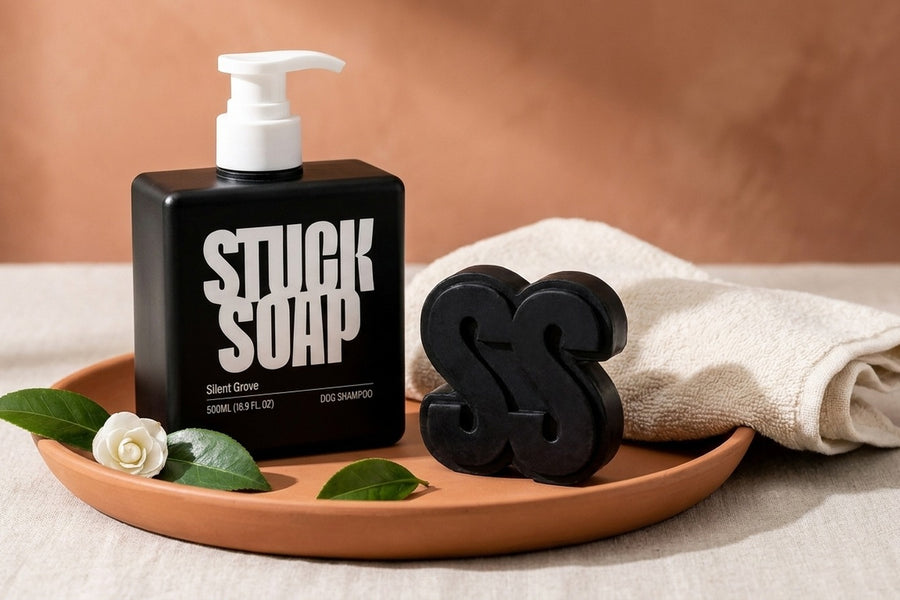
This is where the shampoo bar quietly wins. A bar does not leak into your bag on the drive over. It does not roll off the ledge and empty itself down the drain while you are holding a wet dog with both hands. It does not turn into a half-full bottle you forget in the trunk for a month. You wet it, you glide it along the back and legs, and it lathers directly against the coat, which is exactly what a dense coat needs. When the session ends, it goes back in the tin damp and is fine. If you are weighing the two formats, we compared them directly in shampoo bar versus liquid dog shampoo and in why owners are switching to solid bars.
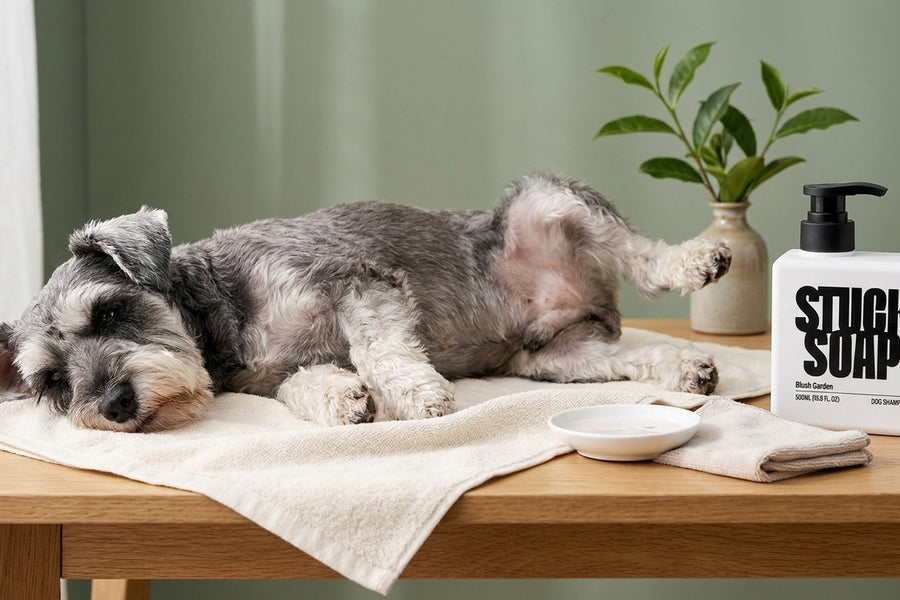
That is the whole argument for keeping a bar in the bay bag. It is the format that survives a car, a wet ledge, and a gym bag. STUCK SOAP makes both a liquid and a zero-waste bar in Silent Grove and Blush Garden, formulated with green tea, camellia oil, and centella asiatica, pH-balanced for dog skin and vegan. The bar is the one that lives in the trunk.
Frequently Asked Questions
Can I bring my own shampoo to a self-serve dog wash?
Yes. Nearly every self-serve wash allows it, and most staff will not blink. The wall dispenser is a diluted, general-purpose product meant to work on every coat that walks in. Your own bottle or bar lets you match the formula to your dog's coat type and skin needs.
How long does a self-serve dog wash session take?
Plan on 35 to 50 minutes for a medium dog with a normal coat, and up to 75 minutes for a heavy double coat. Roughly a third of that is washing and rinsing. The rest is drying, which is the slow part and the reason the bay is worth paying for.
Is a self-serve dog wash cheaper than a groomer?
Per wash, yes. Self-serve sessions typically run a fraction of a full-service groom because you supply the labor. A groomer still wins when your dog needs a haircut, nail work, or handling you cannot safely do yourself. Many owners alternate: self-serve for maintenance baths, a groomer for full trims.
How do you use a high-velocity dryer without scaring your dog?
Start on the lowest setting with the nozzle aimed at the chest or shoulder, never the face. Keep about eight inches of distance and let your dog hear the motor before the air arrives. Work in short bursts, praise between them, and stop before your dog stops coping.
Is a shampoo bar better than liquid for a self-serve wash?
For travel, the bar has real advantages. It cannot spill in a car, leak into a bag, or roll around a wet bay half empty. A bar also lathers directly against the coat, which helps on thick fur. Liquid is faster for very large dogs and frequent home baths.
Should I use a self-serve wash if my dog has itchy skin?
Not as a fix. Persistent itching, hot spots, open sores, hair loss, or a sudden change in smell are reasons to call your veterinarian, not to book a wash bay. A grooming bath is cosmetic care. Get the skin looked at first, then follow whatever bathing routine your vet recommends.
Sources
- American Kennel Club, Expert Advice: Grooming
- Merck Veterinary Manual, Skin Disorders of Dogs
- American Veterinary Medical Association, Pet Owner Resources
Build the bag once and the bay stops being a scramble. If you want a shampoo that travels without leaking and lathers hard enough to reach skin through a thick coat, look at the bar and the liquid at stucksoap.com.