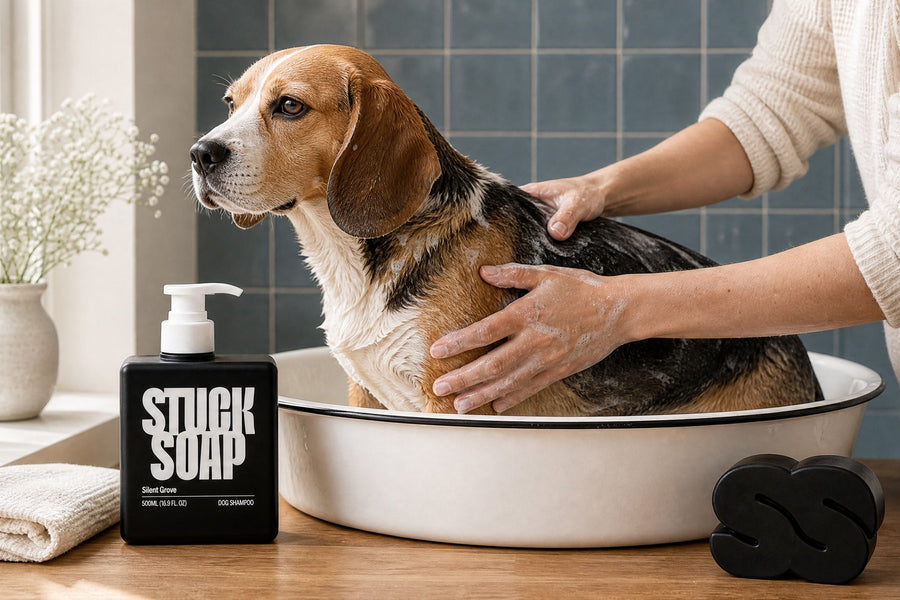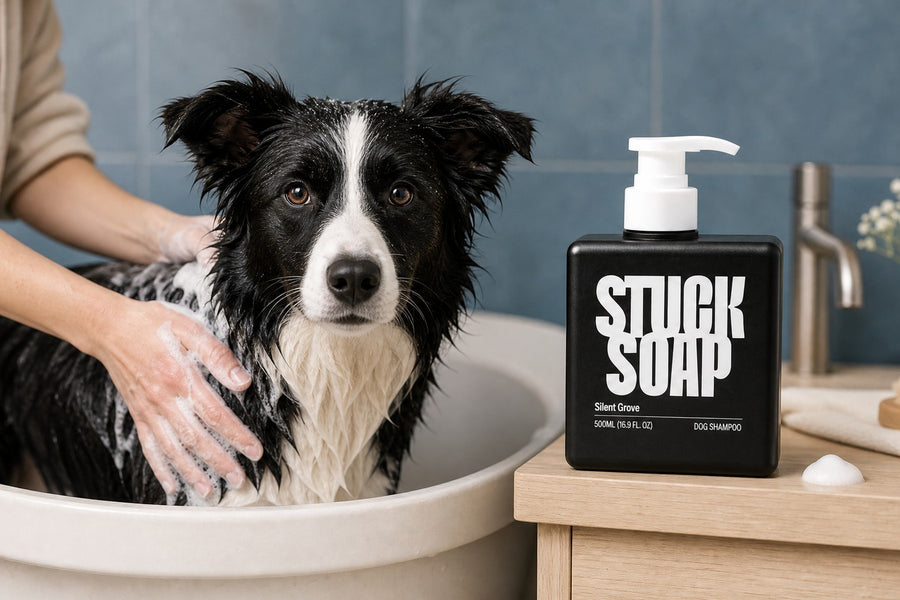



To wash a big dog without a bathtub, use your walk-in shower stall: put a rubber-backed non-slip mat on the floor, stick a lick mat to the wall at the dog's nose height, and run a handheld shower head on a long hose. Work sitting on a low stool instead of bent over the dog, and rinse in sections from the neck back.
Most people searching how to wash a big dog without a bathtub get sent to training articles about dogs who panic at water. That is a different problem. This one is about square footage, drainage, footing, and the fact that a wet 75-pound retriever is a load-bearing situation for your lumbar spine. Solve the room and the equipment, and the dog usually stops being the hard part.
Pick the Space Before You Pick the Shampoo
The setup decides everything downstream: how long the bath takes, how sore you are afterward, how much water ends up on your bath mat. Choose it deliberately.
Where to wash a big dog when there is no bathtub
A walk-in shower is the default answer in most apartments and newer builds. A curbless shower is one where the floor runs level from the bathroom into the stall with no lip to step over, and it is the single best home setup for a large dog: the dog walks in, nothing gets lifted, and the drain handles hair better than a tub drain does. A shower with a low curb (two to four inches) works almost as well. A tub-shower combo with a 16-inch wall is where the trouble starts, because now you are lifting a wet animal over a barrier at the exact moment your back is already loaded.
Outdoors, a hose is free and contains the mess completely, but you give up temperature control. Cold water makes people rush the rinse, and an incomplete rinse is the most common cause of a dull, itchy coat a week later. A deep utility sink in a laundry room is excellent at waist height, but realistically caps out around 25 pounds.
| Setup | Typical cost | Water temp control | Back strain | Practical size ceiling | Mess containment |
|---|---|---|---|---|---|
| Walk-in / curbless shower | Already in the home | Full | Moderate, low if you sit | No real ceiling | Excellent |
| Tub-shower combo (high wall) | Already in the home | Full | High, lifting over the wall | About 40 lb | Excellent |
| Deep utility / laundry sink | Already in the home | Full | Low, waist height | About 25 lb | Good |
| Outdoor hose | Free | Poor to none | Moderate | No ceiling | Total (it's outside) |
| Self-serve wash bay | Roughly $12 to $25 per wash | Full | Lowest, raised tub with ramp | No ceiling | Excellent, and not your cleanup |
| Professional groomer | Roughly $60 to $120+ | Not applicable | None | No ceiling | Not applicable |
Footing First
Non-slip footing means a surface with enough grip that a wet dog can stand, shift weight, and shake without their paws sliding out from under them. This is the part people skip, and it is the part that causes 80 percent of shower-stall chaos. A dog whose feet slip once will spend the rest of the bath bracing, leaning on you, and trying to leave.
What actually grips wet tile
A rubber-backed bath mat is the cheap version and it works. A rubber horse stall mat cut down to your shower footprint is the durable version: heavy enough to stay put, thick enough that the dog feels stable, and it rinses clean. What does not work is a folded terry towel, which turns into a slip-and-slide the second it is soaked.
Trim the fur between the paw pads before bath day, too. Long pad hair on a wet tile floor behaves like a sock on hardwood. Two minutes with blunt-tip scissors buys you a calmer dog.
Older dogs and joint comfort
If your dog is a senior or has a history of joint issues, footing matters more, not less. Cornell's Riney Canine Health Center lists home changes for dogs with osteoarthritis including the "use of non-slip rugs and ramps to get on beds, couches or cars." The same logic applies to a wet stall floor. Anything that looks like actual pain, limping, or reluctance to bear weight is a conversation for your veterinarian, not something to work around with a better mat.
Gear for Washing a Big Dog Without a Bathtub
Short list. Everything here earns its place in a cramped stall.
- Handheld shower head on a 5- to 6-foot hose. The single highest-value upgrade. A fixed overhead head means you move the dog to the water; a handheld means you move the water to the dog, which is the difference between rinsing a chest and flooding a face.
- Rubber-backed mat or cut stall mat. Covered above.
- Lick mat. A lick mat is a flat silicone pad with a textured surface; you spread something soft on it (plain pumpkin puree, unsweetened yogurt, a thin layer of dog-safe peanut butter) and the suction cups hold it to the tile. Mount it at the dog's nose height on the wall they will face. It gives the dog a job and a direction to point.
- Squeeze bottle. Pre-mix diluted shampoo so you can lay down a line along the spine in one pass.
- Rubber curry brush or grooming mitt. Works lather down to the skin on a thick coat far faster than fingertips.
- Two towels inside the stall, two outside. Non-negotiable with a big dog.
- A low stool or a folded towel to kneel on. This is back equipment, not dog equipment.
How to Wash a Big Dog Without a Bathtub: The Back-Saving Order of Operations
Sequence is where the strain lives. Every time you stand up, bend down, and reach across a wet dog, you pay for it. Batch the work so you only change posture a few times.
- Brush the dry coat first, outside the bathroom. Five minutes here removes loose undercoat that would otherwise turn into a shampoo-resistant mat and clog your drain.
- Stage everything inside the stall before the dog comes in. Shampoo, squeeze bottle, curry, two towels on a hook. Nothing should require you to stand up mid-bath.
- Mat down, lick mat loaded and stuck to the wall. Set the temperature before the dog arrives. The American Kennel Club's guidance on home baths is simply warm, not hot; test it on your inner wrist.
- Walk the dog in and close the door. Let them find the lick mat on their own.
- Sit down. Low stool, or kneel on a folded towel. Position the dog with their body between your knees and the far wall so they are gently boxed in and you are never reaching across.
- Wet from the neck back, then the legs, then the head last. Keep the sprayer head close to the coat, almost touching. Held close, water pushes through the coat instead of bouncing off it, and it is quieter.
- Lather in one pass. Line of diluted shampoo down the spine, work it out and down with the curry, then the chest, legs, and belly.
- Rinse in sections, top to bottom, and rinse longer than feels necessary.
- Towel the dog inside the closed stall. Get the first shake to happen behind glass. This is the whole trick.
- Open the door and walk out together. No lifting, at any point.
If containment is your main worry, the sequencing tricks in our guide on bathing a dog without making a mess stack neatly on top of this.
Lathering and Rinsing When the Stall Is the Size of a Phone Booth
A standard shower stall is roughly 32 by 32 inches or 36 by 36 inches. A shepherd standing in it leaves you about eight inches of floor for your own feet. Two things follow from that.
Use less product than you think
Volume of shampoo is the hidden tax on a small space. Every extra pump is another 30 to 60 seconds of rinsing, in a stall where you are already crouched and the dog is already done with the whole idea. This is the practical case for a high-concentrate formula: one pump of a concentrated shampoo lathers a large dog's back through to the skin, so you spend your time rinsing rather than chasing suds. Our STUCK SOAP liquid shampoo and shampoo bar are both built that way, with a fine-bubble lather that rinses out fast, which matters far more in a 36-inch stall than it does in a groomer's raised tub. If you want the numbers by weight and coat type, the dog shampoo dosage chart lays it out. The bar is worth a look for cramped showers specifically, since there is no bottle to knock over; the shampoo bar walkthrough covers technique.
Rinse checkpoints for a thick coat
Rinsing is where big-dog baths actually go wrong. Four places hold product: the ruff behind the ears, the chest between the front legs, the belly-to-groin fold, and the base of the tail. Hit each one deliberately with the sprayer held against the skin. Squeeze a handful of coat as you go; if it still feels slick or squeaks under pressure, keep going. Our piece on checking for shampoo residue covers the tests that actually detect it.
Drying and Getting a Wet Dog Out of the Stall
The first shake is going to happen. Your only decision is where. Keep the door closed, throw a towel over the dog's back and stand still for ten seconds; most dogs shake once the weight of the towel settles. That single shake sheds a large share of the surface water while it is still contained by glass.
Then towel in order: head and ears, chest, back, legs, tail. Use one towel to absorb and a second, dry towel for the final pass. If you use a forced-air dog dryer, do it outside the stall on the non-slip mat you moved out with you, on a warm and gentle setting, held well back from the skin. Human hair dryers run hotter than a dog's skin should take.
Give the dog somewhere boring to be for the next twenty minutes. A damp dog on carpet will roll. A damp dog on a tile floor with a chew usually just lies down.
Cleaning Up in Ten Minutes
Pull the hair off the drain screen while it is still wet and clumped, because dry dog hair welds itself to a drain cover. Hang the rubber mat over the shower rod to drip. Run the sprayer around the walls to knock down loose hair before it dries onto the tile. Wipe the glass. Wash the towels on hot, separately, and skip fabric softener since it coats fibers and kills absorbency for the next bath.
If your tap runs hard, mineral scale is doing quiet damage to both your tile and your dog's coat. Our notes on hard water and coat quality explain what to look for.
One Note on Fear
If your dog is not just large but genuinely frightened of water, no amount of equipment fixes that, and forcing a scared dog through a bath in a confined stall makes the next one worse. That is a separate project with a separate approach; start with our guide on bathing a dog that hates water.
Practical Takeaways
- The walk-in shower is the answer for most large dogs. Curbless is best, low-curb is fine, high-wall tub is the one to avoid.
- Rubber footing goes down before anything else happens.
- A handheld sprayer on a long hose is the highest-return purchase in this whole article.
- Sit down. Every posture change costs your back more than the bath itself.
- Stage all supplies inside the stall before the dog enters.
- Less shampoo means less rinsing means less time crouched in a small wet box.
- Towel the dog behind closed glass so the first shake stays in the stall.
- Frequency: the Merck Veterinary Manual describes a roughly monthly bath as typical for many dogs, adjusted for season and how dirty the coat gets. Coat type shifts that, and so does what your dog rolls in.
Frequently Asked Questions
How do you wash a big dog without a bathtub?
Use a walk-in shower stall with a rubber-backed non-slip mat down, a handheld shower head on a long hose, and a lick mat stuck to the wall at nose height. Wash from the neck back, rinse in sections, and towel the dog inside the stall before opening the door.
What can I use instead of a bathtub to bathe my dog?
A curbless or low-threshold walk-in shower is the closest substitute. Other options: a deep laundry or utility sink for dogs under about 25 pounds, an outdoor hose in warm weather, or a self-serve wash bay at a pet store, which gives you a raised tub and a warm-water sprayer.
How do I keep my dog from slipping in the shower?
Put a rubber-backed bath mat or a cut rubber stall mat on the shower floor before the dog steps in. Rubber grips wet tile far better than terry towels, which slide. Trim the fur between the paw pads too, since long pad hair acts like a sock on slick surfaces.
How do I bathe a big dog without hurting my back?
Sit or kneel on a folded towel or a low stool instead of bending at the waist, and keep the dog's body between your knees and the wall so you are never reaching across. Pre-mix diluted shampoo in a squeeze bottle so you lather in one pass rather than three.
How much shampoo does a large dog need?
Less than most people use. A concentrated dog shampoo typically needs one to two pumps for a 60 to 80 pound dog, worked into wet fur with your hands or a rubber curry. Overdosing mainly makes rinsing take longer, which is the part that hurts in a small stall.
Can I bathe my dog with the outdoor hose instead?
In warm weather, yes, if the water runs comfortably warm and your dog is healthy. Cold hose water is unpleasant and tends to make people rush the rinse. Below roughly 65 degrees Fahrenheit outside, move the bath indoors where you control temperature and can dry the coat properly.
How long does bathing a large dog in a shower take?
Plan on 25 to 40 minutes door to door for a 70 pound dog: five minutes of setup, five to eight minutes of wetting and lathering, eight to twelve minutes of rinsing, and ten minutes of toweling and cleanup. Rinsing takes the longest on thick double coats.
Sources
- American Kennel Club, It's Bath Time! Towels, Brushes, Dog Shampoo, and More
- Merck Veterinary Manual, Routine Health Care of Dogs
- Cornell University College of Veterinary Medicine, Riney Canine Health Center, Osteoarthritis
Small Space, Fewer Suds
STUCK SOAP makes a K-Beauty style dog shampoo built around green tea, camellia oil, and centella asiatica: vegan, pH-balanced for dog skin, and concentrated enough that one pump covers a large dog's back. In a 36-inch shower stall, that translates directly into less rinsing and a shorter bath. Available as a 500ml liquid or a zero-waste bar, in Silent Grove (earthy) or Blush Garden (floral), at stucksoap.com.