


How to Get Shampoo Through a Double Coat: A Skin-First Method
To get shampoo through a double coat, soak the coat for roughly three to eight minutes until it lies flat and the skin is visibly wet at the part, then apply a thin, diluted lather in sections and finger-walk it to the root against the direction of hair growth. Nearly everyone asking how to get shampoo through a double coat is actually stuck one step earlier, at the water.
Here is the scene. You run the sprayer over your dog's back for thirty seconds, the water beads up and rolls off like it hit a raincoat, and you go ahead and pump shampoo on anyway. You scrub. You get a satisfying head of foam. You rinse, you towel, you tell yourself the job is done. Two days later the dog smells like a dog again, and the undercoat near the skin was never touched by anything.
Every guide on the internet handles this by sorting dogs into breeds, then giving each breed a paragraph. That structure hides the actual problem. The problem is not that your dog is a specific breed. The problem is that cleansing has to reach a surface buried under two distinct layers of hair, and hair is very good at keeping water out. So this article does one thing only: it rebuilds the bath from the skin outward.
Why It Is Hard to Get Shampoo Through a Double Coat
A double coat is a two-layer coat: a dense, soft, insulating undercoat close to the skin, topped by a longer, coarser layer of guard hairs that sheds water and debris. The two layers do different jobs, and both of them work against you at bath time.
Guard hairs repel from the outside
A guard hair is the long, stiff outer hair that forms the visible surface of the coat and carries most of its water resistance. Guard hairs are coated in sebum and lie in an overlapping direction, so water hitting them behaves the way rain hits a shingled roof. It moves sideways and down instead of in. The American Kennel Club's overview of double-coated breeds is a useful primer on why that outer layer exists in the first place: it is protective equipment, not decoration.
The undercoat traps air on the inside
Even after you defeat the guard hairs, the undercoat is waiting. Dense undercoat holds a cushion of trapped air against the skin, and air is a barrier. Water cannot occupy a space that air already occupies, which is why a dog can be soaking wet on the outside and bone dry at the root. The skin itself, described in the Merck Veterinary Manual, sits under all of that with its own protective film. Sebum, dust, dander, and outdoor grime accumulate right there, at the base, which is precisely the zone your shampoo never sees on a rushed bath.
This is also why sorting dogs by coat length misleads people. Two dogs with the same visible coat length can have completely different densities at the root, and density is what sets your timing. We have argued this before in why grooming should stop sorting dogs by coat.
The Pre-Soak Is the Whole Job
If you take one thing from this piece, take this: the wetting stage is not a warm-up for the bath. It is the bath. Shampoo cannot clean what it cannot touch, and it cannot travel through a dry undercoat. Water opens the road.
Saturation point, defined
The saturation point is the moment the coat holds no more air, lies flat against the body, and the skin at the part is visibly wet rather than damp. It is a physical state, not a number on a clock. Two dogs of the same size can be four minutes apart.
Three checks that tell you the coat is actually wet
- The drape test. A saturated coat gives up its loft. It stops standing away from the body and hangs. If the silhouette still looks fluffy, you are not there.
- The part test. Push the coat open with two fingers down the spine, the shoulder, and the outside of the thigh. A saturated coat stays open. A dry-at-the-root coat springs shut like a closing curtain.
- The root test. Look at the base of the hair inside that part. Wet undercoat is dark and clumps into strands. Dry undercoat stays pale, powdery, and separate. This is the single most reliable check, and it takes four seconds.
Run all three at the hardest spots, not the easy ones. Chest, rump, the base of the tail, the back of the thighs, and the ruff around the neck saturate last on almost every dog.
Set Up the Water Before You Touch the Shampoo
Small mechanical choices cut soak time in half.
Brush first, while the dog is dry. Loose dead undercoat is the air-trapping layer, and pulling it out before the water hits is the highest-leverage minute of the entire bath. Use lukewarm water, not hot and not cold: warm water loosens sebum and relaxes the coat. Get the nozzle in contact with the coat rather than spraying from a distance, so pressure pushes water in instead of misting the surface. Work in the direction of the body, not the air, and move slowly enough that each zone gets steady contact instead of a pass.
If you are working with a large dog outside a tub, the same principles apply but the water management changes. We covered that setup in how to wash a big dog without a bathtub.
How to Get Shampoo Through a Double Coat, Step by Step
Once the coat is saturated, stop thinking about surface area and start thinking about sections. You are not washing a dog. You are washing eight to twelve small patches of skin.
- Dilute the shampoo. Mix concentrate with warm water in a squeeze bottle or applicator. A thin, mobile solution penetrates dense hair. A thick undiluted blob sits on the guard hairs and never moves.
- Divide the dog into zones. Neck and ruff, each shoulder, back, each flank, chest, belly, each rear leg, tail base. Finish one zone before starting the next.
- Part the coat before you apply. Open a line down to the skin with your fingers, then squeeze the diluted shampoo directly into that open line. You are delivering product to skin, not to hair.
- Finger-walk against the grain. Spread your fingers, press the pads to the skin, and walk them in small circles moving against the direction of hair growth. Your fingertips should feel skin the entire time. If you feel only hair, you are still on the surface.
- Squeeze and release. Grip a handful of coat, compress it firmly, and let go. Compression pushes lather down; release draws it through. Repeat five or six times per zone. This does more than scrubbing.
- Move root first, surface last. Only after the root is worked should you sweep lather outward along the guard hairs. Reverse that order and the surface soaks up all the product.
- Let it sit. Contact time matters more than pressure. Details are in how long to leave shampoo on a dog.
- Rinse in the same sectioned way. Part, direct water at the root, squeeze, release, repeat. Rinsing is harder than washing on a dense coat, and residue at the skin causes more trouble than a slightly under-washed coat ever will.
Timing by Density Tier, Not by Breed
Density is the variable that sets your clock. Breeds are only shorthand for density, and a single dog moves between tiers across the year as the coat comes in and blows out. Find your dog on the field test, not on a breed list.
| Density tier | Field test at the part | Water to saturation | Lather working time | Rinse time |
|---|---|---|---|---|
| Tier 1: light | Part opens easily, skin visible right away, undercoat thin | 1 to 2 min | 2 to 3 min | 2 to 3 min |
| Tier 2: moderate | Part closes slowly, undercoat springy but compressible | 2 to 4 min | 3 to 5 min | 3 to 5 min |
| Tier 3: high | Part springs shut, undercoat packed, fingers meet resistance | 4 to 6 min | 5 to 7 min | 5 to 8 min |
| Tier 4: peak seasonal shed | Coat is blowing, dead undercoat felts into the live coat | 6 to 8+ min | 7 to 10 min | 8 to 12 min |
Two notes on reading this table. First, the same dog can be Tier 2 in August and Tier 4 in March. Second, product volume scales with density too, not just with body weight, which is the point of our dosage chart by weight and coat.
Thin Lather Travels, Thick Foam Sits
There is a persistent belief that a big pile of foam equals a strong wash. On a double coat the opposite is closer to true. Large, stiff bubbles have too much structure to migrate between densely packed hairs, so they park on top of the guard layer and give you a visual reward for a wash that never landed. A finer, wetter, more mobile lather flows down the hair shaft toward the root, which is where the sebum actually is. We took that apart in detail in does more lather mean a cleaner dog.
The Four Places People Lose a Double Coat Bath
Quitting the soak early. By far the most common failure. Everything downstream depends on it.
Applying product to hair instead of skin. If you did not part the coat before the bottle touched the dog, the shampoo is on the outer layer.
Scrubbing horizontally. Rubbing back and forth across the surface tangles the coat and moves product sideways. Pressure needs to go downward, toward the skin.
Under-rinsing. A dense coat holds diluted shampoo at the root long after the surface runs clear. Use the squeeze test from how to tell when your dog is actually rinsed, and while you are down at skin level, run a quick body check the way we describe in the bath-time body scan.
One boundary worth stating plainly. If you find hot spots, open or crusted lesions, a smell that comes back within a day, or itching severe enough to break skin, that is a veterinary question, not a bathing technique question. Book the exam. No grooming routine substitutes for a diagnosis.
Practical Takeaways
- Judge saturation by state, not by clock. Flat drape, open part, dark clumped roots.
- Brush dry before you wet. It is the cheapest time you will ever save.
- Dilute the shampoo so it can travel through hair instead of sitting on it.
- Part, apply to skin, finger-walk against the grain, squeeze and release.
- Scale time by density tier, and expect the same dog to change tiers across the year.
- Budget as much time for the rinse as for the wash, or more.
Where the Product Choice Actually Matters
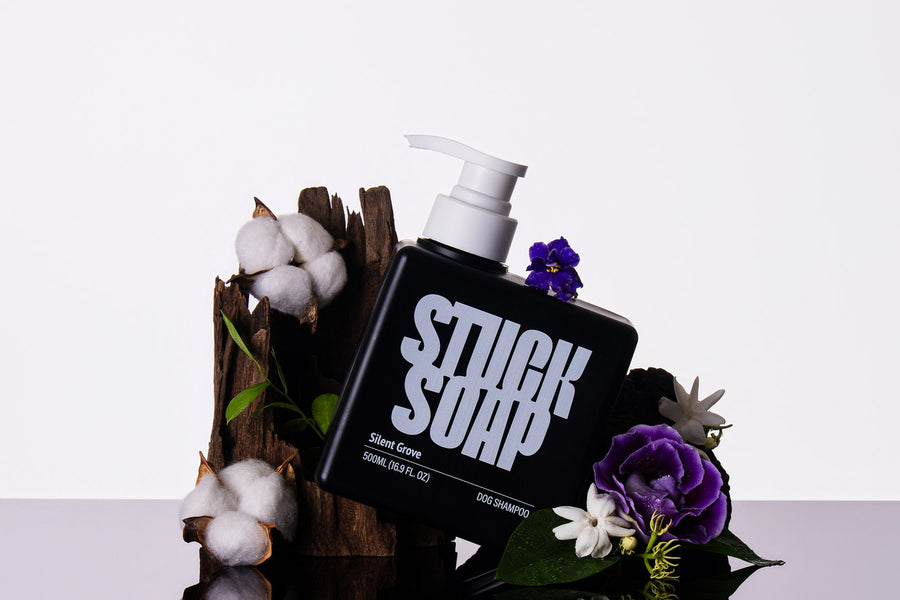
Most of this is technique, and technique carries the majority of the result. The place formulation genuinely helps is lather character. STUCK SOAP shampoo is built as a high-concentrate, fine-bubble, pH-balanced cleanser with green tea, camellia oil, and centella asiatica, which means one pump dilutes into a thin, mobile lather rather than a stiff foam that parks on the guard hairs. It is a vegan, non-medicated grooming cosmetic, and it is designed for sebum control and skin-barrier support at the root, which is the layer this entire article is about. If you prefer the zero-waste bar, build the lather in your hands first and apply it to parted sections; the method is in how to use a dog shampoo bar.
FAQ
How long should I soak a double coat before shampooing?
Plan on three to five minutes of steady water contact for a moderate coat, and up to eight for a very dense one. Saturation is not a timer, it is a state: the coat should feel heavy, lie flat against the body, and stay parted when you push it open.
How do I know the water has reached the skin?
Part the coat with your fingers down to the skin and look. If the skin surface is shiny and wet and the undercoat at the base is dark and clumped rather than fluffy, you have reached it. Dry, powdery undercoat at the root means keep rinsing water in.
Should I use more shampoo on a thick double coat?
More product is rarely the fix. Dose by body weight and coat volume, then dilute it so the lather is thin enough to travel. A concentrated shampoo watered down in a bottle spreads through dense hair better than a thick blob squeezed onto one spot of the back.
Why does my dog still smell after a bath?
Usually because the wash never reached the skin, or the rinse did not. Odor lives in sebum at the root, not on the guard hairs. If the smell returns within a day or two, or the skin looks red or irritated, book a veterinary exam instead of rewashing.
Do I need to brush before bathing a double coat?
Yes, and it is the highest leverage minute of the whole bath. Loose undercoat traps air and blocks water, so removing it before the dog gets wet cuts saturation time noticeably. Brushing a soaked, matted coat is harder on the skin and much harder on your hands.
Does a shampoo bar work on a double coat?
It can, as long as you build lather in your hands or on a wet cloth first and apply that lather to parted sections. Rubbing a bar across the top of a dense coat only coats the guard hairs. The bar is a lather source, not an applicator.
How much longer does a dense coat take than a short one?
Roughly double to triple the wetting and lathering time, and often more at the rinse. A short single coat can be soaked in under a minute. A heavy working coat in full undercoat can need eight minutes of water before the shampoo has anywhere useful to go.
Sources
- American Kennel Club, Double-Coated Dog Breeds
- American Kennel Club, How Often Should You Wash Your Dog?
- Merck Veterinary Manual, Structure of the Skin in Dogs
Give the Root Layer Something Worth Reaching
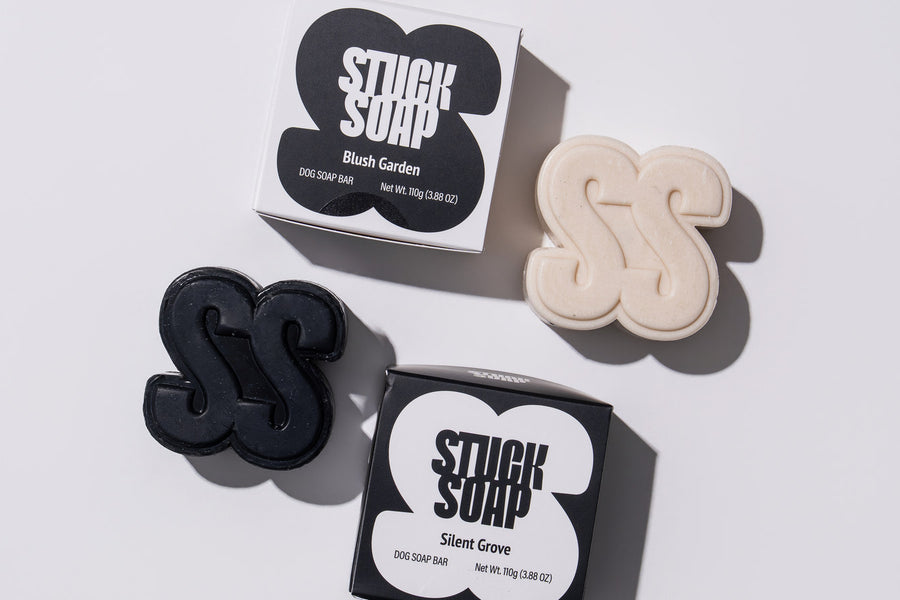
Technique gets the lather down to the skin. A pH-balanced, fine-bubble, high-concentrate formula makes the trip easier. Shop the Liquid Shampoo 500ml and the zero-waste Shampoo Bar in Silent Grove or Blush Garden at stucksoap.com.