


Here's how to groom a curly coated dog at home: line brush down to the skin every day or two, check your work with a metal comb, bathe with a shampoo that rinses fully out of dense curls, and dry the coat to the skin while you brush it straight. Book a professional haircut every 4 to 8 weeks, and leave tight mats, clipping and scissor work to the groomer.
Wire coats, the crisp jackets on most Terriers, follow different rules: they mat less and need dead hair pulled out rather than cut. Our coat type guide introduces all six coats briefly, and our routines so far cover short, medium-long and double coats. This is the deeper chapter for the two the hub only introduced.
Why Doodles and Terriers Need Their Own Chapter
Walk through any US dog park and count the Doodles. Goldendoodles, Labradoodles, Bernedoodles and Cavapoos are now some of the most common dogs you'll meet, and a 2022 peer-reviewed study of US owners calls designer dogs "an extremely popular pet choice in the United States." A routine series that skipped curly coats would skip a big share of US dogs.
The same study found a gap between what people expect and what they get. Many buyers believed Doodles would be non-shedding, hypoallergenic and low maintenance. The researchers reported that "meeting the maintenance and grooming needs of doodle dogs required more investment than owners expected." In the owners' own comments, grooming complaints came second only to barking.
About that word: "hypoallergenic" is a marketing term, not a guarantee. The American Kennel Club is blunt that no dog is 100% hypoallergenic, because allergens come from dander and saliva as well as hair. What a curly coat offers is low shedding, which is not the same as low maintenance: hair that would have hit the floor stays tangled in the curls.
Curly vs. Wire Coats at a Glance
Both coats are "low shed," which is why they get lumped together. Up close they behave like opposites.
| Curly coat (Poodles, Doodles, Bichons) | Wire coat (most Terriers, Schnauzers) | |
|---|---|---|
| Texture | Soft coils or loose waves that keep growing | Harsh, crisp outer hair, often over a softer undercoat |
| Shedding | Low, but loose hair gets trapped in the curls | Low, dead hair stays in the coat until it's removed |
| Main risk | Matting close to the skin, often hidden under a fluffy surface | Coat turning soft, dull and fuzzy if dead hair is clipped instead of removed |
| Brushing | Daily or every other day, line brushing to the skin | About once a week, plus extra attention to beard and legs |
| Drying | Must be dried to the skin; damp curls tangle fast | Towel and air or low dryer; less critical, but dry the beard and legs |
| Professional interval | Haircut commonly every 4 to 8 weeks | Hand-strip or trim commonly a few times a year |
| Realistic home scope | Brushing, comb checks, baths, drying, small tangles | Weekly brush and comb, beard cleanup, light finger plucking with guidance |
The intervals in the table are common ranges from the sources at the end of this article, not STUCK SOAP data. Your groomer sets the real schedule.
How to Groom a Curly Coated Dog at Home: The Weekly Loop
For curly coats, brushing is the main job. VCA Animal Hospitals says dogs with long, silky or curly coats need daily brushing to keep tangles and mats from forming, especially behind the ears, in the armpits and along the back of the legs. Our guide on how often to brush your dog covers how to fit it into a week.
Line brushing is a method of brushing a thick coat in thin sections. You hold the hair up with one hand to expose a visible line of skin, brush the hair below that line down and away from the skin, then move the line up a little and repeat.
Line brushing and the comb check, step by step
- Gather two tools. A slicker brush and a metal comb with wide and fine teeth.
- Add a little slip. Lightly mist the section with water or a leave-in conditioner so the brush glides. Never brush a bone-dry, dirty coat.
- Start low. Begin at a back foot and work up. Lower legs are where mats like to start.
- Make your line. Push a band of hair up with your free hand until you see skin. Brush the hair below the line in short, light strokes, from the skin outward.
- Move up a half inch. Let down a new layer of hair and repeat until you reach the top of that area.
- Comb check. Slide the metal comb through the section all the way to the skin. If it passes cleanly from root to tip, you're done there. If it catches, go back with the brush.
- Hit the friction zones. Behind the ears, collar and harness lines, armpits, the inner thighs and the tail base get extra passes.
- Stop before your dog does. Ten calm minutes is better than thirty tense ones. Pick up where you left off tomorrow.
Brush lightly. A slicker pressed hard against the skin can scratch, and a dog that learns brushing hurts will fight you every time. AKC's Standard Poodle grooming guide makes the same point: brush all the way to the skin, but don't scrape it.
Bath Day for Curls: Rinse Clean, Then Dry to the Skin
The order matters. Brush out tangles before the bath, because water tightens a small tangle into a real mat. Our piece on brushing before or after a bath goes deeper on why.
Lather that reaches the skin and rinses out
A dense curly coat holds water and product like a sponge. Work shampoo in with your fingertips, at the skin, rather than piling foam on the surface. Then rinse longer than feels necessary: leftover shampoo deep in the curls leaves hair sticky, and sticky hair tangles faster. If you're not sure the coat is clear, our shampoo residue check walks through it.
Drying steps for a curly coat
A curly coat left to air dry can look dry on top while staying damp at the base, and those damp roots tangle quickly. The PetMD guide to matting lists bathing, swimming and rain among the things that worsen tangles.
- Blot, don't rub. Press a towel into the coat and squeeze. Rubbing back and forth is the fastest way to twist curls into knots.
- Use cool or low heat. Set the dryer to a cool or low setting and keep the nozzle moving, several inches from the skin.
- Brush while you dry. Dry one section at a time while brushing it straight. This lifts the hair away from the skin so air reaches the base.
- Dry to the skin. Part the coat in a few places and touch the base. Cool and dry means finished. Cool and damp means keep going.
- Finish with the comb. Run the metal comb through once more. Anything it catches now is easier to deal with than tomorrow.
Matting: What You Can Fix and What You Can't
A mat is a clump of loose and growing hair that has tangled and tightened against itself. PetMD notes that mats can pull on the skin, trap moisture and debris, hide skin problems and cause pain. On curly coats they start small, behind the ears, under the collar and in the armpits, and grow quietly under a fluffy topcoat.
A pelted coat is one where mats have joined into a continuous, felt-like layer sitting close to the skin, sometimes over a large part of the body. Trying to brush through it hurts. A pelted coat is a job for a professional groomer, and often a check with your vet.
A small, loose tangle you can work open with your fingers, a little conditioner and the wide end of your comb, holding the hair at the base so the pull doesn't reach the skin. Anything tight, flat against the skin or bigger than a small patch goes to the groomer. Please don't reach for scissors. AKC's at-home grooming guide says plainly, "Do not attempt to cut mats out of your dog's coat yourself." The Merck Veterinary Manual gives the reason: with scissors, it's easy to accidentally cut the skin. A tight mat sits right against the skin and pulls on it, so there is almost no gap to work in.
If you or your groomer find redness, sores, odor or moisture under a mat, that's a vet visit, not a grooming fix.
Wire Coats: The Terrier Routine
Wire coats are built tough. The outer hair is coarse and springy, and dead hair stays in the coat until something removes it.
Hand-stripping is a grooming technique for wire coats in which dead outer hairs are pulled out by hand or with a stripping tool, in the direction of growth, so new harsh hair can grow in. AKC describes it as a specialized procedure that keeps the coat's coarse texture. Carding, a related step, removes loose soft undercoat.
Hand-stripping vs. clipping
According to AKC's hand-stripping guide, clipping a wire coat instead of stripping it will eventually soften the coat and can affect its color and texture. That said, the groomer AKC interviewed notes that most pet owners keep wire coats in a "pet strip," a clipper trim combined with carding, and that this works well for many family dogs. She also says real hand-stripping "is a premium service and will (and should) be more expensive than a traditional groom." Which way to go depends on the look you want and the groomers near you.
For timing, PetMD's Wire Fox Terrier profile describes stripping by a groomer a few times a year, with most other coat care done at home.
What a Terrier owner can do between appointments
AKC's wired-coat care article lays out a sensible weekly routine: brush with a pin brush, comb with a medium comb, then a fine comb down to the skin, then a final pass with a slicker. It also suggests teasing out a few dead hairs with your fingers now and then, and leaving the clipping to a professional. Wipe the beard after meals and towel the legs after wet walks. Go easy on rich products on the body: heavy conditioning softens the crisp texture a wire coat is supposed to have.
How to Groom a Curly Coated Dog at Home vs. What to Leave to the Groomer
Home grooming doesn't replace your groomer. It sends your dog in with a coat that can be cut, not shaved down for mats.
| Task | At home | Leave to the groomer |
|---|---|---|
| Line brushing and comb checks | Yes, daily or every other day for curls, weekly for wire | Groomer does a full brush-out at each visit |
| Bathing and drying to the skin | Yes, with a careful rinse and full dry | High-velocity drying and fluff drying |
| Small, loose tangles | Yes, with fingers, comb and conditioner | Mention any repeat spots at your next visit |
| Tight mats or a pelted coat | No, and never with scissors | Yes, plus a vet visit if the skin underneath looks irritated |
| Full haircut or clipping | Not for most owners | Yes, commonly every 4 to 8 weeks for curly coats |
| Face, sanitary and paw-pad scissoring | Not for most owners | Yes |
| Hand-stripping a wire coat | Light finger plucking only, ideally after your groomer shows you | Yes, commonly a few times a year |
Practical Takeaways for Curly and Wire Coats
- Curly coats need brushing to the skin every day or two. The metal comb tells you whether it worked.
- Always brush out tangles before a bath, and dry curly coats all the way to the skin.
- Small loose tangles are a home job. Tight mats and pelted coats are not, and scissors are never the answer.
- Wire coats need weekly brush-and-comb sessions and periodic stripping or a pet strip from a groomer.
- Between baths, our care-between-baths guide keeps both coat types fresh without extra washing.
Where STUCK SOAP fits
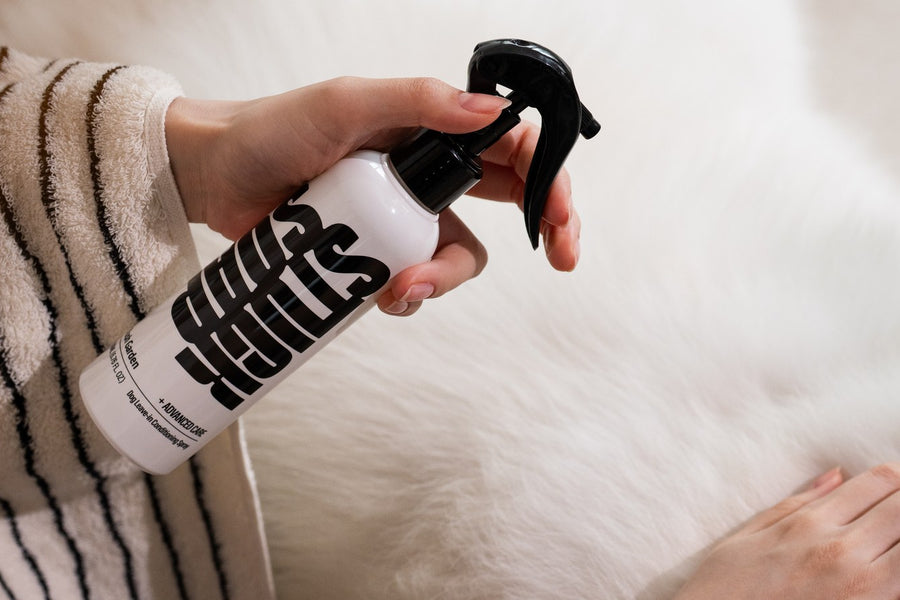
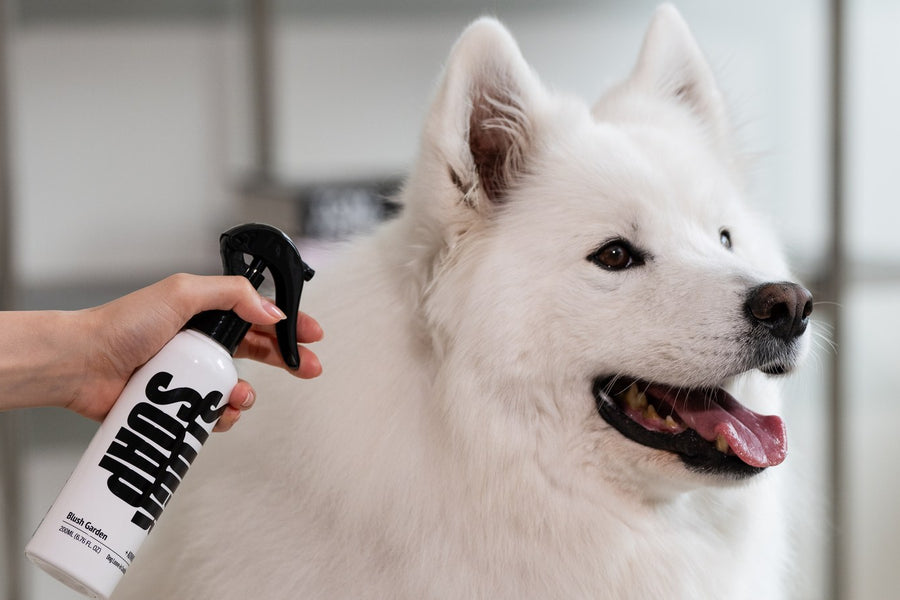
For curly coats, a light mist of our Leave-In Conditioning Spray before line brushing gives the brush some slip so it moves through the curls instead of tugging. It won't work a mat loose on its own; it simply makes regular brushing more comfortable. It's built around three patented Korean actives: Mung Bean Sprout Extract (KR patent 10-1841429), a longtime Korean beauty botanical we chose for a gentle, conditioning feel; Tannin Complex HR (10-0955389), plant polyphenols included to help the coat feel clean and tidy once the spray dries; and ODOR-BYE (10-2746186), there because a between-bath refresher makes the whole routine easier to keep up. On wire coats, use it sparingly, mostly on the beard and legs. Our leave-in how-to covers technique.
On bath day, dense curls are where a rinse-clean lather earns its keep. Our pH-balanced Liquid Shampoo is high-concentrate, so one pump goes a long way, and its fine-bubble lather is easy to work down to the skin and rinse back out. It's made with Green Tea, Camellia Oil and Centella Asiatica, it's vegan, and it comes in Silent Grove (earthy) or Blush Garden (floral). The zero-waste Shampoo Bar is the low-plastic option. Find both at stucksoap.com.
FAQ
How often should I brush a curly coated dog?
Most curly coats, including Poodles and Doodles, do best with brushing every day or every other day. Use line brushing to reach the skin, then run a metal comb through to check your work. Short, frequent sessions prevent mats far better than one long session on the weekend, and they are easier on your dog.
How often does a Doodle need a professional groom?
A common range for curly coated dogs is a professional haircut every 4 to 8 weeks, depending on how long you keep the coat and how well it is brushed at home. Shorter cuts can stretch the interval. Longer, fluffier styles need more home brushing and often more frequent visits. Your groomer will recommend a schedule.
Can I cut mats out of my dog's coat with scissors?
No. A tight mat sits right against the skin and pulls on it, so it is very easy to cut your dog by accident. Work small, loose tangles open with your fingers, a little conditioner and a comb. Leave tight mats or a pelted coat to a professional groomer, and see your vet if the skin underneath looks irritated.
Are Doodles hypoallergenic?
No dog is truly hypoallergenic. The term is mostly marketing, and allergens come from dander and saliva as well as hair. Many Doodles do shed less, but some shed more than owners expect. Low shedding also means more grooming, because loose hair stays trapped in the curls and can mat if it is not brushed out.
What is hand-stripping, and can I do it at home?
Hand-stripping is pulling dead outer hairs from a wire coat, in the direction of growth, so new harsh hair can grow in. It keeps the crisp Terrier texture. Full stripping is a specialized skill best left to a trained groomer. Owners can do weekly brushing and combing and light finger plucking after guidance.
Is it bad to clip a wire-coated Terrier instead of hand-stripping?
Many family Terriers are kept in a pet strip, which combines a clipper trim with carding to remove soft undercoat. The tradeoff is that clipping alone tends to soften a wire coat over time and can change its color and texture. Hand-stripping keeps the traditional harsh jacket. Ask your groomer which approach suits your dog's coat.
Sources
- Hladky-Krage, B. and Hoffman, C. L., "Expectations versus Reality of Designer Dog Ownership in the United States," Animals 12(23):3247 (2022), via PubMed Central. pmc.ncbi.nlm.nih.gov
- American Kennel Club, "Does a Completely Hypoallergenic Dog Exist?" akc.org
- American Kennel Club, "How to Groom a Standard Poodle." akc.org
- American Kennel Club, "Dog Grooming at Home: The Dos and Don'ts of Proper Hygiene." akc.org
- American Kennel Club, "Everything You Need to Know About Hand-Stripping Dog Coats." akc.org
- American Kennel Club, "Wired-Coat Care: Stripping." akc.org
- Merck Veterinary Manual, "Routine Health Care of Dogs" (owner edition). merckvetmanual.com
- VCA Animal Hospitals, "Grooming and Coat Care for Your Dog." vcahospitals.com
- PetMD, "How To Handle Matting in Dogs and Cats." petmd.com
- PetMD, "Wire Fox Terrier Dog Breed Health and Care." petmd.com
Curls or wire, the routine starts with a good brush and a clean rinse.
Shop the Liquid Shampoo, Shampoo Bar and Leave-In Conditioning Spray in Silent Grove or Blush Garden at stucksoap.com.