

Your dog's coat type is one of six: short (smooth), medium, long, double, wire or curly. You can usually tell which one in about ten seconds by pinching, parting and rubbing the hair along the back. That matters because the dog coat types differ in what goes wrong between baths. Some tangle, some trap a hidden layer of shed fur, and some hold on to shampoo long after you think you've rinsed. This guide walks you through the touch test, sets out the care burden of each type in one table, and explains how your answer changes the way you bathe, brush and dry.
One thing first, so this article and our skin guide don't step on each other. Skin type decides which formula you use. Coat type decides how you apply it, brush, rinse and dry. If you haven't sorted out your dog's skin yet, start with our guide to dog skin types, then come back here for the method.
The 10-second dog coat types check
You don't need a breed chart. Coat genetics come down to a few variables: length, curl, and whether the dog has "furnishings," meaning a beard and eyebrows. The American Kennel Club describes coat variation as differences that "basically vary along three dimensions." Your hands can pick up all three, plus the one that causes most bath-day trouble, which is the undercoat.
Pick a spot on the middle of the back, then do this:
- Pinch (2 seconds). Hold a tuft between thumb and forefinger and pull it upright. Under about an inch is short. One to three inches is medium. Anything longer is long.
- Part (3 seconds). Push your fingers against the grain at the neck or hip. If a dense, soft, often lighter layer shows up under the outer hairs, it's a double coat.
- Rub (3 seconds). Roll a few strands between your fingers. Crisp, coarse and springy points to wire. Soft and slippery points to a long, silky coat. Hair that coils back on itself is curly.
- Watch (2 seconds). Let go and see what the coat does. Does it lie flat, stand away from the body, or spring into ringlets?
Plenty of dogs land in two categories. A long double coat and a wire coat with a soft undercoat are both common. When that happens, use whichever type carries the heavier care burden in the table below.
The six dog coat types, defined
Short (smooth) coat
Close-lying, under about an inch, usually sleek to the touch. A short coat dries fast and rarely mats. Short hairs do shed constantly, though, and they work into fabric. The skin sits close to the surface, so whatever you leave behind on the coat ends up sitting on the skin.
Medium coat
One to three inches, often with a light fringe on the legs and tail. Medium coats are the middle ground: easy most of the year, with tangles at friction points behind the ears and under the collar.
Long coat
Long, fine hair that falls to either side of a parting. Groomers sometimes call this a drop coat. Many long coats keep growing instead of following a strong seasonal shed, so loose hairs stay in the coat and wrap around their neighbors. That's how mats start.
Double coat
Two layers: coarser outer guard hairs over a soft, insulating undercoat. The Merck Veterinary Manual explains that adult dogs grow several secondary hairs from each follicle alongside a central hair, and that this layer insulates best when it stays dry. The undercoat is also why double coats shed heavily, typically in spring and fall.
Wire coat
Harsh, crisp outer hair, usually over a softer undercoat, often with a beard and eyebrows. Traditionally, dead wire hair gets plucked out by hand (stripping) so new, firm hair can grow in. Heavy conditioning softens the texture this coat is meant to have.
Curly coat
Tight curls or loose waves that keep growing and don't shed on a seasonal cycle. Very little hair falls on your floor, but shed hair stays tangled in the curls. Curly coats mat fast, especially close to the skin, where you can't see it happening.
Care burden by coat type
Every coat has a weak spot. This table rates the three problems owners run into most: mats and tangles, undercoat buildup, and residue (shampoo or conditioner left behind after rinsing).
| Coat type | Mats / tangles | Undercoat buildup | Residue risk | Where to focus |
|---|---|---|---|---|
| Short (smooth) | Low | Low | Moderate (sits right on the skin) | Thorough rinse, rubber-mitt brushing |
| Medium | Moderate at friction spots | Low to moderate | Moderate | Ears, collar line, feathering |
| Long | High | Low to moderate | High (lather hides in length) | Detangle before bathing, rinse in sections |
| Double | Moderate (felting in the undercoat) | High | High (water beads off the outer coat) | Getting shampoo down to the skin, then drying fully |
| Wire | Moderate (beard, legs) | Moderate | Moderate | Light products, protect the crisp texture |
| Curly | Very high | Low (but trapped shed hair) | High | Brush to the skin, rinse longer than feels necessary |
Read across a row and the pattern shows: the coats that hold on to hair also hold on to product. That's why rinsing gets its own step below.
Skin type picks the formula, coat type sets the method
Owners often shop by coat ("a shampoo for long hair"), and that's where the confusion starts. Shampoo does its real work at the skin and the base of the hair, where oil, dander and odor build up. So the question of which formula you buy belongs to skin type: oily, dry, sensitive or balanced. We cover that in dog skin types, not coat types.
Coat type is the delivery problem. A Labrador and a Poodle can have the same skin and need the same formula, and still need completely different bath days. One needs lather pushed through a water-resistant outer coat. The other needs curls opened so the rinse water can reach the skin. Two questions, two answers, and you need both.
What skin type answers
- Which formula and how gentle it should be
- How often your dog can be bathed comfortably
- Whether to add leave-in moisture between baths
What coat type answers
- How you wet the coat and work in lather
- How you brush, before and after
- How long you rinse and how you dry
How coat type changes bath day
Apply
Short and medium coats take shampoo easily. Long and curly coats do better when you dilute the shampoo in a cup of water and work it in section by section. Double coats are the hard case: the guard hairs shed water, so the undercoat stays dry while the outside looks soaked. Our walkthrough on getting shampoo through a double coat covers the technique. More product won't fix poor coverage. Our dog shampoo dosage chart gives amounts by size and coat.
Brush
For long, curly and double coats, brush out before the bath. Water tightens mats, so a small tangle going in comes out as a felted lump. The AKC recommends weekly brushing for double coats with a slicker brush followed by a comb, and passes on one groomer's tip: "brush the hair, not the skin." Wire coats need a gentler hand and, ideally, periodic stripping. If your dog is in its fall shed right now, our fall shedding guide fits alongside this step.
Rinse
This is where coat type matters most. Long, double and curly coats all trap suds close to the skin. A good rule: once the water runs clear, keep rinsing for another minute, lifting the hair as you go. If your dog seems itchy or the coat feels tacky the next day, read how to tell if shampoo is fully rinsed out.
Dry
Short coats towel dry in minutes. Double coats need patience, because a damp undercoat against the skin is uncomfortable and slow to dry. Use a towel, then a dryer on a cool or low setting, and keep it moving. Curly and long coats dry best while you brush, which also stops new tangles forming.
Practical takeaways for every coat
- Do the ten-second check once, write the answer down, and plan your routine around the heavier type if your dog fits two.
- Choose the formula by skin type. Choose the technique by coat type.
- Brush before every bath for long, double and curly coats.
- Rinse past the point where the water runs clear.
- Dry all the way to the skin, especially for double coats.
- Between baths, keep up the brushing and quick touch-ups covered in dog care between baths.
- Skip shaving a double coat. The AKC warns it can damage the coat and its insulation and can raise the risk of sunburn.
When to call the vet instead
A coat check is a grooming tool, not a health exam. Bald patches, sores, scabs, persistent scratching or licking, a strong odor that comes back right after a bath, or a sudden change in texture or density are all reasons to see your veterinarian before you change shampoos.
Coming in this series
Each coat type will get its own step-by-step routine over the coming weeks: short and smooth, medium, long, double, wire and curly. Check back in the Journal as they publish.
Where STUCK SOAP fits in a coat-type routine
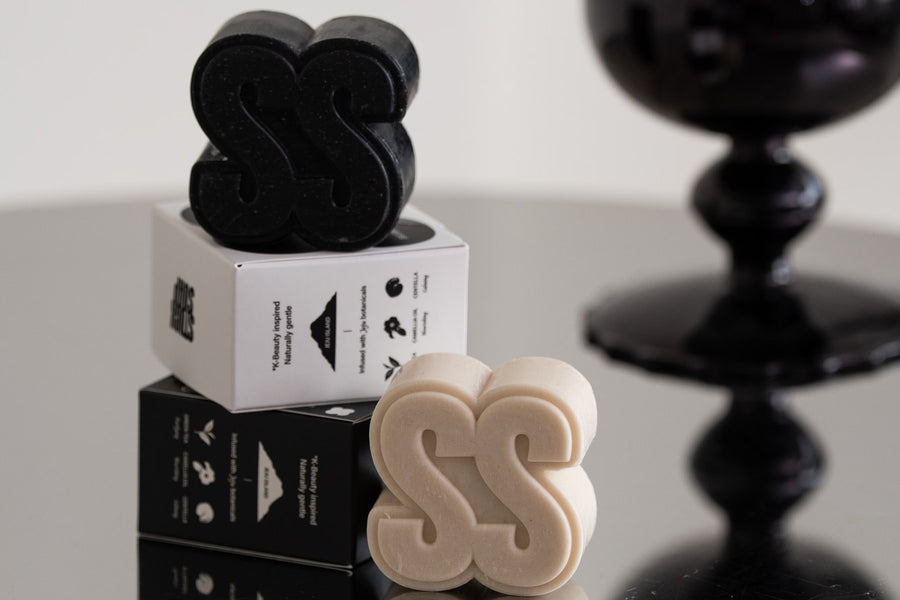
Our shampoos are built for the skin-first half of the equation: pH-balanced for dog skin, vegan, with Green Tea, Camellia Oil and Centella Asiatica chosen for sebum control and skin-barrier support. The fine-bubble lather matters most on dense and long coats, where coarse suds tend to sit on top of the hair. The Liquid Shampoo is high-concentrate, so one pump goes a long way when diluted for a curly or double coat. The zero-waste Shampoo Bar works well on short and medium coats, where you can rub it straight along the back.
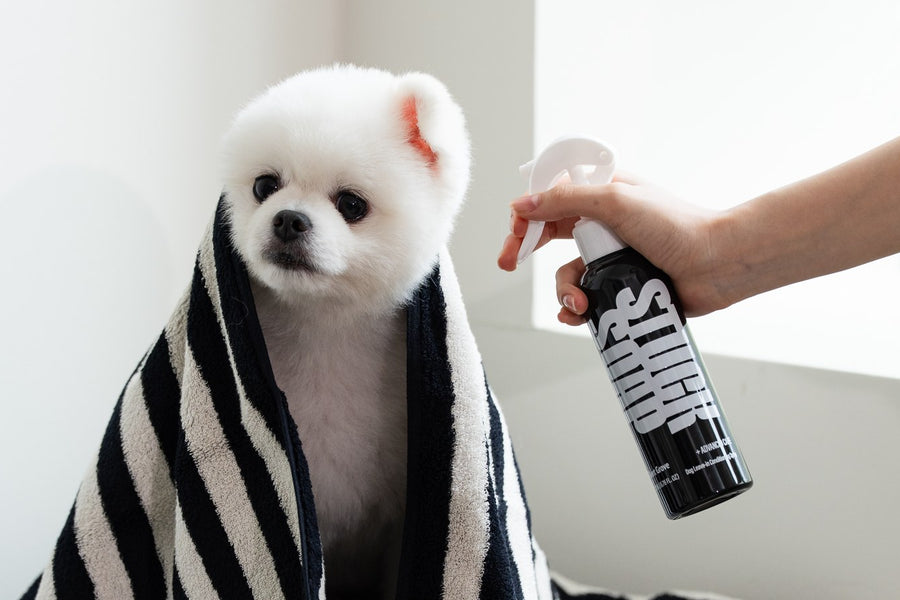
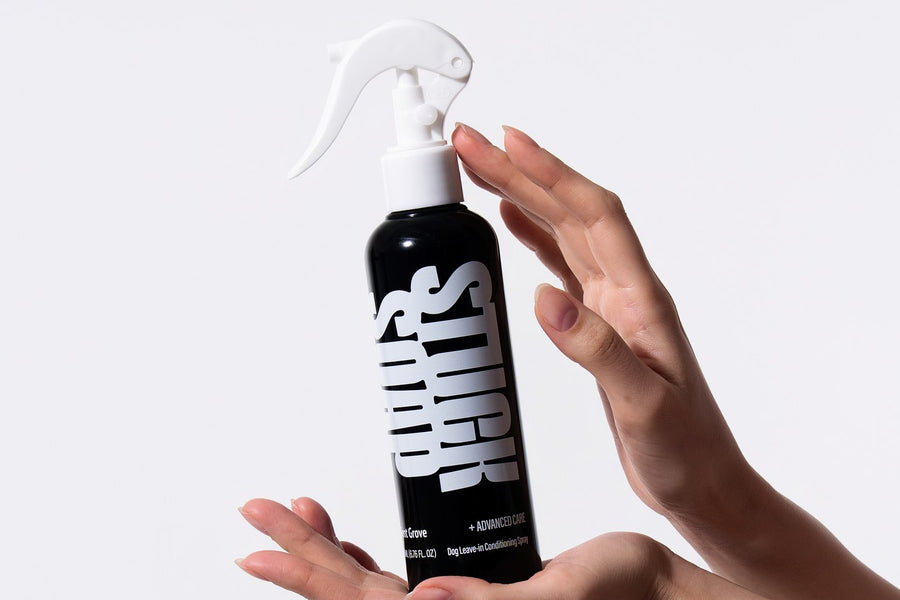
Between baths, the Leave-In Conditioning Spray is a no-rinse, lightweight mist, which matters on long and curly coats that hold on to anything heavy. We chose its three patented actives with care: Mung Bean Sprout Extract (KR patent 10-1841429) for conditioning, Tannin Complex HR (10-0955389) as a plant-derived complex, and ODOR-BYE (10-2746186) for freshness between washes. Both come in Silent Grove (earthy) and Blush Garden (floral). You can see the full lineup at stucksoap.com.
FAQ
What are the main dog coat types?
Most dogs fall into six practical dog coat types: short (smooth), medium, long, double, wire and curly. They overlap, so a dog can have a long double coat or a curly coat with facial furnishings. Groomers sort coats by how they grow, shed and tangle, because those traits decide how a coat should be bathed and brushed.
How can I tell if my dog has a double coat?
Push your fingers against the direction of hair growth at the neck or hip. If you see a dense, soft, often lighter layer packed beneath longer, smoother outer hairs, your dog has a double coat. Heavy shedding in spring and fall, plus clumps of fluffy fur on the brush, are strong supporting clues.
Does coat type or skin type decide which shampoo to use?
Skin type decides which formula you choose, because shampoo is meant to clean the skin and the base of the hair. Coat type decides how you use it: how you work lather down to the skin, how long you rinse, how you brush and how you dry. Most owners need to think about both.
Which dog coat types mat the most?
Curly and long, fine coats mat the most because loose hairs stay trapped in the coat instead of falling out. Friction spots such as behind the ears, under the collar, in the armpits and along the back of the legs tangle first. Double coats can also pack into felt-like mats when the undercoat sheds and is not brushed out.
Should I shave my double-coated dog in summer?
Generally, no. The American Kennel Club advises against shaving double-coated dogs because it can damage the coat and interfere with its insulation, and it can raise the risk of sunburn and skin problems. Regular brushing that removes loose undercoat is the usual way to keep a double coat comfortable. Ask your vet about exceptions.
Can a dog's coat type change?
A coat's basic type is set by genetics, but its look and feel change over time. Puppies trade a soft puppy coat for an adult coat, and seasons, age, nutrition and hormones all affect texture and density. A sudden or patchy change, bald spots or a dull, brittle coat should be checked by a veterinarian.
Sources
- American Kennel Club, "How Is a Dog's Coat Length and Type Inherited?" akc.org/expert-advice/dog-breeds/dogs-coat-length-type/
- American Kennel Club, "How to Groom a Double-Coated Dog." akc.org/expert-advice/grooming/how-to-groom-a-double-coated-dog/
- American Kennel Club, "Wired-Coat Care: Stripping." akc.org/expert-advice/health/wired-coat-care-stripping/
- Merck Veterinary Manual (Pet Owner Version), "Structure of the Skin in Dogs." merckvetmanual.com
Know your coat? Build the routine around it. Gentle, pH-balanced K-Beauty grooming for every coat type, in Silent Grove and Blush Garden. Shop STUCK SOAP