

What causes dog odor is mostly chemistry on the skin and coat: skin oils that oxidize into sharp-smelling aldehydes and fatty acids, plus the volatile byproducts that bacteria and yeast release as they feed. Ears, mouth, and anal glands add their own separate odors, and none of these molecules disappear when you spray a perfume over them.
Most owners learn that second point the hard way. You bathe, you spritz something floral, and by evening the dog smells like flowers sitting on top of the same old dog. Think of "smell" as a handful of specific molecules, each with its own source, and it becomes obvious why covering them and capturing them are different jobs.
This piece stays at the molecular level. If you want to read the smell by location, our Dog Odor Map covers that, and the practical post-bath routine lives in How to Get Rid of Dog Smell After Bath.
What Causes Dog Odor, in One Paragraph
What is dog odor, chemically? Dog odor is a mixture of small, volatile molecules that evaporate off the skin, coat, and body openings and reach your nose. The main families are aldehydes and short-chain fatty acids from aging skin oils, metabolites produced by the skin's resident bacteria and yeast, sulfur compounds from the mouth, and the pungent secretions of the anal sacs.
Notice what is missing: "dirt." The signature dog smell is mostly made on the dog, by its own oils and the microbes living on them. That is why it returns, in the same character, a few days after a perfectly good bath.
Source One: Skin Oils That Turn Rancid
Dog skin is covered in sebum. According to the Merck Veterinary Manual, sebaceous glands "secrete an oily substance called sebum into the hair follicles and onto the skin," and they are concentrated near the paws, back of the neck, rump, chin, and tail. Sebum keeps skin supple and, the Manual notes, "has antibiotic properties."
The trouble is that oils exposed to air do not stay fresh. Like cooking oil left in a pan for a week, the fats react with oxygen and break into smaller, lighter fragments, and those fragments are what you smell.
Aldehydes: the stale, greasy note
The best-documented example comes from human skin research. A study in the Journal of Investigative Dermatology identified 2-nonenal, "an unsaturated aldehyde with an unpleasant greasy and grassy odor," and concluded that it "is generated by the oxidative degradation of omega7 unsaturated fatty acids" in skin surface lipids. Canine-specific data on this exact pathway is thin, but the principle carries over: unsaturated skin fats plus oxygen and time yield aldehydes with a stale, greasy character.
Short-chain fatty acids: the sour, cheesy note
When skin secretions are broken down further, especially by microbes, you get short-chain fatty acids: small acids with big sour, cheesy smells. In human foot-odor research, the smell "was found to be derived from isovaleric acid," produced when a normal skin bacterium degrades leucine present in sweat. The lesson for dog owners is the pattern: harmless skin residents turning ordinary secretions into potent odor molecules.
Source Two: What Bacteria and Yeast Leave Behind
A healthy dog carries a normal community of skin microbes. They eat what the skin provides, and much of their waste is volatile.
Malassezia yeast and the oily, musty smell
Malassezia pachydermatis is a yeast that lives on many healthy dogs. A 2020 review in Frontiers in Cellular and Infection Microbiology reports that the peri-oral and interdigital skin "is frequently colonized (up to 80%)" in healthy dogs. The same review says the species "should now also be regarded as being 'lipid-dependent'," which is a tidy way to connect source one and source two: the yeast feeds on skin oils. When it overgrows, the review describes skin "often with brown/black greasy, malodourous material matting hairs." Overgrowth is a skin condition for your veterinarian, not a grooming product.
Pseudomonas, Proteus, and the corn chip paw
The famous "Frito feet" smell has a bacterial explanation. The American Kennel Club's chief veterinarian, Dr. Jerry Klein, explains that when paws carry Pseudomonas and Proteus, "they can give off a yeasty odor." Paws are an ideal spot because, per the same article, "the combination of fur, heat, and moisture makes an ideal breeding ground for bacteria and yeast." More on paws in Frito Feet: Why Your Dog's Paws Smell Like Corn Chips.
The AKC also names Malassezia and Staphylococcus pseudintermedius as organisms that can overgrow on dogs and cause odor.
Source Three: The Separate Odor Factories (Ears, Mouth, Anal Glands)
Some smells don't come from the coat at all, and each of these is a reason to call your veterinarian rather than reach for a spray.
Ears
VCA Animal Hospitals notes that with ear infections the ears "may develop a bad odor," often with discharge, and that "several kinds of bacteria and at least one type of fungus" commonly cause them. A new or strong ear smell is a vet question.
Mouth
Bad breath is mostly sulfur. A 2023 study in Veterinary Sciences states that volatile sulfur compounds "are the main cause of halitosis (malodor) in humans and dogs with periodontal disease," naming hydrogen sulfide and methyl mercaptan produced by oral bacteria. Breath that clears a room is a veterinary issue.
Anal glands
Anal sacs are designed to smell. Researchers analyzing their secretions found "organic fatty acids, ketones, aldehydes, esters, and alcohols," which they describe as odorant chemicals carnivores use for social communication. A brief whiff when a dog is startled is normal. A persistent fishy smell, scooting, or licking at the rear means a veterinary visit, not a home fix.
The odor molecules at a glance
| Odor source | Molecule class | Where on the dog | What it smells like |
|---|---|---|---|
| Oxidized skin oils | Aldehydes (for example, nonenal-type compounds) | Neck, back, rump, chin, tail base | Stale, greasy, cardboard |
| Microbial breakdown of skin secretions | Short-chain fatty acids | Skin folds, paws, oily coat areas | Sour, cheesy, sweaty |
| Malassezia yeast | Yeast metabolites from skin lipids | Paws, lips, ears, skin folds | Musty, rancid, "yeasty" |
| Pseudomonas and Proteus | Bacterial metabolites | Between the toes, paw pads | Corn chips, popcorn |
| Oral bacteria | Volatile sulfur compounds | Mouth, gum line | Rotten egg, cabbage |
| Anal sacs | Fatty acids, ketones, aldehydes, esters | Rear end | Fishy, pungent |
Masking vs. Capturing: Why Fragrance Doesn't Touch What Causes Dog Odor
Every molecule in that table is still there after you spray a perfume. Fragrance adds new molecules to the air; it does not remove the old ones.
What masking actually is
A workshop report from the National Institute of Standards and Technology puts it plainly: masking "describes situations in which one odorant can overpower the sensation of another." The report also calls it "a specific case of odor perception from mixtures." Your nose is reading a blend; the odor molecules are simply competing with louder ones.
The AKC makes a related point about pet perfumes, noting that "some skin diseases have a particular smell that a perfume could mask." Covering a smell can also cover a signal you'd want to notice.
Fragrance fatigue works against you
Our noses tune out steady smells. Researchers writing in Scientific Reports describe olfactory habituation as "an unconscious reduced responsiveness to continuous or repetitive stimulation," with the everyday example of "a rapid fading of the smell of sweat when entering a crowded place." You stop noticing the perfume quickly, so you spray more, while the underlying odor keeps being produced.
Why scent plus odor can read worse
Because masking is mixture perception, the result is not subtraction. A heavy floral over a sour, fatty base can land as one confused, cloying smell rather than a clean one. Think air freshener fighting with trash. And dogs, the AKC notes, have a sense of smell "much more sensitive than ours." "Long-lasting scent" is not the same as a clean coat; we unpack that in What "Long-Lasting Scent" Actually Means on a Dog Shampoo Bottle.
What capturing means
Capturing approaches go after the odor molecule itself: binding it, holding it, or otherwise keeping it from reaching your nose. One well-studied example from fragrance chemistry is the cyclodextrin, a ring-shaped sugar molecule with "a hollow hydrophobic cavity, able to host lipophilic 'guest' molecules," according to a 2020 review in Molecules. The idea is that the odor molecule is dealt with rather than drowned out.
| Masking (fragrance) | Capturing (odor-targeting) | |
|---|---|---|
| What it does | Adds stronger, pleasant molecules | Targets the odor molecules themselves |
| Original odor molecules | Still present | The focus of the approach |
| How your nose reads it | As a mixture of both | Less of the original odor to read |
| Effect of nose fatigue | You stop noticing the perfume, then reapply | Not dependent on out-shouting the odor |
Neither approach replaces washing. Shampoo physically lifts oils and the microbes feeding on them; anything you use between baths is working on what is left. For decoding fragrance claims, see our guide to hypoallergenic, fragrance-free, and unscented labels is a useful companion.
Practical Takeaways for Owners
Knowing the molecules makes the routine simpler:
- Identify the smell's character. Stale and greasy points to aging oils. Sour or cheesy points to microbial breakdown. Corn chips means paws. Sulfur means mouth. Fishy means the rear end.
- Route the body-opening smells to your vet. Ears, mouth, and anal glands have their own causes, and a new or strong odor from any of them deserves a professional look.
- Wash the oil, not just the coat. Because the main coat odors start in sebum, a bath that reaches the skin matters more than one that only wets the topcoat.
- Dry completely. Moisture, warmth, and fur are what the microbes want. Get down to the skin, especially between the toes and in folds.
- Between baths, think capture, not cover. Choose care that addresses odor rather than layering a heavy perfume on top of it.
- Notice changes. A dog's normal smell is fairly consistent. A sudden shift in strength or character is information, and it's worth telling your veterinarian.
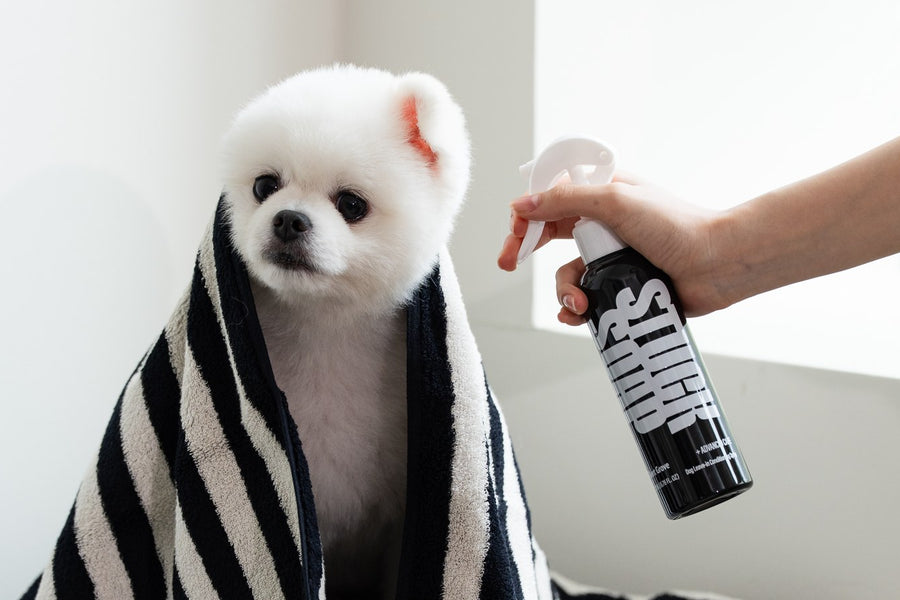
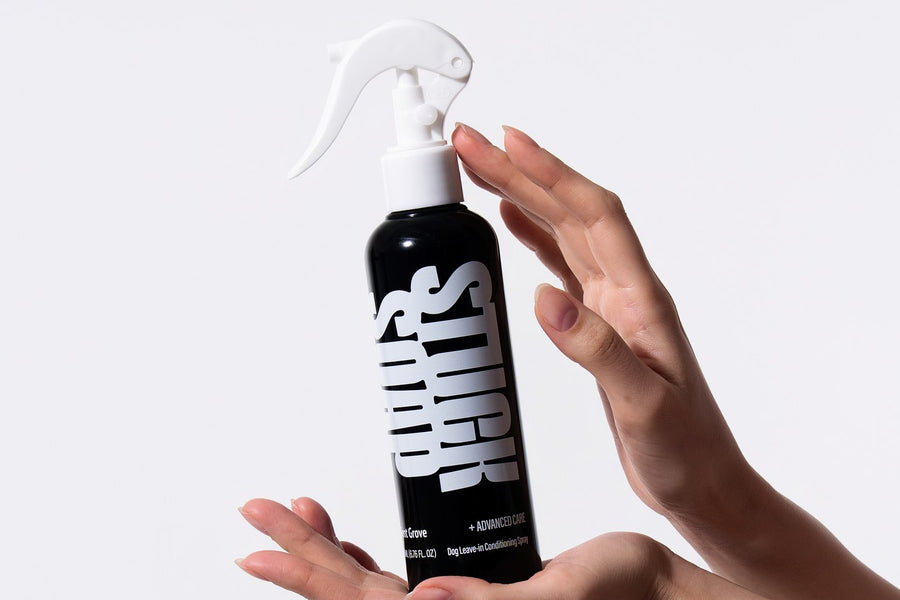
This is the thinking behind our Leave-In Conditioning Spray. ODOR-BYE is one of its three patented actives (KR patent 10-2746186), and we chose it because we wanted to go after the odor molecules rather than cover them with perfume. You can find the spray in Silent Grove and Blush Garden at stucksoap.com.
Frequently Asked Questions
What causes dog odor most often?
Most everyday dog odor comes from the skin itself. Sebum oxidizes into aldehydes, and resident bacteria and yeast break down skin secretions into short-chain fatty acids and other volatile molecules. Ears, mouth, and anal glands produce separate odors with their own chemistry, and a strong smell from any of those areas is worth a veterinary check.
Why does my dog start smelling again a few days after a bath?
Sebaceous glands keep producing oil after every bath, and the skin's normal microbes keep feeding on it. Within days, fresh sebum begins to oxidize and microbial byproducts build up again, so the familiar smell returns. That cycle is normal. A smell that returns unusually fast or unusually strong is something to mention to your veterinarian.
Is a yeasty smell on my dog normal?
Malassezia yeast lives on many healthy dogs, especially on paws and around the mouth, so a faint yeasty note can be ordinary. A strong musty or rancid smell, greasy coat, redness, or constant licking is different and may signal overgrowth. Those signs call for your veterinarian, who can examine the skin properly.
Why does dog perfume stop working after a few minutes?
Two things happen at once. Your nose habituates to steady smells, so you stop noticing the fragrance quickly. Meanwhile, the odor molecules underneath were never removed, so they keep evaporating from the coat. When the perfume fades or you tune it out, the original smell is still there, often blended with the leftover scent.
What is the difference between masking and neutralizing odor?
Masking adds stronger, pleasant molecules so your nose notices them more than the bad smell, but the odor molecules stay present and your nose reads a mixture. Neutralizing or capturing approaches target the odor molecules themselves, binding or holding them so less of the original smell reaches you. Washing still does the heavy lifting.
When should a dog smell be checked by a vet?
See your veterinarian for any new or strong smell from the ears, mouth, or rear end, or for odor paired with redness, discharge, scooting, hair loss, or constant scratching or licking. A sudden change in your dog's usual smell is also worth reporting. Grooming products address the coat, not medical causes.
Sources
- Merck Veterinary Manual: Structure of the Skin in Dogs
- Haze et al., J Invest Dermatol (2001): 2-Nonenal in human body odor
- Ara et al., Can J Microbiol (2006): Foot odor and microbial metabolism
- Frontiers in Cellular and Infection Microbiology (2020): Malassezia in veterinary dermatology
- AKC: Why dogs' feet smell like corn chips
- AKC: Why does my dog smell?
- AKC: Are pet perfumes safe for dogs?
- VCA: Ear infections in dogs
- Veterinary Sciences (2023): Sulfur compounds from canine oral bacteria
- Veterinary Research Forum (2023): Volatiles in canine anal sac secretions
- NIST (2011): Workshop report on odor masking
- Sinding et al., Scientific Reports (2017): Olfactory habituation
- Molecules (2020): Cyclodextrin inclusion complexes for fragrances
Care that goes after odor, not over it. Explore the Leave-In Conditioning Spray, our K-Beauty shampoos, and bundles at stucksoap.com.