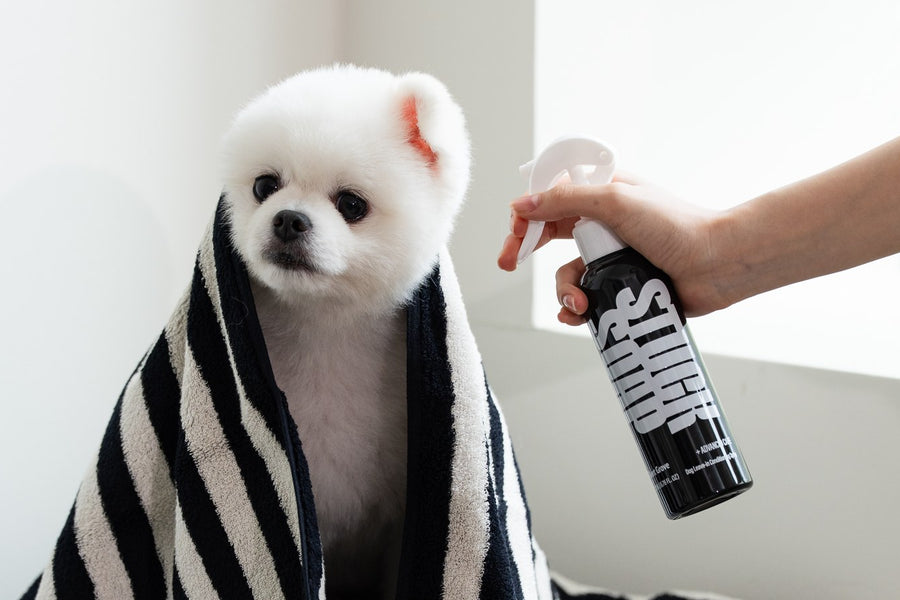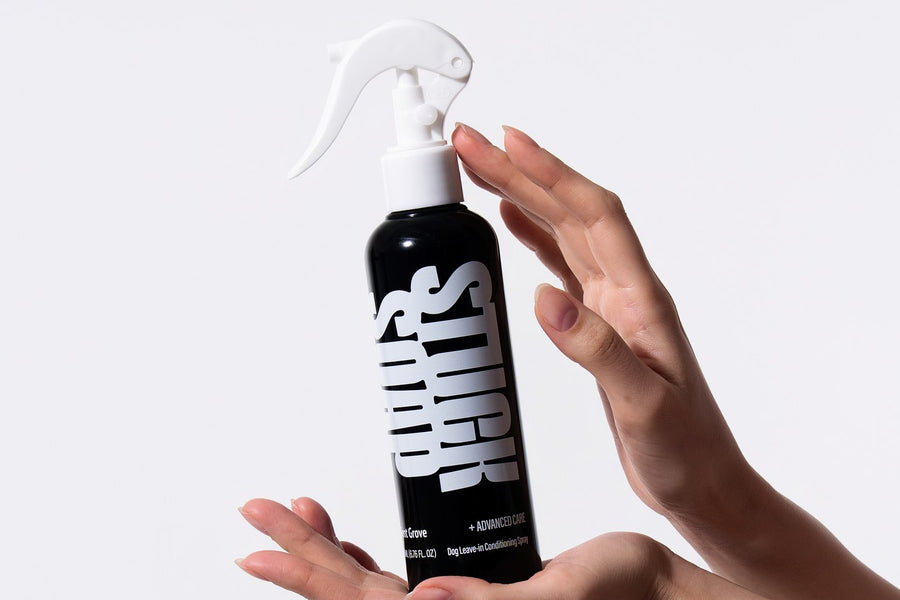


A leave-in conditioner for dogs is a light coat product you don't rinse out. You mist it onto a clean or slightly damp coat so the brush moves through more easily and the hair feels soft and fresh between baths. It is a care step in your grooming routine. It is not a perfume or a shampoo, and it won't fix irritated skin.
That last part matters, because store shelves blur the category. A bottle with a sprayer can be a conditioner, a detangler, a cologne or a waterless shampoo, and the labels don't always tell you which. Here is what a leave-in is built to do, where it stops, and how we thought about the formula when we made ours.
What a Leave-In Conditioner for Dogs Actually Is
The short definition
Leave-in conditioner (dog): a light coat-care product designed to stay on the hair instead of being rinsed away. It is usually a mist or a thin lotion, and you use only a little. Its job is to support how the coat looks, feels and brushes out.
The key word is "designed." You can leave any conditioner in. A true leave-in is formulated from the start to sit on the coat without feeling heavy, tacky or greasy. That is a different problem from making a conditioner that goes down the drain two minutes later.
Where it sits in a grooming routine
Think of grooming in three layers. First comes cleansing (shampoo and water). Then conditioning (rinse-out or leave-in). Then maintenance (brushing and spot care between baths). A leave-in sits where the last two overlap: it finishes a bath and carries into the week after. That is why it fits into a realistic between-bath routine rather than replacing one.
What a Leave-In Conditioner Does
Gives the brush something to glide on
Dry hair creates friction. Strands rub, catch and knot, and a brush dragged through a dry coat tugs at the skin. A light leave-in adds slip to the hair so brushing feels less like a wrestling match, for you and for the dog. The American Kennel Club's grooming advice makes the same point: wet or condition a tangled coat before you work through it, instead of brushing it bone dry.
Changes how the coat feels
After a bath, many coats feel clean but a little rough. Fall is the worst of it: dogs drop undercoat, and the outer hairs take a beating from wind and dry indoor air. (Our guide to fall shedding covers what is normal that time of year.) A leave-in is meant to soften how the coat feels without weighing it down.
Refreshes without a full wash
Between baths, a quick mist and a brush can make a coat feel and smell fresher. That is upkeep, not cleaning. The gap between "fresh" and "clean" is the whole reason we wrote about whether waterless shampoo actually works.
What It Doesn't Do (and Shouldn't Claim To)
It is not a shampoo
A leave-in does not lift away dirt, oil or old product. Water and a surfactant do that. If the coat looks greasy at the roots or smells off close to the skin, your dog needs a bath.
It is not a medicated product
Leave-ins are cosmetic. They are not made to treat skin conditions, and a good one won't pretend otherwise. If your dog's skin is red, broken, flaky or itchy, or has hot spots, keep the spray off those areas and book a vet visit. Allergies, parasites, infections and other problems can all cause those signs, and they need a diagnosis, not a grooming product. The Merck Veterinary Manual's overview of dermatitis in dogs explains why.
It is not a perfume
This is the difference we care about most. A fragrance spray exists to add scent. A leave-in exists to care for the coat, and if it smells nice, that's a finishing detail. We explain why "smells good" and "long-lasting" are slippery promises in what long-lasting scent actually means.
Leave-In vs. Rinse-Out Conditioner vs. Detangler vs. Cologne
These four products often sit side by side on the shelf, and they do overlap. Here is what each one is designed for.
| Product | Rinsed off? | Primary job | When it's used | Texture on the coat |
|---|---|---|---|---|
| Leave-in conditioner | No | Ongoing coat care: slip, softness, freshness | After a bath or between baths, before brushing | Light, meant to disappear into the hair |
| Rinse-out conditioner | Yes | Smooth the coat right after shampoo | In the bath, after shampoo | Richer, built to be washed away |
| Detangler | Usually no | Loosen knots for brushing | Right before working through tangles | Often slick; built for slip more than care |
| Cologne or fragrance spray | No | Add scent | Any time, as a finishing touch | Mostly fragrance and the liquid that carries it, with little coat care |
Of the four, only the leave-in is mainly for ongoing care of the coat itself. That is the job we wanted our spray to do.
"Doesn't a Leave-In Conditioner Just Sit on the Skin?"
We hear this worry more than any other, and it's a fair one. We spend a lot of time telling people to rinse thoroughly. Our guide to telling when your dog is actually rinsed exists because leftover shampoo can irritate skin. So why would a no-rinse product be fine?
Rinse-off and leave-on formulas are built differently
Shampoo contains surfactants: ingredients that grab oil and dirt and wash away with them. Those are exactly what you don't want left behind. A leave-on formula starts from the opposite side. It uses lighter ingredients chosen because they are meant to stay, in small amounts. "No-rinse" is something the formula has to be built for. It is not a shortcut.
pH matters more when a product stays
Dog skin is not human skin. The Merck Veterinary Manual's guide to canine skin structure describes the outer layer, the epidermis, as a protective layer that keeps renewing itself. Veterinary research has also shown that sprays left on dog skin can change its surface pH for hours, as in this Journal of the American Animal Hospital Association study. So a leave-on product does interact with the skin. That is exactly why its pH and ingredient list deserve more attention, not less.
Less is the point
Mist a leave-in on; don't soak the coat. Most of it lands on the hair, which is where it does its work. If the coat feels heavy or coated afterward, use less next time, not more.
Test first, like any new product
Even a gentle formula can disagree with one particular dog. Testing a small spot before full use is a good habit, and our patch test guide works for leave-ins as well as shampoos.
Why We Built Our Leave-In Around Three Patented Actives
When we developed the STUCK SOAP Leave-In Conditioning Spray, the brief was simple: a care product first, with scent as a quiet finish. So we chose actives for what they bring to coat care, not for how strongly they smell. Three made the cut, and each is covered by a Korean patent.
Mung Bean Sprout Extract (KR patent 10-1841429)
Mung bean has a long history in Korean beauty as a gentle plant ingredient. Ground mung bean was a cleanser and skin-care staple in Korea long before K-beauty had a name. We wanted that same gentle tradition in a product that stays on the coat. We wrote more about this ingredient in mung bean for dogs.
Tannin Complex HR (KR patent 10-0955389)
Tannins are plant compounds called polyphenols, found in things like tea and tree bark. Cosmetic science has long studied them because they are astringent and tend to bind to other materials. That binding behavior is why we chose a tannin complex for a coat-care formula. An upcoming post will go much deeper on tannin chemistry.
ODOR-BYE (KR patent 10-2746186)
This ingredient is what makes the spray different from a cologne in principle. ODOR-BYE is a blend made to deal with odor. A fragrance spray layers perfume over whatever is in the coat. We chose ODOR-BYE to work on the odor itself, which is the opposite approach. The light Silent Grove or Blush Garden scent sits on top as a finish, not as the main event.
None of these is a medical ingredient, and the spray does not treat anything. They are simply why the formula looks the way it does.
Practical Takeaways: Using a Leave-In Conditioner for Dogs
We'll publish a full step-by-step guide soon. For now, here is the basic routine:
- Start with a clean coat. A leave-in finishes a bath or stretches the time until the next one. It does not replace one.
- Mist lightly from close range. Aim at the hair, not straight at the skin, and keep it away from the eyes, nose and mouth.
- Brush it through. The brush spreads the product evenly and does the detangling. For thick coats, our notes on working through a double coat apply here too.
- Use less than you think. If the coat feels heavy, use less next time.
- Skip any irritated area. Red, broken or itchy skin is a question for your vet.
Coat type changes the details. Silky coats that hang straight down often need very little, while dense double coats may need a pass section by section. If you're not sure what kind of coat your dog has, start with our coat type guide.
If you want to try a leave-in, our Leave-In Conditioning Spray comes in the same two scents as our shampoo and bar: Silent Grove (earthy) and Blush Garden (floral). You'll find it with the rest of the lineup at stucksoap.com.
FAQ
What does a leave-in conditioner for dogs do?
A leave-in conditioner for dogs is a light, no-rinse coat product misted onto a clean or slightly damp coat. It is designed to help a brush move through the hair more easily, soften how the coat feels, and keep it fresh between baths. It is a grooming step, not a cleanser or a treatment.
Is it safe to leave conditioner on a dog's skin without rinsing?
It depends on the formula. Rinse-out conditioners are built to be washed away, so leaving them in can feel heavy or tacky. A true leave-in is formulated to stay on: lighter, pH-considered for dog skin, and meant to be used sparingly. Patch test anything new, and skip it on irritated skin.
Is a leave-in conditioner the same as dog cologne?
No. A cologne or fragrance spray exists to add scent, and that scent sits on top of whatever is already in the coat. A leave-in conditioner exists to care for the coat itself. Some leave-ins carry a light scent, but the scent is a finishing detail, not the job the product was built to do.
How often can I use a leave-in conditioner on my dog?
Most owners reach for it after a bath, before a brushing session, or when the coat feels dull between washes. Use a light hand, since more product does not mean more care. If the coat starts to feel coated or heavy, space applications out. Your brush and your fingertips are the best guide.
Can a leave-in conditioner help with hot spots or itchy skin?
No, and it should not be used that way. Red, broken, flaky, or itchy skin and hot spots need a veterinarian, because they can have many causes that a grooming product cannot address. A leave-in conditioner is a cosmetic coat-care step for healthy skin. Keep it off any irritated area until your vet weighs in.
Does a leave-in conditioner replace a bath?
No. A leave-in does not lift away dirt, oil, or buildup the way shampoo and water do. Think of it as the step that keeps a clean coat comfortable and easy to brush in the days after a bath. When the coat looks greasy or smells off at the skin, it is time to wash.
Sources
- Merck Veterinary Manual, "Structure of the Skin in Dogs." merckvetmanual.com
- Merck Veterinary Manual, "Dermatitis and Dermatologic Problems in Dogs." merckvetmanual.com
- American Kennel Club, "How to Groom a Golden Retriever." akc.org
- American Kennel Club, "Dog Grooming at Home: The Dos and Don'ts of Proper Hygiene." akc.org
- Matousek JL, Campbell KL, et al. Journal of the American Animal Hospital Association, 2003;39(1):29. jaaha.kglmeridian.com
Care first, scent second. The STUCK SOAP Leave-In Conditioning Spray needs no rinsing and is built around three patented actives. Shop the spray and the full lineup at stucksoap.com.