

Static electricity in dog fur builds up when hair rubs against a brush, a blanket, or your sweater and picks up an electrical charge that dry indoor air can't carry away. The result is the familiar November coat: hairs that stand up and float, a crackle when you pet down the back, and a brush that suddenly drags and snaps strands it used to glide through.
It tends to show up the week the heat comes on: colder outdoor air holds less moisture, the furnace dries what's left, and your dog spends more time curled on fleece. Not an emergency, just a sign the coat needs a slightly different routine until spring.
Static Electricity in Dog Fur: What's Actually Happening
What is triboelectric charging?
Triboelectric charging is the electric charge two materials pick up when they touch and separate, as one surface gives up electrons and the other takes them. Rub hair with a comb or a fleece blanket and both end up charged, with opposite signs.
Hair sits near the top of most published triboelectric tables, meaning it tends to give up electrons readily and end up positively charged. Hairs carrying the same charge push away from each other, which is why a charged coat looks fluffed out and loose fur clings to your leggings and the couch.
Why dry air lets the charge stay put
In humid air, a thin film of moisture on the hair surface helps charge leak away almost as fast as it forms. In dry air, that path mostly disappears. A study of human hair in the Journal of the Society of Cosmetic Chemists put it plainly: "At low relative humidities, the fibers behave like typical insulators." The same paper found that a good share of the charge stayed trapped on the fibers instead of fading.
One honest caveat: nearly all of the research on hair static and humidity was done on human hair tresses, wool, and textiles. Dog hair is built from the same keratin family, so the physics should carry over, but dog-specific data is thin. Treat what follows as well-grounded grooming sense, not a lab result on your Samoyed.
Why Dry, Charged Hair Snaps During Brushing
Owners often notice more broken hairs in the brush in late fall and assume it's shedding. Some of it is. The Merck Veterinary Manual notes that many dogs grow a longer, finer cold-weather coat, and finer hair is easier to tangle and break. Static adds three problems on top of that:
- Friction goes up. A dry hair surface has less slip, so the brush has to pull harder through the same coat. More pull means more stress on each strand.
- Hairs cling and knot. Charged hairs repel each other at rest, then grab at the brush and at neighboring strands as they move. Small tangles form faster than you'd expect.
- Charge builds with every stroke. A Clairol study of combing human hair, also published in the Journal of the Society of Cosmetic Chemists, measured charge spread unevenly along the tress during combing and found that conditioning-type surface treatments changed both how much charge formed and where it sat.
A bone-dry coat brushed hard and fast tends to mean more flyaways and snapped ends. Our guide on how often you should brush your dog covers the frequency side; this piece is about the conditions.
Blankets, Sweaters, and Carpet: The Fabric Factor
Brushing isn't the only source of charge. Every time your dog rolls on a polyester throw or squirms out of a fleece sweater, the coat rubs against a material that sits far from hair on most triboelectric rankings. The farther apart two materials sit, the more charge tends to move between them.
| Surface | Static tendency against hair | Easy swap or fix |
|---|---|---|
| Polyester fleece and microfiber throws | Higher: synthetic, very dry, lots of contact | Lay a cotton sheet or cotton cover over the favorite spot |
| Acrylic or polyester dog sweaters | Higher, especially pulling on and off | Cotton or cotton-blend knits; take sweaters off slowly |
| Nylon or polypropylene carpet and rugs | Moderate to higher in heated rooms | A washable cotton rug in the nap zone |
| Cotton bedding and towels | Lower; cotton sits near the middle of most rankings | Good default for winter beds |
| Wool blankets | Mixed; wool is close to hair but charges against synthetics | Fine on its own; avoid layering with fleece |
These rankings come from materials and textile testing, not dog studies, so read the middle column as a tendency. Bedding also matters for smell and cleanliness through winter; our piece on why a dog smells again after a bath covers washing and drying the bed itself.
Brush and Comb Materials That Make Static Worse (or Better)
The tool touching the hair is the biggest single lever you control. Pick the tool for your dog's coat type first (the American Kennel Club's brush guide is a solid starting point, and so is our dog coat types guide), then consider the material.
| Tool material | How readily it tends to charge hair | When to reach for it |
|---|---|---|
| Stainless steel comb or metal pins | Lower; metal conducts, so charge can drain through your hand | Detangling and finishing in dry months |
| Wood handle or wood pins | Lower to moderate | Pin brushing long coats |
| Natural bristle | Lower to moderate; keratin rubbing on keratin | Short coats and finishing for shine |
| Nylon bristle | Varies by product; can charge in very dry air | Fine with a light mist first |
| Molded hard plastic combs and pins | Higher; many plastics sit far from hair on triboelectric rankings | Swap for metal in winter if flyaways are bad |
| Rubber curry or grooming mitt | Moderate; works well slightly damp | Short coats and bath time |
The pattern is simple: metal and natural materials usually cause less trouble than hard plastic. Technique matters too: AKC advises a light touch with slicker brushes, and short, slow strokes create less friction.
How to Reduce Static Electricity in Dog Fur at Home
Add moisture to the air
Indoor humidity is the root cause, so start there. There is no established humidity target for dogs, but the U.S. Environmental Protection Agency's household guidance is a sensible reference. In its guide to mold and moisture, EPA says: "If possible, keep indoor humidity below 60 percent (ideally between 30 and 50 percent) relative humidity." A cheap hygrometer tells you where your rooms sit.VCA Animal Hospitals also suggests keeping the home humidified in winter. Clean the unit as its maker directs and keep the cord out of chewing range.
We cover heated air and the skin underneath the coat in detail in how indoor heating dries out your dog's skin, so we won't repeat it here.
Give the coat a little moisture before brushing
A lightly conditioned or barely damp coat tends to hold less charge and gives the brush more slip than a bone-dry one. That's why many groomers mist a coat before brushing it out. The key word is lightly: you want the hair surface touched with moisture, not a wet dog. Soaked hair tangles in its own way, and in a double coat it can sit damp against the skin.
What not to use on your dog
Skip dryer sheets, household anti-static sprays, and human hair products. Dogs lick their coats, and anything on the hair ends up in the mouth. The ASPCA lists dryer sheets among household products containing cationic detergents that can cause corrosive injury, and notes fabric softeners may pose comparable concerns.
A Pre-Brushing Routine for a Staticky Coat
Five minutes, most coat types. Adjust the tools to your dog.
- Check the room. Brush where the humidifier runs, or on a cotton towel rather than a fleece bed.
- Start with a dry or towel-dried coat. Never brush a dripping coat. After baths, follow our complete guide to drying your dog first.
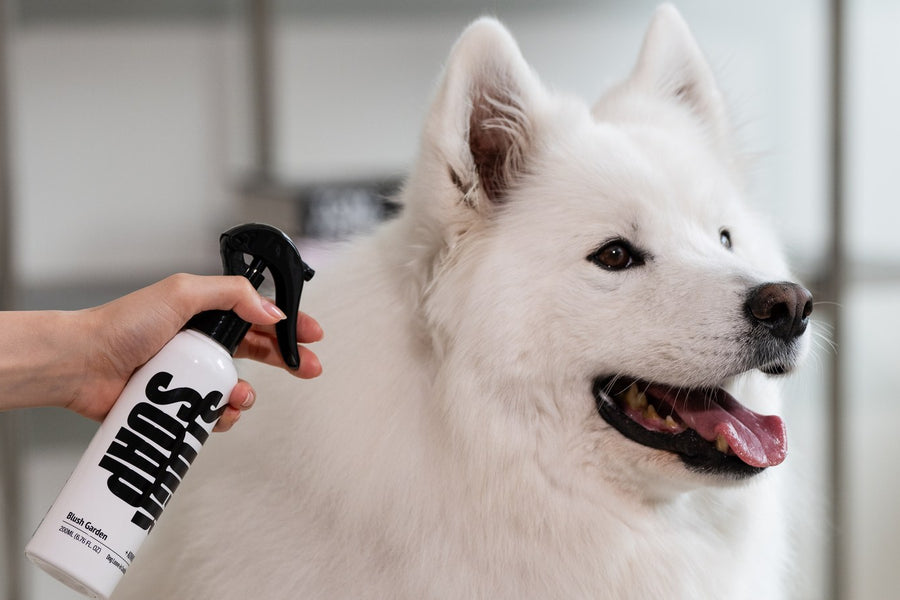
- Mist lightly onto the hair. Hold the bottle a short distance away and aim at the hair, not the skin, one section at a time. Keep spray away from the eyes, nose, and mouth.
- Work in sections with a metal comb or your usual brush. Short strokes, from the tips up toward the skin, holding the hair above any tangle.
- Finish with a natural bristle or pin brush to smooth the topcoat.
- Look at the skin while you're in there. Flakes, redness, or bald spots are worth noting (see the next section).
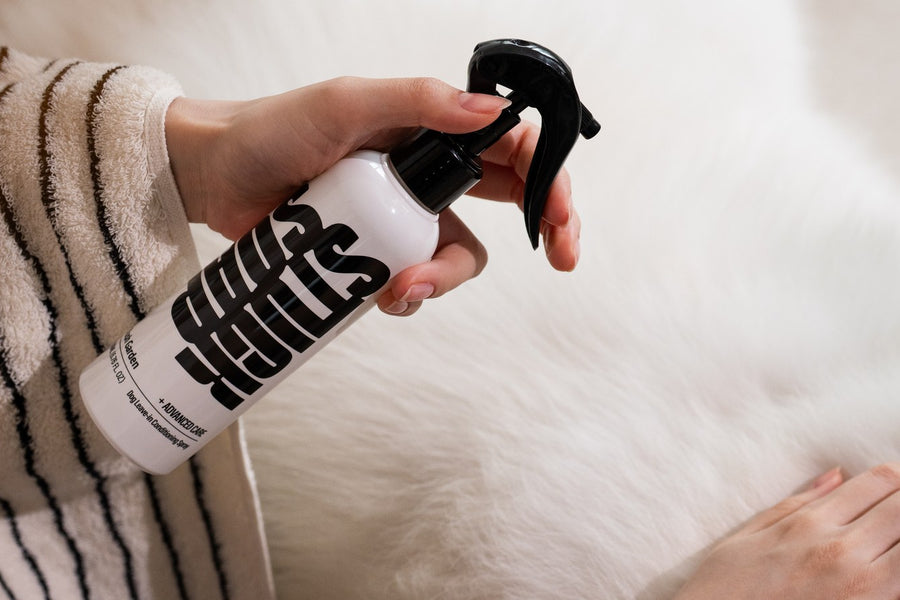
For the misting step, we make the STUCK SOAP Leave-In Conditioning Spray: a lightweight, no-rinse conditioning mist meant to be used on a dry or towel-dried coat before brushing. Shake, mist lightly onto the hair, brush through, no rinse. It's built around three Korean-patented actives: Mung Bean Sprout Extract (KR patent 10-1841429), chosen as a gentle, plant-based conditioning ingredient; Tannin Complex HR (KR patent 10-0955389), plant polyphenols picked for a clean, non-greasy finish; and ODOR-BYE (KR patent 10-2746186), included for freshness between baths. It comes in Silent Grove (earthy) and Blush Garden (floral). Our how-to for leave-in conditioner on dogs covers amounts by coat length, and double-coated owners should read our double coat grooming routine for working down to the undercoat.
If you're building a full seasonal plan, our fall dog grooming routine fits this step into baths, nails, and paws.
When Static Isn't the Real Problem
Static is a coat-surface nuisance. It shouldn't come with skin changes. Call your veterinarian if you see persistent flaking, itching or scratching, hair loss or bald patches, sores, or coat breakage that doesn't improve after a few weeks of gentler brushing and better humidity. Merck notes that hormones, disease, nutrition, and environment all affect hair health, and only an exam can sort those out. Grooming products, ours included, are cosmetic and not a substitute for that visit.
Frequently Asked Questions
Why is my dog's fur so staticky in winter?
Cold outdoor air holds little moisture, and indoor heating dries it further. Hair picks up charge whenever it rubs against brushes, blankets, or clothing, and in humid air that charge leaks away quickly. In dry air it stays on the hair, so strands repel each other, float, and cling to everything nearby.
Is static electricity in dog fur harmful?
A small static shock is startling but generally not harmful. The practical problems are flyaways, tangles, and hair that snaps during brushing. Static itself is a coat-surface issue. If you also notice flaking, itching, sores, hair loss, or bald patches, those point to something beyond static, and your veterinarian should take a look.
What humidity should I keep my home at for my dog?
There is no established humidity target specific to dogs. For households, the U.S. Environmental Protection Agency recommends keeping indoor relative humidity below 60 percent, ideally between 30 and 50 percent. A simple hygrometer shows where your rooms sit, and a humidifier in your dog's sleeping area is a reasonable place to start.
Can I use dryer sheets to stop static on my dog?
No. Dogs lick their coats, so anything rubbed onto the hair can be swallowed. The ASPCA notes that dryer sheets contain cationic detergents that can cause corrosive injury and can also pose a blockage risk if eaten. Human anti-static sprays and hair products are not made for dogs either, so skip them.
Which brush causes the least static?
Metal combs and metal pins tend to cause less static because metal conducts and lets charge drain away through your hand. Natural bristle and wood are usually gentle too. Hard molded plastic tends to charge hair more in dry air. Choose the brush style for your dog's coat type first, then favor these materials.
Should I mist my dog's coat before brushing?
A light mist before brushing is a common groomer habit. A slightly damp or lightly conditioned coat tends to hold less charge and lets the brush slide instead of drag. Mist the hair, not the skin, keep spray away from the face, and never brush a soaking wet coat, which tangles easily.
Sources
- U.S. Environmental Protection Agency, "A Brief Guide to Mold, Moisture and Your Home." epa.gov
- Merck Veterinary Manual, "Structure of the Skin in Dogs." merckvetmanual.com
- Journal of the Society of Cosmetic Chemists, Vol. 36, No. 3, "Relationship between triboelectric charging and surface modifications of human hair." library.scconline.org
- Wis-Surel G, Jachowicz J, Garcia M. "Triboelectric charge distributions generated during combing of hair tresses." Journal of the Society of Cosmetic Chemists, 1987. library.scconline.org
- American Kennel Club, "Dog Brushes: How to Choose the Right Dog Brush for Your Pet." akc.org
- VCA Animal Hospitals, "5 Winter Weather Skin Tips." vcahospitals.com
- ASPCA, "What Pet Parents Need to Know About Corrosive Household Products." aspca.org
Mist, then brush
Make the dry months easier on your dog's coat. The STUCK SOAP Leave-In Conditioning Spray is a lightweight, no-rinse mist in Silent Grove or Blush Garden, made for the step right before the brush.