

A good double coat dog grooming routine between baths comes down to three habits: raking out loose undercoat on a schedule that follows the season, refreshing the coat at the skin instead of on the surface, and drying the undercoat completely every time it gets wet. Keep those three going and a Samoyed, Husky or Golden Retriever stays cleaner, smells fresher and leaves less fluff on the couch in the weeks between full baths.
At bath time, we covered how to get shampoo all the way through a double coat. This is the companion piece: what to do in the two to six weeks after the towel comes off. For most double-coated dogs, that stretch is where the real coat care happens, in short sessions on the floor with a rake and a spray bottle rather than in the tub.
What a Double Coat Is, and Why the Undercoat Does the Damage
Guard hairs on top, undercoat below
A double coat has two layers growing from the same patch of skin. Guard hairs are the longer, coarser outer hairs you see and pet. They shed rain, block sun and give the coat its color and outline. Underneath sits the undercoat: short, soft, crimped hair packed tightly enough to hold a layer of air against the body. The Merck Veterinary Manual's overview of canine skin explains that dog hair follicles are compound: a central hair surrounded by smaller secondary hairs, all exiting from one pore. In double-coated breeds like the German Shepherd and Pomeranian, that dense cluster is a big part of why the coat feels so plush.
Where loose hair, moisture and odor collect
The undercoat sheds in waves, and dead undercoat rarely falls out cleanly. The guard hairs hold it in place, so it packs down into a felted layer close to the skin. That layer soaks up moisture from rain, snow and swims, and it holds skin oil and household dust along with it. This is why a dog can look clean on top and still smell musty up close, something we unpacked in why dogs smell more in fall. If you are not sure which coat your dog actually has, our dog coat types guide walks through the differences.
It can be tempting to solve all of this with clippers, but shaving a double coat tends to create more problems than it fixes, as we explain in our guide to shaving double-coated dogs in summer.
How Often to Rake: A Seasonal Double Coat Dog Grooming Routine
An undercoat rake is a grooming tool with one or two rows of long, widely spaced teeth, usually with rounded tips, built to reach past the guard hairs and pull out loose undercoat without cutting or thinning the outer coat. It is the workhorse of between-bath care for double coats, but it is not the only tool, and how often you reach for it depends on the time of year.
During the blow (spring and fall)
Most double-coated breeds "blow" their undercoat twice a year, dropping huge amounts over two to four weeks. During a blow, rake every day or every other day in short sessions. A Bernese Mountain Dog or Newfoundland in full fall shed can fill a grocery bag in a week, and the goal is to get that hair out before it mats against the skin. Our piece on dog shedding in fall covers what to expect in more detail.
Maintenance months
Outside the blow, one or two rake sessions a week is usually enough, with a quick slicker pass over the friction spots (behind the ears, the collar line, the armpits and the britches) in between. For a breed-by-breed and season-by-season schedule, see how often you should brush your dog.
| Tool | What it reaches | How often (between baths) | Best coat stage |
|---|---|---|---|
| Undercoat rake | Loose undercoat below the guard hairs | Daily during a blow; 1 to 2 times a week otherwise | Blow season and maintenance |
| Slicker brush | Surface tangles and the top of the undercoat | 2 to 3 short passes a week on friction spots | Maintenance, finishing after the rake |
| Pin brush | Guard hairs; light separation and shine | As needed, often after a refresh | Finishing |
| Deshedding blade tool | Loose undercoat pulled through the guard hairs | Sparingly, short sessions during a blow | Heavy blow only |
| Wide-tooth metal comb | Checks for hidden tangles down to the skin | End of every session | All stages (the final check) |
How to Use an Undercoat Rake Without Raking the Skin
Angle and pressure
Hold the rake so the teeth meet the coat at a shallow angle, close to parallel with the body, and pull in the direction the hair grows. Let the teeth do the work. Pressure should feel like stroking the dog firmly, never like scraping. If your dog flinches, leans away or turns to look at the tool, ease off.
Line brushing in sections
Line brushing is the habit that separates a real undercoat session from a surface tidy-up. Start at the back legs. With one hand, push the coat up against the grain to expose a thin line of skin, then rake down the hair just below that line. Move the part up an inch and repeat. Work in sections: rear legs, britches, sides, chest, then neck and ruff. For a second perspective on brushing thick coats, the AKC's guide to grooming double-coated dogs is worth a read.
Know when to stop
Stop when the rake glides through a section with only a few hairs coming out, not when the coat looks "done." Overworking one spot can irritate the skin underneath. If you hit a mat that sits flat against the skin, do not rake through it. Mats down to the skin, red patches, scabs or bald spots are a reason to call your veterinarian, not a reason to try harder.
A Between-Bath Refresh That Reaches the Undercoat
Why misting the top does very little
Most owners spray a refresher across the back, rub it in with a palm and call it done. On a double coat, almost all of that product lands on the guard hairs. The undercoat, where the odor and the dry, static-prone hair actually live, stays untouched. A refresh that works has to part the coat and get to the base.
The refresh, step by step
- Rake first. Take out what is already loose so the spray reaches skin-level coat instead of dead hair.
- Lift a section. Part the coat with your hand or the back of a comb, the same way you did for line brushing.
- Mist lightly into the part. Hold a no-rinse leave-in conditioning spray a few inches away and aim at the base of the coat, not the tips. One or two light sprays per section is plenty.
- Work it in with your fingers. Massage down toward the skin so the product spreads through the undercoat instead of beading on the top layer.
- Follow with the rake. One slow pass distributes the product and lifts out any loose hair it helped release.
- Finish with a pin brush or comb over the guard hairs to settle the outer coat.
How much and how often
Once or twice a week is a sensible rhythm for most double coats, more often after a muddy hike or a damp week. Keep it light: the coat should feel soft, not wet. For more on technique, read how to use leave-in conditioner on dogs and our broader look at leave-in conditioner for dogs. The rest of the weekly routine (paws, ears, bedding) lives in dog care between baths.
Why Complete Drying Matters for Double Coats
What a damp undercoat does
A dense undercoat is designed to keep water out, which also means it is slow to let water go once it gets in. A dog that comes in from the rain or a swim can feel dry on top for hours while the base of the coat stays damp against warm skin. That trapped moisture is a classic source of musty smell, and warm, damp skin under a thick coat is one of the conditions linked to hot spots, the red, moist, irritated patches described in the AKC's overview of hot spots on dogs. If you see one, that is a job for your veterinarian.
Towel, dryer, air time
Press, do not rub: blot with a large absorbent towel, working against the grain in sections. A high-velocity dog dryer on a cool or low-heat setting is the most efficient way to push water out of a thick undercoat. Without one, give the dog plenty of time indoors somewhere warm before a nap on the dog bed or a trip back outside. Our complete guide to drying your dog after a bath applies just as well to rainy walks.
The finger test
Do not judge dryness by the surface. Slide your fingers through the coat until you touch skin at the ruff, the chest, behind the elbows and at the base of the tail. If any of those spots feel cool or damp, keep drying. The surface lies; the skin tells the truth.
Practical Takeaways for Your Double Coat Dog Grooming Routine
- Rake daily during a spring or fall blow, and once or twice a week the rest of the year.
- Line brush in sections from the back legs forward, and stop at the skin.
- Refresh at the base of the coat: lift, mist, work in with fingers, then rake.
- Dry until the skin is dry, not just the top of the coat, after every bath, swim or rainy walk.
- Hand anything that looks like a skin problem (hot spots, mats against the skin, bald patches, odor that lingers) to your vet.
A Suggested Routine: Double Coat = Soap + Conditioning Spray
Here is the pairing we suggest for double-coated dogs. It is a grooming routine, not a treatment, and it fits around the raking and drying habits above.
At bath time: the shampoo bar, worked to the skin
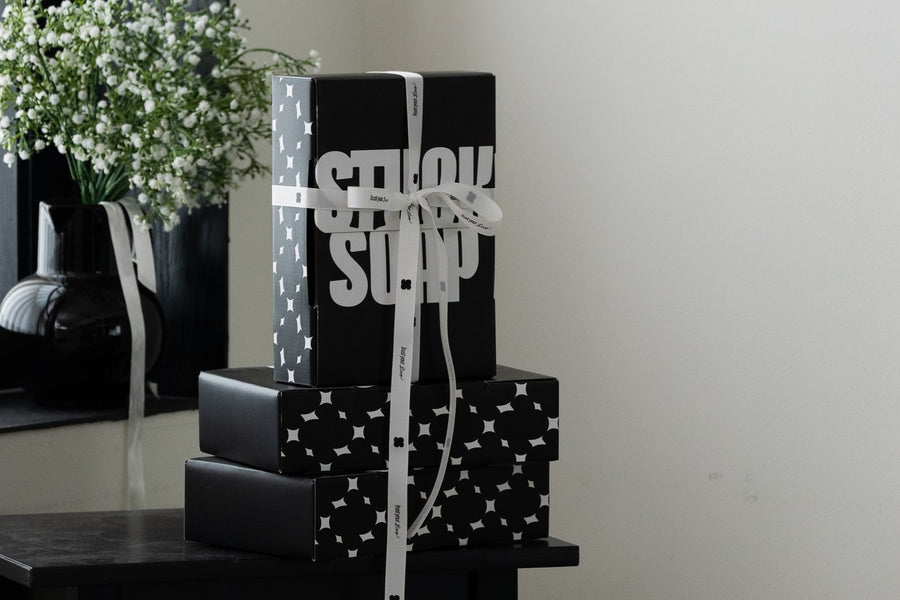
The STUCK SOAP Shampoo Bar (110g) is easy to control on a thick coat. Glide it along the parted coat section by section so lather starts at the skin instead of foaming on the guard hairs, a method we laid out in getting shampoo through a double coat and how to use a dog shampoo bar. It is vegan, pH-balanced for dog skin, built around Green Tea, Camellia Oil and Centella Asiatica, and the bar format is zero-waste. Choose Silent Grove (earthy) or Blush Garden (floral).
Between baths: the leave-in conditioning spray
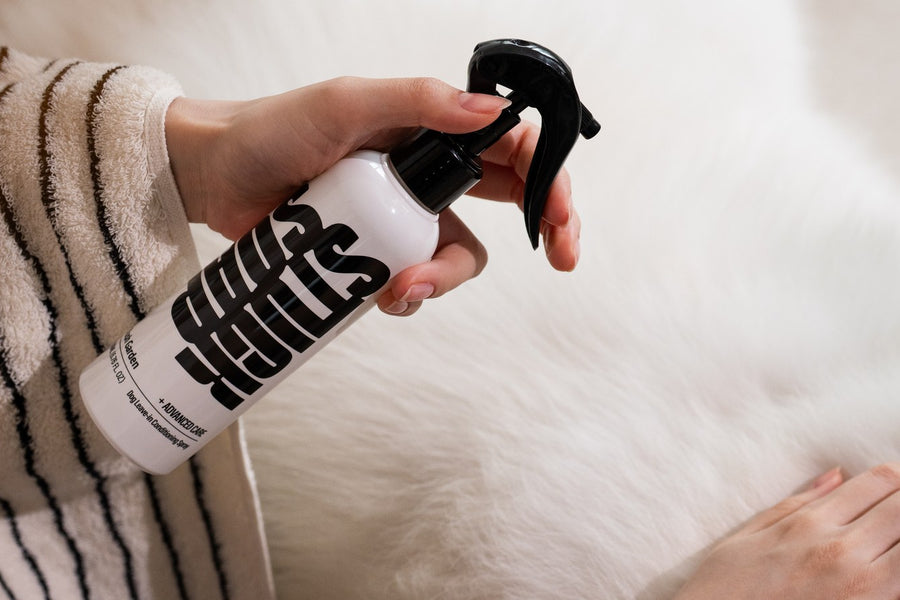
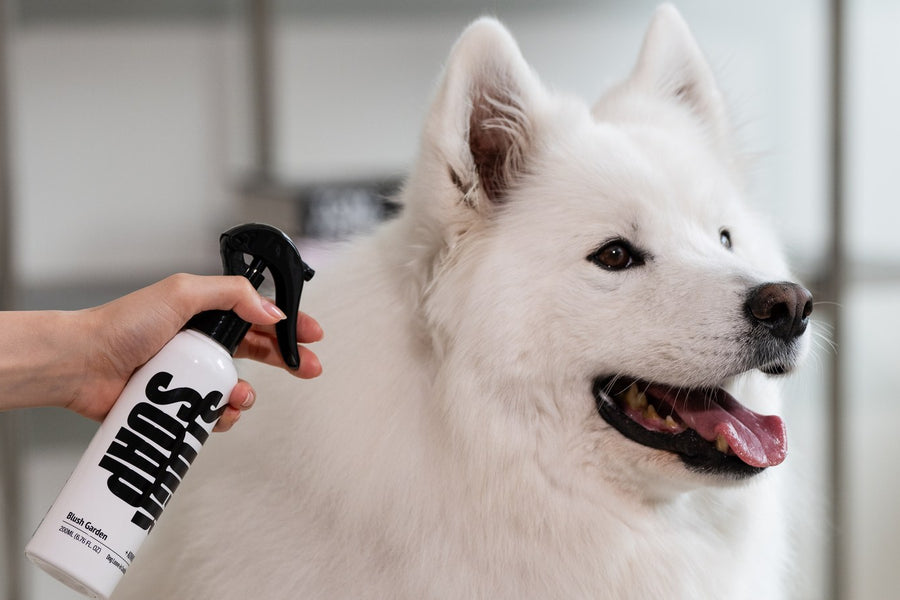
The Leave-In Conditioning Spray is a lightweight, no-rinse formula made for exactly the lift, mist and rake refresh described above. It carries three patented Korean actives, each chosen for a reason. Mung Bean Sprout Extract (KR patent 10-1841429) comes from a traditional Korean skin-soothing botanical. Tannin Complex HR (KR patent 10-0955389) is built on tannins, astringent plant polyphenols. ODOR-BYE (KR patent 10-2746186) is a deodorizing complex aimed at odor molecules themselves rather than covering them with fragrance. It comes in the same two scents as the shampoo. You can find the STUCK SOAP shampoo bar and leave-in conditioning spray together on our site.
Frequently Asked Questions
How often should I use an undercoat rake on a double-coated dog?
During a spring or fall coat blow, rake daily or every other day in short sessions until loose hair slows down. The rest of the year, one or two sessions a week is enough for most double-coated breeds, with quick slicker passes on friction spots like the collar line, armpits and the back of the thighs.
Can an undercoat rake hurt my dog's skin?
It can if you press hard or hold the teeth upright against the body. Keep the rake at a shallow angle, use light pressure, pull with the direction of hair growth and work in thin sections. Never rake through a mat sitting flat against the skin. Redness, scabs or flinching mean you should stop and check with your veterinarian.
What is line brushing?
Line brushing is a sectioning technique for thick coats. You hold the coat up against the grain to expose a thin line of skin, brush or rake the hair just below that line, then move the part up an inch and repeat. It makes sure the tool reaches the undercoat instead of only skimming the outer guard hairs.
Does leave-in conditioner reach the undercoat of a double-coated dog?
Only if you apply it that way. Spraying across the top mostly coats the guard hairs. Instead, part the coat in sections, mist lightly at the base, massage the product down toward the skin with your fingers and then follow with one slow pass of the undercoat rake to spread it evenly through the dense under layer.
Why does my double-coated dog smell musty after it rains?
A dense undercoat holds water close to warm skin long after the surface feels dry, and trapped dead undercoat adds to the problem. Towel and blow-dry until the skin is dry, rake out loose undercoat regularly, and talk to your veterinarian if a musty or sour smell lingers even when the coat is clean and fully dry.
How do I know a double coat is completely dry?
Check at the skin, not the surface. Slide your fingers down through the coat until you feel skin at the neck ruff, chest, behind the elbows and at the base of the tail. If any spot feels cool or damp, keep drying with a towel or a high-velocity dryer on a low-heat setting before the dog lies down.
Sources
- American Kennel Club: How Should You Groom a Double-Coated Dog? What to Know
- American Kennel Club: Hot Spots on Dogs: Signs, Treatment, and Prevention
- Merck Veterinary Manual: Structure of the Skin in Dogs
Build your double coat routine. Pair the STUCK SOAP Shampoo Bar for bath day with the Leave-In Conditioning Spray for the weeks in between, in Silent Grove or Blush Garden. Shop the bar and the spray at stucksoap.com.